Last Updated on October 11, 2026
Before buying a flashlight, it’s important to understand which features match your needs. One of the most overlooked factors is the beam pattern. When comparing flashlight flood vs throw, the biggest difference is how the light spreads and how far it reaches.
A flood flashlight produces a wide beam that illuminates nearby surroundings. A throw flashlight concentrates more light into a smaller area, making it useful for seeing distant objects.
Whether you’re camping, hiking, repairing a car, or working outdoors after dark, choosing the right beam can make a noticeable difference.
In this guide, we’ll compare flood and throw flashlights, explain lumens and candela, discuss their advantages and drawbacks, and help you choose the right option. If you’re unfamiliar with flashlight specifications, our everyday carry flashlight buying guide is another useful place to start.
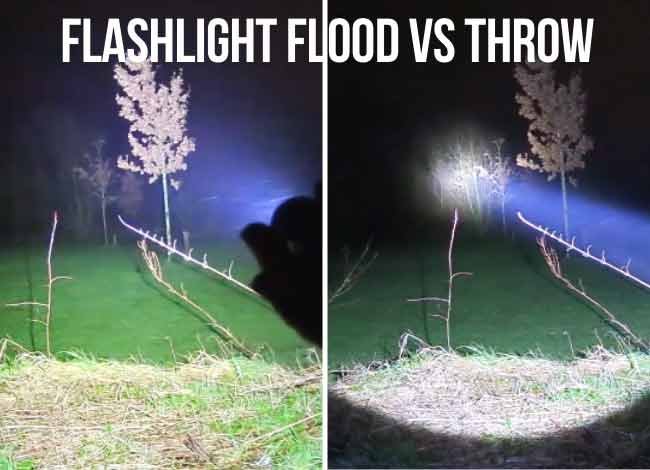
Flashlight Flood vs Throw: Quick Comparison
Both flashlight types have advantages. The better choice depends on whether you need to illuminate a wide area or see something farther away.
| Feature | Flood Flashlight | Throw Flashlight |
|---|---|---|
| Beam Pattern | Wide, evenly spread beam | Narrower, concentrated beam |
| Beam Distance | Usually shorter | Usually longer |
| Beam Intensity | Generally lower peak candela | Generally higher peak candela |
| Nearby Visibility | Excellent | Limited by a narrow hotspot |
| Long-Distance Visibility | Less effective | Better for distant objects |
| Optics | Often broad reflectors or diffusing optics | Often deep reflectors or specialized focusing optics |
| Common Uses | Camping, indoor work, car repairs | Search operations, distant inspection, open areas |
| Main Advantage | Illuminates more surrounding area | Concentrates light over longer distances |
What Is a Throw Flashlight?
A throw flashlight is designed to project a concentrated beam over a longer distance. Instead of spreading light evenly across a wide area, it directs much of its output toward a central hotspot.
Throw flashlights are particularly useful when you need to see objects far away, such as a distant trail marker, a fence line, or an area across an open field.
Key Characteristics of Throw Flashlights
- Focused Beam: Concentrates light into a narrower area for long-distance visibility.
- High Candela: Greater peak beam intensity helps the light reach farther.
- Specialized Optics: Deep reflectors, smooth reflectors, or dedicated TIR optics can produce focused beams.
- Longer Rated Distance: Many throwers are designed to reach several hundred meters, although actual performance varies.
- Defined Hotspot: The brightest part of the beam is concentrated near its center.
Advantages of Throw Flashlights
- Better for identifying distant objects.
- Useful across open spaces and large properties.
- Provides strong central beam intensity.
- Well suited to long-distance inspection and search tasks.
Disadvantages of Throw Flashlights
- Narrower illumination can limit nearby visibility.
- Bright central hotspots may cause glare indoors.
- Some models have larger heads and reflectors.
- Less convenient for reading or close-range repairs.
A throw flashlight can be useful for security patrols or searching across an open area. However, it may not be the best choice for tasks that require seeing everything around you.
What Is a Flood Flashlight?
A flood flashlight spreads its light over a wider area. Rather than concentrating brightness into one distant spot, it provides broad illumination for nearby surroundings.
This makes flood flashlights practical for camping, household maintenance, vehicle repairs, and other close-range activities.
For example, if you’re changing a tire at night, a flood beam can illuminate the wheel, tools, and surrounding ground without constantly repositioning the flashlight.
Key Characteristics of Flood Flashlights
- Wide Beam: Covers a larger area close to the user.
- Lower Peak Intensity: Often produces fewer candela than a similarly bright thrower.
- Broad Optics: Shallow reflectors, frosted lenses, or TIR optics can create a wider beam.
- Comfortable Nearby Lighting: Useful when working inside rooms or enclosed spaces.
- Less Concentrated Hotspot: Light is distributed more evenly across the beam.
Advantages of Flood Flashlights
- Excellent for close-range activities.
- Illuminates more surroundings at once.
- Useful for camping, repairs, and indoor work.
- Reduces the need to constantly move the flashlight.
- Often comfortable for general everyday use.
Disadvantages of Flood Flashlights
- Usually shorter beam distance.
- Less effective for examining distant objects.
- Light spreads across a wider area instead of concentrating ahead.
- Very bright flood beams can still create glare or reflection.
If you mostly use a flashlight around the house, campsite, or garage, a flood beam will often feel more practical than a narrow throw beam.
Flashlight Flood vs Throw: Which Is Best for Different Activities?
Choosing between a flood and throw flashlight becomes easier when you consider where you’ll use it.
| Activity | Recommended Beam | Reason |
|---|---|---|
| Camping | Flood | Lights up tents, cooking areas, and nearby surroundings |
| Hiking | Balanced or Hybrid | Provides both trail visibility and some distance |
| Search and Rescue | Hybrid or Throw | Useful for scanning larger areas and spotting distant objects |
| Hunting | Throw or Hybrid | Helps inspect distant areas where permitted |
| Car Repairs | Flood | Illuminates tools and nearby components |
| Security Patrol | Balanced or Throw | Provides distance while maintaining surrounding visibility |
| Reading | Low-output Flood | Offers comfortable close-range illumination |
| Home Emergencies | Flood or Hybrid | Useful for moving through rooms and examining surroundings |
| Everyday Carry | Balanced | Handles common nearby and moderate-distance tasks |
These are general recommendations rather than strict rules. A wide beam can still work outdoors, while a throw flashlight can be useful at home when checking a distant part of your property.
Lumens vs Candela: What Matters More?
One of the biggest mistakes people make when choosing a flashlight is looking only at the lumen rating.
Lumens measure the total amount of visible light produced by a flashlight. Candela measures luminous intensity in a particular direction, with peak candela describing the brightest part of the beam.
Both measurements matter, but they tell you different things.
Why More Lumens Don’t Always Mean More Throw
Imagine comparing two flashlights. One produces 1,500 lumens with a very wide beam. Another produces only 700 lumens but concentrates more of that light into a narrow hotspot.
The second flashlight may illuminate distant objects more effectively despite having fewer lumens.
That’s because beam distance depends heavily on peak intensity and optical design, not simply total output.
Understanding ANSI/PLATO FL1 Beam Distance
Under the ANSI/PLATO FL1 flashlight measurement system, rated beam distance is the distance at which the beam produces 0.25 lux of illumination.
This is a relatively low level of light, comparable to illumination from a full moon under favorable conditions.
For example, a flashlight rated for 300 meters doesn’t necessarily allow you to identify small objects clearly at that distance. Real-world visibility depends on contrast, weather, surroundings, and eyesight.
When comparing flood vs throw flashlights, check both the lumen output and candela rating rather than relying on one number.
Beam Angle and Optical Design
A flood flashlight generally spreads its light across a wider angle, while a throw flashlight concentrates light into a narrower angle.
However, there is no universal rule stating that all flood beams must exceed 90 degrees or that all throw beams must remain between 15 and 25 degrees.
Beam design varies considerably between manufacturers and models.
Some flashlights have a focused hotspot surrounded by a broad, dimmer spill beam. Others distribute light more evenly across the entire illuminated area.
That is why real beam photographs and independent testing can be useful when shopping for a flashlight.
Hybrid Flashlights: Can You Get Both Flood and Throw?
Yes. Many modern flashlights provide a balance between wide illumination and long-distance visibility.
Hybrid or combination models may use:
- Dual LEDs: Separate flood and spot emitters.
- Adjustable Focus: A movable lens that changes the beam from wide to narrow.
- Combined Optics: A central hotspot with surrounding spill.
- Separate Lighting Channels: Independent flood and throw modes.
A hybrid flashlight can be useful if you regularly move between close-up tasks and long-distance inspection.
However, adjustable-focus flashlights aren’t automatically better. Moving optical systems may add bulk and compromise water resistance or efficiency depending on their design.
Does a Flood or Throw Flashlight Use More Battery?
Beam pattern alone doesn’t determine battery consumption.
Battery runtime depends on LED efficiency, output level, driver electronics, battery capacity, and temperature management.
A 500-lumen flood flashlight may run longer than a 1,500-lumen throw flashlight. But a lower-output thrower may also operate longer than a powerful floodlight.
The important comparison is how long each flashlight maintains a useful output level.
Some high-performance flashlights automatically reduce brightness after a short period to control heat. Therefore, maximum advertised output and sustained brightness aren’t always the same.
If rechargeability is important, our rechargeable flashlight comparison covers battery and charging features worth considering.
How to Choose the Right Flashlight: Flood vs Throw Buying Guide
1. Consider Your Main Purpose
Start with how you’ll use the flashlight most often. Close-range activities usually benefit from a flood beam, while long-distance tasks require greater beam concentration.
If you do a little of everything, a balanced beam is often the most convenient option.
2. Think About Your Environment
Indoor environments generally benefit from wider, lower-output lighting. Open outdoor areas may require more throw.
However, outdoor use doesn’t automatically mean you need a thrower. Hiking along uneven trails often requires good peripheral visibility as well.
3. Compare Lumens and Candela
Check both figures. Lumens describe total output, while candela helps indicate how concentrated the beam is.
A flashlight with a moderate lumen rating and high candela can have more throw than a higher-lumen model with a broad beam.
4. Check Size and Weight
Long-throw flashlights sometimes use larger reflectors and heads, making them less comfortable for pocket carry.
Smaller flood or balanced lights can be easier to carry every day.
5. Evaluate Battery Runtime
Look at the manufacturer’s runtime chart rather than just the maximum runtime advertised on the package.
Pay particular attention to Medium and High modes, since these are often more useful in practice than very short Turbo settings.
6. Consider Water Resistance and Controls
For outdoor use, check the IP rating, switch placement, battery compatibility, and whether the flashlight can be operated comfortably with one hand.
These features can matter just as much as beam distance when you’re working in poor weather or darkness.
Flood vs Throw Flashlight: Which One Should You Buy?
There isn’t one flashlight beam that works best for everyone.
- Choose a Flood Flashlight if you often work indoors, repair vehicles, camp, or need wide nearby illumination.
- Choose a Throw Flashlight if your main purpose is inspecting distant objects or searching across open spaces.
- Choose a Hybrid Flashlight if you need both nearby visibility and useful long-distance illumination.
For many everyday users, a flashlight with a balanced hotspot and surrounding spill is a practical starting point.
You can also compare different flashlight designs in our Fenix vs Nitecore flashlight comparison.
Frequently Asked Questions
1. What is the main difference between a flood and throw flashlight?
A flood flashlight produces a broad beam for nearby illumination, while a throw flashlight concentrates light into a narrower beam for longer-distance visibility.
2. Can a flashlight have both flood and throw?
Yes. Some flashlights have separate flood and spot LEDs, adjustable optics, or a balanced beam combining a central hotspot with surrounding spill.
3. Which flashlight is better for camping?
A flood flashlight is generally better for lighting tents and nearby surroundings. A balanced beam is useful if you also need to see farther along a trail.
4. Are throw flashlights good for indoor use?
They can work indoors, but concentrated hotspots may create glare and leave nearby surroundings less evenly illuminated. Flood or balanced beams are usually more comfortable.
5. Do more lumens mean a flashlight has more throw?
Not necessarily. Throw depends heavily on peak candela and optical design. A flashlight with fewer lumens but a more concentrated beam can reach farther.
6. Which uses more battery, flood or throw?
Neither beam type automatically consumes more power. Runtime depends on total output, LED efficiency, battery capacity, electronics, and heat management.
Final Thoughts: Why Flashlight Flood vs Throw Matters
Understanding the difference between flashlight flood vs throw can help you avoid buying a flashlight that doesn’t suit your needs.
A flood beam is useful when you need wide, comfortable illumination for nearby tasks. A throw beam is better when you need concentrated light for distant objects. Hybrid designs offer a practical middle ground.
Before making your decision, compare lumens, candela, beam pattern, battery runtime, and overall size. The brightest flashlight isn’t always the most useful one.
Choose a beam that matches where and how you’ll actually use it, and you’ll get far more value from your flashlight.