Last Updated on November 11, 2026
18650 flashlights are among the most useful options for everyday carry, outdoor work, and emergencies. But what exactly does 18650 mean? It describes a cylindrical cell about 18 mm wide and 65 mm long before any extra length from a protection circuit, raised terminal, or USB charging board. Most flashlight cells of this size are rechargeable lithium-ion. That is a lot of power in a light you can still carry on your belt.
If you are looking for the best 18650 flashlight, start with the job you need it to do. I would look for a tail switch I can find by feel for outdoor work, a usable low mode for reading at camp, and a charging setup I can keep working on a trip. AA flashlights make sense if you already keep AA spares at home. Small AAA flashlights are easier to carry as backups. The rechargeable lights below make the most sense when you can keep their cells charged and want more output or reach.
Finding a quality flashlight is especially important in an emergency. The models here range from compact pocket lights to a larger handheld with room for two cells. Some of the photos show older versions, so check the model labels alongside the buttons before comparing brightness or picking up a spare battery.

Check Our Recommended Fenix PD35 V3.0 Flashlight Details
Avoiding Common Mistakes When Buying a 18650 Flashlight
Many people shop for the best 18650 flashlight by price or by the biggest number on the box. Start with build quality, battery compatibility, the beam, and the switches. A bright Turbo setting is useful for a quick look across a field. For an hour of walking or work, check what the light does on Medium or High after it warms up. Also check how easy it is to reach Low from off. A light that always starts on its brightest setting can be a nuisance inside a tent or beside someone who is sleeping.
Look for candela or rated beam distance if you need to pick out objects farther away. Lumens describe the total amount of light. Candela describes intensity in the strongest part of the beam. Two flashlights with the same lumen figure can light a path very differently, as our guide to flashlight flood and throw explains. On wet ground, a large bright patch near your feet can make it harder to see past it. A lower setting can be more useful even when the high setting is available.
Why Choose an 18650 Flashlight in 2026?
The appeal of an 18650 flashlight is the balance between battery capacity and size. There is room for a comfortable grip and a useful low mode without making the body much wider than a pocket light. A larger 21700 can be worth carrying if you need more capacity, but it takes up more space and needs a light made for that size. The best 18650 flashlight for a coat pocket will often be a different model from the one you keep beside the back door.
Check what comes in the box separately from what the light accepts. Some packages include a rechargeable cell and cable, while others include disposable batteries or the flashlight alone. If you plan to leave the light in a kit, check its charge periodically and carry approved spare cells in a protective case. For a light that uses two or more cells together, keep them as a matched set of the same type and charge state.
Best 18650 Flashlight Comparison: Three Choices and a 21700 Alternative
Use the first three rows to compare a tail-switch tactical light, a ThruNite handheld, and a compact magnetic-charging option. The last row keeps the larger Klarus alternative separate because it uses a different battery size. Scroll the table sideways on a small screen.
| 18650 Flashlights | Photo & link | Peak output and modes | Battery and charging |
|---|---|---|---|
| Fenix PD35 TAC pictured; older PD35 kit linked |  PD35 TAC photo / older PD35 kit link |
1,000 lm for the pictured TAC, rated to 200 m. The TAC manual gives about five minutes on Turbo before it drops to 500 lm. | One compatible 18650 or two 3 V CR123A in the TAC. No charge port in the light. 89 g without the battery. Read review. |
| ThruNite TN12 pictured; TC15 family linked |  TC15 family link |
The linked TC15 family has multiple generations. TC15 V2 is rated at 2,531 lm with about 2½ minutes before step-down; V3 is rated at 2,403 lm. Those ratings do not apply to the TN12 shown. | One compatible protected 18650 in the TC15 family. Check the model for body Micro-USB or USB-C. Read review. |
| Olight S2R Baton family; S2R Baton II linked |  S2R Baton II link |
1,150 lm for about two minutes, then a 400-lm stage. Rated to 135 m. Five steady levels plus strobe. | Customized 3,200 mAh 18650 for magnetic charging. 98.5 g including the battery. Read review. |
| 21700 alternative: Klarus ST15 pictured; XT21X linked |  XT21X link (21700) |
The linked XT21X is rated 4,000 lm on Turbo and 1,200 lm on the separate High setting. Two switch configurations, with multiple lighting levels. | One approved 5,000 mAh 21700 in the XT21X. Body Micro-USB. 158 g without the cell. Read review. |
For a slim everyday light, I would start with the PD35 V3.0 linked above or the Olight S2R Baton II. The Fenix suits someone who wants a tail switch and an easy-to-carry spare. The Olight suits someone who wants a short light they can stick to a steel work surface and top up with a magnetic lead. The ThruNite TN12 Pro reviewed below is the better comparison if you specifically want a USB-C port on the flashlight and direct access to Turbo at the tail.
Best 18650 Flashlight List from Popular Brands
Look at the model name, the battery, and the control layout together. The versions below are grouped by the original flashlight reviewed. Where a button leads to a different model, the specifications and the product link are labelled separately.
Fenix PD35 TAC and PD35 V3.0
If you are looking for a dependable light for hiking, outdoor work, or everyday carry, the Fenix PD35 Tac Edition is a useful starting point. The TAC shown in the photo has a 1,000-lumen Cree XP-L V5 LED. Its aluminum body, clip, and anti-roll shape are practical if the light often comes out of a belt holster or rests on a workbench. Outdoor mode uses the side switch to cycle through brightness levels. Tactical mode puts Turbo, Low and Strobe under the tail switch. Those controls are part of the appeal of this older model.
The top recommendation and the button in this specification table link to the newer PD35 V3.0. It is rated for 1,700 lumens and 357 m with its Luminus SFT40. It keeps a tail switch for power and a side switch for brightness, with five steady levels and strobe. If you want more reach in the same general size, that is my best 18650 flashlight pick for a belt holster. The photo still shows the TAC kit.
| Feature | Details |
|---|---|
| Maximum output | TAC: 1,000 lm. V3.0: 1,700 lm. |
| Longest and shortest modes | TAC: 8 lm Eco for 140 hr; 60 lm for 29 hr 15 min. Turbo rating: 1 hr 10 min total with step-down. |
| Beam distance | TAC: 200 m. V3.0: 357 m. |
| Outdoor and Tactical modes | TAC: five steady settings and strobe in Outdoor; Turbo, Low and Strobe in Tactical. |
| Body and LED | Hard-anodized aluminum; Cree XP-L V5 (TAC), Luminus SFT40 (V3.0). |
| Water resistance | TAC: IPX8 to 2 m. V3.0: IP68. |
| Length and weight | TAC: 137 mm, 89 g without battery. V3.0: 134 mm, 83 g without battery. |
| Power source | One compatible 18650 or two 3 V CR123A, depending on the manual for the exact version. |
| Charging | No port on either light. Remove the rechargeable cell and use its own USB port or an approved external charger. |
| Photo and product link |  PD35 V3.0 link |
The TAC manual specifies an automatic drop from 1,000 to 500 lumens after five minutes. Its 500-lumen High is a better reference if you need to keep working at a steady pace. The V3.0 uses temperature control, so its Turbo runtime also includes lower output. Temperature, airflow and battery charge affect when a light steps down. Think of Turbo as a brief extra setting to call on when you need it.
For either light, use a Fenix-approved, compatible protected button-top 18650. The newer V3.0 kit cell has a USB-C port on the battery; earlier USB-equipped kit cells used Micro-USB. Unscrew the light and take the cell out to reach that port. A regular approved cell without a socket goes into a suitable charger. If you would rather plug a cable straight into the light, see the Fenix PD35 vs UC35 comparison for the different charging layouts. CR123A primaries are backup power only and must stay out of any charger.
Pros
- Slim aluminum body with a clip and holster on the original TAC kit.
- Separate switches make brightness easy to change in Outdoor mode.
- Compatible disposable cells give you a backup when you are away from an outlet.
Cons
- The light itself has no charging socket.
- A flat-top or oversized cell may not fit or make contact. Match the battery to the exact PD35 generation.
Streamlight ProTac HL 4 Handheld
The Streamlight ProTac HL 4 is a large handheld for someone who wants a wide, useful beam with a defined center. Its rubber sleeve and programmable tail switch make more sense for a work kit or belt carry than for the front pocket of a pair of jeans. The fixed optic gives you a bright center and useful spill around it, so you can check a gate or the far end of a driveway without losing all the light near your feet.
The photo and the specifications below are for the ProTac HL 4 handheld. The button leads to the ProTac Rail Mount HL-X, a separate 1,000-lumen rail light with its own mounting hardware and battery instructions. Streamlight also makes a handheld ProTac HL USB. That third model has a port on the flashlight and its instructions are different again.
| Feature | Details |
|---|---|
| Maximum output | 2,200 lm on High, 600 lm on Medium, 60 lm on Low. |
| Runtime | High: about 1½ hr. Medium: 4 hr on CR123A or 4¼ hr with SL-B26. Low: 40 or 43 hr respectively. |
| Beam distance | 346 m on High in Streamlight’s published chart. |
| Switch and modes | TEN-TAP programs: High/Strobe/Low, High only, or Low/Medium/High. |
| Build and beam | Aluminum with textured rubber grip and a fixed beam-shaping optic. |
| Water resistance | IPX7, 1 m for 30 min. |
| Length and weight | 8.63 in (21.9 cm); about 17 oz with batteries. |
| Battery type | Two approved protected Streamlight SL-B26 packs or four CR123A primaries. |
| Charging | Remove both SL-B26 cells and charge through the ports on the cells. Older approved Streamlight 18650 packs without USB use the specified charger. |
| Photo and product link |  Rail Mount HL-X link |
The 2,200-lumen rating tells you what High can deliver at the start of the test. For a long inspection or a walk on uneven ground, compare the 600-lumen Medium runtime with the output you actually need. You cannot slide or twist the head to zoom as you can on the PeakPlus or Outlite. The broader fixed beam is part of what makes the HL 4 easier to use around a vehicle or work area.
For someone who wants the best 18650 flashlight for a work bag and has room for a longer body, the HL 4 is worth a look. Set the TEN-TAP program before you need it. The Low/Medium/High program gives you less glare in a small room. The High-only program makes sense when you want the same response every time you press the tail switch. Keep the two rechargeable packs together as a pair, and change all four disposables together when using CR123A. The linked Rail Mount HL-X uses one approved SL-B26 or two CR123A.
Pros
- Large grip and one-handed tail operation.
- A useful Medium setting for longer work.
- Manufacturer-approved rechargeable and disposable power options.
Cons
- Long and heavy for everyday pocket carry.
- Charging the rechargeable pair means taking both cells out.
ThruNite TN12 EDC LED Flashlight and TN12 Pro
The earlier ThruNite TN12 pictured here was a simple everyday carry light with a tail switch for power and a side switch for modes. The external charger in the photo is a clue: the classic TN12 has no charging socket in its body. The 2016 TN12 with the XP-L V6 is rated around 1,050 lumens, with a very low Firefly setting for close-up work. Other TN12 generations have different output and emitter figures.
The product button in this review leads to the TN12 Pro. The earlier comparison table button leads to the TC15 family, a side-switch design. If your idea of the best 18650 flashlight includes instant access to a bright beam from a tail switch, the TN12 Pro and TC15 are worth treating as separate choices. The TC15 V2 manual lists Micro-USB charging, while the TC15 V3 uses USB-C.
| Feature | Details |
|---|---|
| Maximum output | Earlier TN12 (2016): about 1,050 lm. TN12 Pro: 1,900 lm rated Turbo, 380 m. |
| Light modes | Five steady levels including Firefly, plus strobe on both models. Exact outputs differ. |
| Body and LED | Aluminum. Cree XP-L V6 in the 2016 TN12; Luminus SFT40 in the TN12 Pro. |
| Water resistance | Earlier TN12: IPX8; TN12 Pro manual: IPX8. |
| Size and weight | Earlier TN12 is roughly 5.5 in long, around 3 oz without a battery. The Pro is a separate body. |
| Battery type | Use a protected compatible 18650. ThruNite specifies its 3,400 mAh cell for the Pro. |
| Charging | Classic TN12: external charger or USB-equipped compatible cell. TN12 Pro: USB-C on the flashlight. |
| Runtime | 2016 TN12: up to 74 days in Firefly. TN12 Pro Turbo steps from 1,900 to 477 lm. |
| Photo and product link |  TN12 Pro link |
A low Firefly mode is handy for checking a map or moving through a room without waking someone. If you are out on a trail, the TN12 Pro’s rated 550-lumen High or 220-lumen Medium is a better guide to regular use than its Turbo figure. The manufacturer’s chart shows about seven minutes at 1,900 lumens before a lower 477-lumen stage. It rates High for 2½ hours and Medium for nine hours under its test conditions. The tail switch gives direct access to Turbo, while the side switch handles the regular levels.
Use the rechargeable cell specified for the exact TN12 you have. Battery guidance for a classic TN12 does not automatically carry over to the Pro, whose manual specifies a single compatible 18650. ThruNite sells a protected button-top cell compatible with the Pro and several other TN12 generations. If that cell has its own port, that still does not turn the original flashlight into a USB-C model. For the classic TN12, some manuals also allow two CR123A primaries. Check the exact generation, keep them out of the charger, and use only the approved rechargeable cell in the Pro. Keep the rubber flap on the Pro seated after charging.
Pros
- The classic TN12 has straightforward switches and a useful low setting.
- TN12 Pro adds body USB-C and direct tail access to Turbo.
- Useful choice if you prefer a narrower beam than a typical zoom light on wide focus.
Cons
- The pictured TN12 and the two linked ThruNite models use different controls and charging arrangements.
- Expect Turbo output to fall as the light warms.
Olight S2R Baton and S2R Baton II
The Olight S2R is a short side-switch light with a magnetic tail. Stick it to a clean steel surface while checking under the hood or working inside a cabinet. For hands-free repairs it is one of the best 18650 flashlight choices here. Its fixed TIR optic is convenient at close to medium range because you get a usable spread without adjusting the head. The image shows the S2R Baton family, and both buttons lead to the S2R Baton II.
The first S2R used a Cree XM-L2 and is rated at 1,020 lumens. The linked model is rated at 1,150 lumens and has its own output curve, dual-direction clip and magnetic cable. Our Olight S2R Baton II review covers the newer model’s controls and charge indicator in more detail.
| Feature | Details |
|---|---|
| Maximum output | S2R: 1,020 lm, then 500 lm. S2R II: 1,150 lm, then 400 lm. |
| Output modes | Five steady brightness levels plus strobe. |
| Body and LED | Aluminum body with a fixed TIR optic; original S2R uses Cree XM-L2. |
| Water resistance | IPX8 on both generations. |
| Length and loaded weight | S2R: about 105 mm, 101.5 g. S2R II: 100 mm, 98.5 g. |
| Battery type | Model-compatible customized Olight 3,200 mAh 18650 for magnetic charging. |
| Charging | Compatible magnetic USB lead attaches to the tail. |
| Warranty | Check the coverage for your region and model. Battery and light coverage can differ. |
| Photo and product link |  S2R Baton II link |
The original S2R manual shows about two minutes at 1,020 lumens and a 500-lumen stage afterward. The Baton II manual lists two minutes at 1,150 followed by 230 minutes at 400. The Baton II also offers a separate 400-lumen High mode. That is the setting I would look at for a repair or a dog walk, where you want useful light throughout the job.
The customized cell has contacts that let the magnetic tail charge it. Match both the cell and lead to the exact model. See our guide to Olight magnetic charger compatibility if you already own another Olight. The first-generation S2R manual also lists two CR123A primaries as an operating option. A compatible conventional 18650 may run that light, but it must be charged outside it. CR123A primaries must never be charged. For the S2R II, use its supplied customized cell as the normal option. Only use emergency alternatives if the manual for your specific unit permits them, and never try to charge an alternative cell through the magnetic tail.
Pros
- Compact aluminum body, side switch and a useful Moonlight setting.
- Magnetic tail doubles as a hands-free mount on steel.
- Lockout helps prevent the light turning on inside a pocket.
Cons
- Magnetic charging depends on the model-compatible battery and cable.
- Fixed beam and short Turbo stage suit nearby work better than extended long-distance use.
SureFire P1R Peacekeeper Rechargeable Flashlight
The SureFire P1R Peacekeeper is built for someone who wants a strong center beam and a straightforward tail switch. The aluminum body has a textured grip and weather-resistant seals. The older Peacekeeper reviewed here has two outputs, with 600 lumens for checking a larger area and 15 lumens for close work. SureFire also made a single-output Peacekeeper Tactical, so the name on the body and the switch behavior matter.
The photo shows a Peacekeeper Tactical. The button leads to the P1RZ Dual Fuel Combat Light. That newer light uses a different grip and control arrangement. The P1RZ-B-DFT is rated at 1,500 lumens on its rechargeable cell. The older Peacekeeper’s low mode and runtime figures belong to the P1R, not to the linked Combat Light.
| Feature | Details |
|---|---|
| Peak output | P1R Peacekeeper: 600 lm. Dual-output model adds 15 lm Low. |
| Runtime | P1R dual-output: rated up to 46 hr on Low. High is rated at 1 hr 45 min for both older Peacekeepers. That figure is total rated runtime. |
| Modes | Dual-output P1R: High and Low. Pictured Peacekeeper Tactical: single output. |
| Body and beam | Hard-anodized aerospace aluminum and a reflector with useful spill. |
| Water resistance | Weather-resistant seals. Follow the manual for your version before exposing it to standing water. |
| Weight | About 6.2 oz with the battery in the P1R datasheet. |
| Power source | P1R: compatible SureFire 18650 or two 123A lithium primaries. |
| Charging | P1R: remove its 18650 for the specified external charger. P1RZ-B-DFT: Micro-USB on the supplied rechargeable cell. |
| Photo and product link | 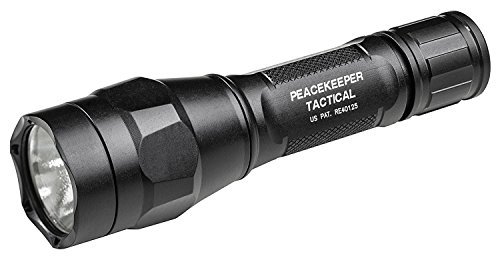 P1RZ Dual Fuel Combat Light link |
The low setting on the two-output Peacekeeper is useful for checking a bag, reading labels or doing a job that does not call for the full beam. If you are looking for the best 18650 flashlight for work at arm’s length, decide whether you want that lower setting before choosing between the single-output and dual-output lights. The catalog describes the dual-output model as High-first, which is worth knowing if you need a light that starts quietly on Low.
For the old Peacekeeper, recharge the approved lithium-ion cell outside the light. The original kit’s AC or vehicle charging connection feeds its external charger. With the newer linked light, connect Micro-USB to the cell itself. Carrying two matched 123A primaries is an option for backup power on both lights. They must never be connected to a charger.
Pros
- Simple tail control and aluminum body.
- Dual-output P1R adds a useful low beam.
- Approved disposable backup cells fit the documented dual-fuel models.
Cons
- The original P1R requires a separate charging arrangement.
- The pictured Tactical and the linked Combat Light differ from the dual-output P1R.
Klarus ST15 Rechargeable Flashlight Review
The Klarus ST15 is an older 18650 model with a tail switch for power and a side switch for changing modes. The head has an anti-roll shape, and the two-way clip lets you choose how it sits in a pocket. To compare the ST15 with the best 18650 flashlight options for walking a trail, look first at its 400-lumen High. Save Turbo for the brief times you need to see farther ahead.
Both photos in this guide show the ST15. The comparison table links to the XT21X and the button below links to the G15. Both linked models are 21700 alternatives. The XT21X is longer and has dual tail switches and body Micro-USB. The USB-C G15 is shorter and designed for pocket carry, with a side switch. Pick the ST15 only if you want the older 18650 model described here.
| Feature | Details |
|---|---|
| Maximum output | ST15: 1,100 lm Turbo. Its separate High setting is 400 lm. |
| Lighting modes | Turbo, High, Medium, Low, Strobe and SOS. |
| Body and LED | Hard-anodized 6061-T6 aluminum and Cree XP-L HI V3. |
| Water resistance | IPX8, rated for 2 m in the ST15 manual. |
| Length and weight | 138 mm and 110 g without the cell. |
| Battery compatibility | One 18650 with a protection circuit, or two 3 V CR123A primaries. The manual excludes 16340. |
| Charging | ST15: remove the cell for charging. XT21X and USB-C G15: charging ports on their respective flashlight bodies. |
| Photo and product link |  Klarus G15 link (21700) |
Temperature regulation changes the ST15’s output to manage heat. Its 1,100-lumen rating describes the top setting. The 100-lumen Medium is a practical choice around camp, where your eyes have already adjusted to the dark, and the 10-lumen Low is better for finding a small item in a bag. The side switch lets you move between those settings without changing your grip much.
For the ST15, buy a protected rechargeable cell that meets the manual’s size and contact requirements. If you use the two-CR123A option, change both batteries together. The 21700 lamps linked here need the cells specified for their own models. Even if an 18650 can slide into a wider tube, that does not make it an approved substitute.
Pros
- Separate switches, a two-way clip and useful low settings.
- Battery indicator and temperature regulation.
- Protected 18650 and documented CR123A backup option.
Cons
- The ST15’s charging process requires removing the rechargeable cell.
- The linked G15 and XT21X use a different battery size.
PeakPlus Super Bright LED Tactical Light: LFX1000
The PeakPlus Super Bright LED Tactical Light is a budget kit with an adjustable beam. The sliding head spreads the beam for working around camp or narrows it to check a spot farther away. The pictured LFX1000 and the linked kit are the same model family. Five modes cover High, Medium, Low, Strobe and SOS. Use the focus to change the shape of the beam and the switch to change its output.
The useful part of the kit is the separate battery charger and AAA carrier. With the approved 18650 charged, the light can go straight into an emergency bag. If you already keep AAA batteries for other equipment, the carrier provides a second way to power the light. Before storing the kit, try the carrier and the rechargeable cell separately so you know how each fits.
| Feature | Details |
|---|---|
| Light output and distance | High, Medium and Low with adjustable focus. Treat unverified lumen and distance figures as estimates rather than comparable FL 1 ratings. |
| Modes | High, Medium, Low, Strobe and SOS. |
| Material and beam | Aluminum body, textured grip and sliding zoom head. |
| Water resistance | Water-resistant for incidental splashes. Keep it out of standing water. |
| Size and weight | Check the light-only weight separately from the case and accessories. |
| Battery options | One compatible rechargeable 18650 or three AAA batteries in the supplied holder. |
| Charging | Remove the 18650 and use the separate USB battery charger. Do not charge AAA primaries. |
| Photo and product link |  PeakPlus LFX1000 link |
A zoom light can be handy around the house because the same light can cover a room or pick out a small spot. In wide focus, use it close to the work so you can see the whole area. In spot focus, the beam narrows and the edges go darker. If you need to keep seeing your footing and the end of the path at the same time, a fixed-beam light with useful spill may work better.
For long sessions, start on Medium and step up only when needed. If your best 18650 flashlight kit is one you can keep by the door with a charger and spare holder, the LFX1000 makes sense. If the flashlight is for a job where you need a specific amount of light for an entire shift, choose a model with a published runtime curve at the brightness you expect to use.
Pros
- Adjustable beam and five modes.
- External charger, case and a separate AAA holder are useful in a kit.
Cons
- No comparable sustained-output figure for the reviewed configuration.
- A sliding zoom head is best kept away from grit and immersion.
Anker Tactical Rechargeable LED Flashlight Review: Bolder LC90
The Anker Tactical Rechargeable LED Flashlight is the Bolder LC90, a zoomable light with an aluminum body and a tail switch. It gives you a wider beam for the near side of a campsite and a tighter beam to inspect a spot across the yard. The linked LC90 matches the model shown. If the best 18650 flashlight for you is one you can charge without removing the cell, the LC90 has an advantage over the PeakPlus.
Anker advertised this LC90 at up to 900 lumens, with up to six hours on Medium in the kit description. Use Medium as the starting point if you need the light for a full walk. The maximum output is for times when you need more light briefly, and the zoom setting changes how concentrated it looks.
| Feature | Details |
|---|---|
| Peak output | 900 lm advertised for the LC90. |
| Runtime | Up to 6 hr on Medium in the kit description. |
| Light modes | Low, Medium, High, Strobe and SOS. |
| Material and LED | Aluminum body and Cree LED. |
| Weather resistance | Suitable for rain and splashes within the rating on the exact unit. The LC90 is not for immersion. |
| Rated beam and weight | Guide lists up to 200 m and about 177 g without the battery. |
| Battery type | One compatible 18650 rechargeable lithium-ion cell as specified for the LC90. |
| Charging | Micro-USB port on the flashlight, accessed by unscrewing the tail cap. |
| Warranty | The original kit advertised an 18-month warranty. Check the terms for your region. |
| Photo and product link |  Anker Bolder LC90 link |
To charge it, turn it off, open the tail cap, and connect the Micro-USB cable to the port underneath. The port stays covered during use. After charging, unplug the cable and seat the cap before taking the light back outside. Check for grit or water around the cap first. A Micro-USB cable is easy to keep in the case, but you will need it even if the rest of your gear has moved to USB-C.
Use the supplied cell or the replacement specified for the exact version. Different LC90 documents and kit descriptions show different capacities and water-resistance claims, so use the manual shipped with your light for those details. A spare marked 18650 may still differ in length or contact shape.
Pros
- Adjustable beam, useful grip and five modes.
- The port is protected by the tail cap during normal use.
- Charges without taking out the supplied rechargeable cell.
Cons
- Requires a Micro-USB cable and opening the tail cap to charge.
- Check the exact kit’s battery and water-resistance markings.
Outlite A100 Handheld LED Light
The Outlite A100 handheld flashlight is a straightforward zoom light for household jobs and backup use. Slide the head for a wider beam under the sink or a tighter beam in the yard. The photo and review describe the Outlite A100. The button leads to a Jardlite adjustable-focus four-pack. It looks similar, but the Outlite’s specifications and kit contents should not be applied to the four-pack.
The A100 has five settings and a tail switch. A half-press can be useful for stepping through modes on versions that support it. Try that sequence before relying on the light in a dark stairwell or unfamiliar room. Most of the time, a steady Low or Medium is more useful than flashing modes.
| Feature | Details |
|---|---|
| Light output | Exact FL 1 peak and sustained output are unspecified for the A100 shown. |
| Modes | High, Medium, Low, Strobe and SOS. |
| Body and optics | Aluminum with a sliding focus head. LED and output claims can vary by kit. |
| Water resistance | Treat the light as splash-resistant and check the instructions for your unit. |
| Weight | Varies with the holder and cells fitted. |
| Battery | One compatible 3.6/3.7 V 18650 with the specified sleeve, or three AAA batteries in the correct holder. |
| Charging | Use an appropriate external charger for the rechargeable 18650. Never charge disposable AAA cells. |
| Photo and product link |  Jardlite adjustable-focus four-pack link |
Use one battery arrangement at a time. The sleeve is used with the single rechargeable cell and the carrier holds the three AAA batteries. If the flashlight flickers after swapping batteries, check the holder orientation, battery fit and tail cap before assuming the light has failed. Avoid using a damaged carrier or trying to bridge a gap with metal.
The sliding head gives you a choice of beam shapes, but the A100 is most useful at ordinary household distances. If you need to identify something farther away reliably, compare models with documented beam distance and candela. When comparing the best 18650 flashlight options for a backup, check that the kit you choose includes the holder and any spare cells you need.
Pros
- Simple tail switch and adjustable beam.
- Compact enough to keep by the door or in a toolbox.
- Two power arrangements on the documented A100.
Cons
- Output and accessories vary across similar-looking kits.
- The adjustable head can collect grit during outdoor use.
Urpower Tactical Rechargeable Flashlights
The Urpower is another budget zoom light for general use. The pictured light has a sliding head and the familiar sequence of three steady modes, Strobe and SOS. A wide beam makes it easy to see the path near your feet. At tighter focus it can help you check the far side of a yard. The linked item is an older zoomable kit, and packaging for similar versions may identify it as Urpower or Nestsun.
Choose this kind of light for the adjustable beam, simple tail switch and rechargeable kit. The headline lumen, range and runtime numbers for older kits are difficult to compare with a model that has a manufacturer’s FL 1 chart. The best 18650 flashlight for a shift or an evening hike will have a documented medium setting and a clear replacement battery specification.
| Feature | Details |
|---|---|
| Light output, range and runtime | Published FL 1 figures for this kit are unclear. Use the steady modes and adjust focus for the job. |
| Modes | High, Medium, Low, Strobe and SOS on the pictured version. |
| Body and beam | Aluminum with an adjustable focus head. |
| Weather resistance | Use in incidental rain only if the rating for your unit permits it. Keep it out of water. |
| Size and weight | Compact handheld; dimensions and weight vary with the kit and cell. |
| Battery | Use the rechargeable 18650 specified for your kit. The cell format alone does not establish compatibility. |
| Charging | Use the matched external charger specified for the supplied rechargeable cell. |
| Photo and product link |  Zoomable rechargeable kit link |
Check the charger and cell before depending on the flashlight. The charger should identify the battery chemistry it supports. If the label is unreadable or the cell wrap is damaged, replace it with the type specified for the light. A generic promise of battery protection is no substitute for knowing which cell and charger the manufacturer intended.
This is a useful format for a short walk or looking for something in a shed. If you buy a flashlight for emergency use, keep it where you can find it by touch and check it periodically on Low and High. That gives you time to spot a loose tail cap or a tired cell before you need the light.
Pros
- Adjustable spot and flood, with simple operation.
- Several steady settings for close work.
Cons
- Exact sustained brightness and runtime vary by version.
- Plan around the specified charger and supplied rechargeable cell.
Most common questions about the best 18650 flashlight
What does 18650 mean?
It is a size designation, roughly 18 mm by 65 mm for the bare cylindrical cell. Most flashlight 18650s are lithium-ion and rated at 3.6 or 3.7 V nominal. A fully charged conventional cell is around 4.2 V. AA, AAA and CR123A refer to other formats with different voltages and chemistries. Our guide to flashlight battery types explains those differences. Match the cell to the flashlight’s manual before buying a spare.
Can I use any 18650 as a replacement?
Check three things: the size that actually fits the tube, the shape of the positive contact, and the current the manufacturer requires. A button-top has a raised positive contact. A flat-top may be too short to make contact in the same light. A protected cell has a circuit that can add length and interrupt operation when the current exceeds its limit. Some lights also require a manufacturer-specific arrangement of contacts, particularly for magnetic charging. The best 18650 flashlight for sharing spares is one whose manual explicitly lists the same protected cell as your other light.
Read the printing on the battery that came with the flashlight and compare it with the manual. Avoid forcing a long cell into the tube or using improvised spacers to make a short cell touch. Stop using a cell with a torn wrap, a dent, or unusual heat. Keep spare cells in a case so the terminals cannot touch keys or coins.
How can I tell where the charging port is?
Look for the socket under a cover on the flashlight, on the removable battery itself, or on a separate cradle. On the TN12 Pro the USB-C port is on the flashlight. On the PD35 V3.0 it is on the included cell in newer kits. The LC90’s Micro-USB port is under the tail cap. The Olight uses a magnetic cable at the tail with its customized battery in place. If the manufacturer lists CR123A primaries as alternatives, remove them before using any charging setup. A USB-C cable alone does not tell you which cell the light accepts.
If you want to charge several different lights from the same cable, look for models that put USB-C on the body and check their power requirements. If you prefer swapping batteries, a compatible spare and an external charger may be more practical. Compare those options in our guide to rechargeable flashlights before setting up a travel or work kit.
Why does Turbo get dimmer before the rated runtime ends?
The light reduces output to manage heat or as battery voltage falls. In an ANSI/PLATO FL 1 runtime test, the endpoint is 10 percent of the initial measured output. A light can spend much of that rated runtime below its opening brightness. When a maker lists both a Turbo step-down and a High runtime, use the High figure for a fairer comparison. If you need to work for an hour, look for a graph showing what the beam does over the whole hour, with the same battery type you plan to carry.
Beam distance is also a test value. The rated endpoint is based on light falling to 0.25 lux. That is useful for comparing beams, but it does not promise that you can identify an object at that distance. A smaller object, rain, dust, or bright light in the foreground can shorten the distance you find useful.
Conclusion
A dependable flashlight earns its place when you walk the dog, check equipment after dark, or need to find your way during a power outage. The best 18650 flashlight for me is the one with the right beam, a low setting I can reach quickly, and a charging routine I can stick with. The PD35 V3.0 makes sense if you want a tail switch and more reach. I would take the S2R Baton II for close work and hands-free use, or the TN12 Pro if I wanted USB-C on the flashlight body.
The bigger ProTac HL 4 suits a work bag better than a pocket. A basic zoom kit is handy around the house if you prefer a beam you can spread or narrow and can keep the supplied charger nearby. Whichever you choose, try the low setting, learn the switch sequence and check that you can charge or replace the cell before you need the light in a hurry.
FAQ
My flashlight is flickering. What should I do?
Turn it off and check the cell’s charge, polarity, and fit. A loose tail cap or dirty contact can interrupt power. Remove the cell first. Wipe accessible contacts with a dry cloth, or follow the manufacturer’s instructions if they allow a lightly moistened swab. Let everything dry before reassembly. If the light still flickers with a known good compatible cell, inspect the cap and switch or have the light serviced.
How do I change the batteries in my flashlight?
Turn the light off and open it at the end shown in the manual. Use the polarity marks in the battery tube or holder. Magnetic-charging models can install their cells in a different direction from a conventional tail-switch light. Tighten the cap evenly and check the light on Low first. Replace all cells in a multi-cell light together and keep rechargeable and disposable types separate.
Is there any difference between waterproof and water-resistant?
Yes. A splash rating is for incidental water exposure. An immersion rating specifies the conditions the enclosure can tolerate. IPX7 commonly means temporary immersion to 1 m for 30 minutes. For IPX8, use the depth and conditions published by the manufacturer. Check that charging covers are seated and seals are clean before taking a light out in the rain. The X means a dust rating is not specified by that code.
Still have a question about choosing the best 18650 flashlight? Comment below.
Will the flashlight be damaged if an 18650 5000mAh is used instead of an 18650 4000mAh?
It will not damage 18650 flashlights. But, 5000mAh battery has more capacity, more storage. That means, it will last a bit longer than 4000mAh.