Last Updated on November 17, 2026
Being an outdoor enthusiast, I always appreciate a flashlight that is easy to carry and ready when the lights go out. The Olight S1A Baton fits in a pocket, runs on one AA-sized battery, and gives you a useful range of brightness settings. With an ordinary AA, it’s a compact everyday light. Fit a compatible 14500 Li-ion cell and you can get a short burst of up to 600 lumens.
Whether you’re heading out for a camping trip, checking under the hood at night, or putting together an emergency kit, the battery choice changes what you get from the light. This Olight S1A review covers the AA and 14500 ratings, how to use the side switch, and how the original S1A compares with the rechargeable S2R Baton II.
If you want to compare the S1A with other compact models, our best everyday carry flashlight guide covers different sizes, batteries, and controls.
Olight S1A Review: Key Features and Specifications
The S1A’s biggest advantage is that you can decide how to power it. An AA lithium primary cell gives it a long Moonlight runtime and a rated 220-lumen High mode. A compatible 14500 gives you Turbo, and the light steps the output down to manage heat and battery drain. Here’s how that design compares with the larger S2R Baton II.
| Feature | Original Olight S1A Baton | Olight S2R Baton II |
|---|---|---|
| Maximum output | 600 lm with compatible 14500, 220 lm on rated AA High | 1,150 lm on Turbo |
| Maximum beam distance | 118 m on 14500, 71 m on rated AA High | 135 m |
| Power source | One compatible AA or 14500 Li-ion cell | Customized rechargeable 18650 Li-ion |
| Charging | External charger for rechargeable cells | Magnetic USB charging with specified cell and cable |
| Output levels | Moonlight, Low, Medium, High, Turbo on 14500, plus strobe | Moonlight, Low, Medium, High, Turbo, plus strobe |
| Maximum Moonlight runtime | 25 days on AA lithium primary | 60 days |
| LED | Cree XM-L2 | Luminus SST-40 |
| Body and protection | Anodized aluminum, IPX8, 1.5 m impact rating | Anodized aluminum, IPX8, 1.5 m impact rating |
| Controls | Side switch, 3- or 9-minute timer | Side switch, 3- or 9-minute timer |
| Separate rechargeable model | Olight Baton 4 is a different flashlight from both models above. | Browse an Olight rechargeable alternative |
The name on the flashlight matters. The original S1 Baton is a shorter, 500-lumen design for a CR123A or compatible RCR123A. The Olight S1A Baton is the one with the longer AA-sized battery tube. The S1R Baton II is another model with magnetic charging and its own rechargeable cell. These lights look similar at first glance, but the battery and charging instructions belong to the exact model.
Durable Design with Outdoor Readiness
Built with Premium Aluminum Alloy
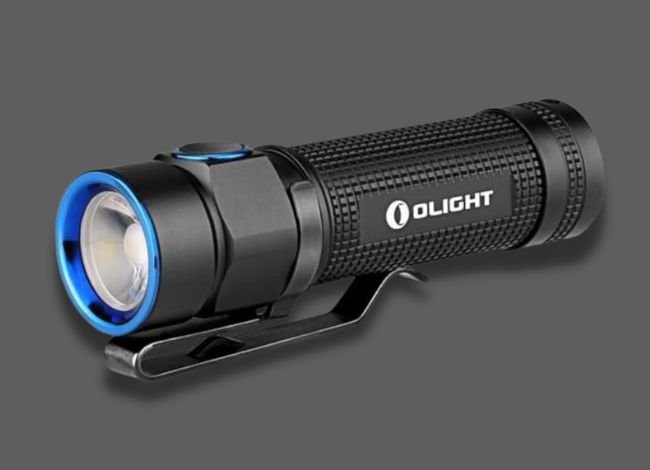
The aluminum S1A has a 6061-T6 body and a Type III hard-anodized finish. The textured tube helps you find your grip and the stainless steel clip lets you carry the light where you can reach it. The blue bezel and side switch look much like those on other Baton models. Check the battery tube and the model marking if you’re trying to tell them apart.
For a small flashlight, the S1A is well suited to regular pocket carry. If you’re comparing lights that can share cells with a remote or another piece of gear, our guide to the best AA flashlights covers more one-AA options.
Water and Impact Resistance
The S1A carries an IPX8 water-resistance rating and a specified impact rating of 1.5 meters. It can handle rain and wet trails with the tailcap and seal in good condition. On an older light, inspect the seal before depending on that rating. Dirt caught under the cap can get in the way of a good seal, and opening a wet light can bring water into the battery compartment.
Olight S1A Battery Compatibility and Performance
The S1A supports several AA-sized battery types. A fresh cell of the right type makes more difference than the brand on the wrapper.
- AA alkaline. An everyday option for occasional use. The manual lists a shorter initial High interval than it lists for the supplied AA lithium primary.
- AA lithium primary. The original box included a 1.5-volt lithium iron disulfide AA. Its published runtime is useful if you spend most of your time on Medium or below.
- AA NiMH rechargeable. The manual lists NiMH as compatible. The table below gives the published figures for the other three tested cell types, so use those runtimes as a guide to the relevant chemistry.
- Compatible 14500 Li-ion. This higher-voltage rechargeable cell unlocks 600-lumen Turbo. A 14500 is about the size of an AA and has a different voltage. Use it only in lights that specifically support it.
Unscrew the tailcap, remove the factory insulating film if it is still present, and insert the battery with the positive end facing the LED. If the light fails to come on after a battery change, check that orientation and tighten the tailcap before assuming the switch has failed. Make sure the threads and contact surfaces are clean and dry.
Does the Olight S1A Have Built-in Charging?
The original S1A has a magnetic tailcap for mounting, and there is no built-in charger or USB port. Take the rechargeable cell out and use a charger designed for its chemistry and voltage. A NiMH AA and a Li-ion 14500 need different charging programs. Disposable alkaline and lithium primary cells stay out of chargers.
The magnet is useful under a vehicle hood or on a steel shelf. If you use several Baton lights, check where the cable connects on each one. On an S2R Baton II, the magnetic tailcap includes charging contacts for its specified battery and cable. On the S1A, the magnet is there to hold the flashlight in place.
Cree XM-L2 LED and Beam Performance
The Olight S1A uses a Cree XM-L2 LED. Olight rates it at up to 118 meters with a compatible 14500 in Turbo and up to 71 meters on the 220-lumen AA High setting. In practice, the shape of the beam is useful for lighting a trail, looking through a pack, or checking the area just outside your door. The rated distance is a standardized threshold, and you’ll want to be closer to see fine details.
Our Klarus Mi7 review covers another compact side-switch light with both AA and 14500 support. The cells fit the same general size class, but the Mi7 has its own output levels, step-down behavior, and controls.
PMMA TIR Lens: Balanced Illumination
The S1A uses a total internal reflection (TIR) optic to give the beam a usable hotspot and light around the edges. That balance helps when you’re working at arm’s length. There is enough center light to find a dropped tool, and you can still see the surrounding area as you move the beam. Turn the output down when working on shiny surfaces close to the lens.
The S1A is easiest to appreciate as a short- to mid-range light. If your main job is finding a trail marker across a field, look at beam intensity and shape as well as total output.
Olight S1A Lighting Modes and Runtime
You can choose a dim setting for close work or a stronger beam when you need to see farther. The runtime figures below come from Olight’s original S1A documentation. An arrow shows a step-down in the same mode. For example, the 14500 Turbo rating is one minute at 600 lumens followed by 60 minutes at 300 lumens under the rated conditions.
| Mode | AA lithium primary | AA alkaline | Compatible 14500 Li-ion |
|---|---|---|---|
| Moonlight · 0.5 lm | 25 days | 20 days | 15 days |
| Low · 5 lm | 80 hr | 75 hr | 60 hr |
| Medium · 50 lm | 10.5 hr | 4.5 hr | 6.5 hr |
| High · 220 → 100 lm | 110 + 30 min | 12 + 80 min | 100 + 10 min |
| Turbo · 600 → 300 lm | Unavailable on AA | Unavailable on AA | 1 + 60 min |
| Strobe | Triple-click | Triple-click | Triple-click |
High on an AA can step down too. The specified alkaline cell reaches the initial 220-lumen level for a much shorter period than the supplied AA lithium primary. The 25-day figure applies to Moonlight on that original AA lithium primary, so it is useful for comparison with other very low modes. Actual runtime also depends on cell condition, temperature, and how often you restart a higher mode.
Battery Efficiency in Moonlight Mode
Moonlight is one of the reasons I like this light for camping. Half a lumen gives you enough light to find items inside a tent without lighting up the whole space. Medium is a more useful starting point on a path. Save Turbo for a brief look farther ahead, then return to a lower setting to extend runtime.
Ease of Use and Practical Design
Simple Side Switch Operation
- Single click. Turn the light on or off. The S1A remembers the previous brightness setting.
- Hold while on. Cycle through Low, Medium, and High. Release at the level you want.
- Hold for more than a second while off. Go directly to Moonlight.
- Double-click while off. Go to Turbo with a compatible 14500. The manual lists direct access to High with the AA lithium primary cell.
- Quick triple-click. Enter strobe.
Check the beam before starting a close-up task if the light was last used at a high setting. The direct shortcut to Moonlight is useful when you want the first output to be dim. The timing of the double-click matters because the button has a different job once the light is on.
Timer and Lockout Considerations
Double-click while the light is on to select its automatic shutoff timer. One blink indicates three minutes and two blinks indicate nine minutes. Double-click again after setting it to toggle between the two timings. It’s handy when you want to light the inside of a tent or your work area briefly and then let the light turn itself off.
For storage or transport, Olight’s S1A instructions advise backing off the tailcap slightly to cut power. That helps prevent accidental operation if something presses the side switch inside a bag. Tighten the cap again before using the light or taking it into wet conditions.
Lightweight and Pocket-Friendly
The S1A is small enough to keep in a pocket or tool pouch. I would carry it as a pocket flashlight because the clip gives you a repeatable place to find it. For something that can live on a key ring, see our keychain flashlight recommendations for smaller lights that suit that job.
Pocket Clip and Lanyard
The stainless steel pocket clip helps keep the S1A near the top of a pocket, and the original package included a lanyard. The magnet provides a third way to use it when you need both hands. Try the mount on the actual surface first. Aluminum body panels and many plastic storage cabinets give the magnet nothing to grip.
Olight S1A vs Olight S2R Baton II
These lights make sense for different routines. The S1A lets you drop in an AA when you can’t charge a battery. The S2R Baton II uses a larger 18650 and gives you more output and more time at low levels. Read our Olight S2R Baton II review for its mode chart and how its magnetic charging system works.
| Comparison | Olight S1A Baton | Olight S2R Baton II |
|---|---|---|
| Brightness and reach | 600 lm and 118 m on 14500 Turbo | 1,150 lm and 135 m on Turbo |
| Cells | AA or compatible 14500 | Customized 18650 Li-ion |
| Charging | Remove rechargeable cell to charge | Magnetic cable attaches to the tail |
| Longest Moonlight runtime | 25 days with AA lithium primary | 60 days |
| Magnetic tailcap | Yes, for mounting | Yes, for mounting and compatible charging |
| Water resistance | IPX8 | IPX8 |
| Choose it for | Small size and AA battery flexibility | Greater output and convenient charging |
| Separate Olight model | Baton 4 rechargeable alternative | View an Olight Baton 4 |
The S2R Baton II is rated at 1,150 lumens initially and then steps down to 400 lumens. Its 135-meter and 4,600-candela ratings explain its reach, while the larger cell gives it a rated 60 days on Moonlight. Both lights can attach to steel. The S2R Baton II adds charging through the tail with the correct customized battery and magnetic cable.
Which One Should You Choose?
Choose the S1A if a replaceable AA is useful on trips or as a backup, and if you’d rather carry a smaller light. Choose the S2R Baton II if you use the light frequently, want more output on walks, and prefer to set the whole light on its charger between uses. The removable AA is more useful when you already carry AA cells for other equipment.
Olight S1A Warranty and Customer Support
The original S1A manual describes a five-year limited manufacturer warranty for eligible defects. Its terms depend on the purchase date and the applicable regional policy. Keep your receipt and the model marking handy if you contact Olight. Worn seals, leakage, or damage from a modified or unsupported battery should be checked against those terms.
Is the Olight S1A Still Worth It in 2026?
Yes, if you value a small flashlight with several supported battery options. An ordinary AA makes a good backup, and the 14500 gives you more output when you need it. For trips where you already pack AA batteries, that flexibility can be more useful than another charging cable.
The main compromise is that you have to remove a rechargeable battery to charge it. Turbo is also brief. If you usually work at close range, the lower modes and magnet are more likely to matter than the peak 600-lumen number. If you need sustained higher output, compare larger battery designs at the brightness you expect to use.
Olight S1A Pros and Cons
| Pros | Trade-offs |
|---|---|
| Compact and easy to carry | The small battery limits time at higher output. |
| Anodized aluminum and IPX8 water resistance | The tailcap seal needs to be clean and fitted. |
| Supports several AA types and compatible 14500 cells | 600-lumen Turbo requires a 14500 and steps down. |
| Useful Moonlight mode and a shutoff timer | The longer Moonlight runtime depends on the cell type. |
| Magnetic tailcap for mounting | Charging a rechargeable cell requires removal. |
Who Should Buy the Olight S1A?
Campers and hikers can use it as a backup light or clip it inside a tent pocket. At home it is useful for cupboards, drawers, and jobs around a car. I would keep a charged 14500 for higher output and a compatible AA spare for trips where there’s no charger. If you want a simpler AA-only tail switch, our Fenix E12 version comparison explains how that smaller design differs and which batteries it uses.
 Check Today’s Price for an Olight Alternative
Alternatives to the Olight S1A
- Olight Seeker 2 Pro: A larger rechargeable Olight for work that benefits from more output and a wider beam.
- ThruNite TN12: A conventional tactical-style alternative if you want a larger 18650 flashlight with a tail switch.
- Olight Baton 4. A smaller rechargeable Baton with a different battery system and magnetic charging. Its ratings and charger do not apply to the S1A.
For a different rechargeable form factor, see the rechargeable flashlight listing on Amazon for a compact magnetic-charging flashlight.
Frequently Asked Questions – Olight S1A Review
- What is the maximum brightness of the Olight S1A flashlight? 600 lumens initially on a compatible 14500. The rated Turbo runtime includes a drop to 300 lumens after about one minute.
- Can I use regular AA batteries with the Olight S1A? Yes. The original manual supports AA lithium primary, AA alkaline, and AA NiMH. For the highest output you need a compatible 14500 Li-ion cell.
- Is the Olight S1A flashlight waterproof? It has an IPX8 rating. Check that the seal is clean and the tailcap is tight before using the light in wet conditions.
- How long does the Olight S1A battery last? The original AA lithium primary is rated for 25 days at 0.5 lumens, 80 hours on Low, and 10.5 hours on Medium. See the table for High and other tested cell types.
- What is the difference between the Olight S1A and S2R Baton II? The S1A takes AA-sized batteries and offers up to 600 lumens with a 14500. The S2R Baton II reaches 1,150 lumens and uses a customized 18650 and magnetic charging.
- Can I charge the Olight S1A with a USB cable? The S1A has no in-light charging. Remove the rechargeable cell and use a compatible external charger.
- Can I use an Olight S1 Baton battery in the S1A? The original S1 uses a CR123A-size battery, while the S1A takes AA-sized cells. Check the model name before choosing a spare.
- Is the Olight S1A a good everyday carry flashlight? Yes, especially if you want AA compatibility, a pocket clip, and a low output you can access from off. If you want regular in-light charging, pick a model with that feature.
Final Verdict: Olight S1A Review
The Olight S1A Baton still offers a useful combination of small size, a magnetic tailcap, and battery flexibility. The 600-lumen Turbo is nice to have when you need a brief boost. For everyday use, I would choose it for the dim settings and the option to put in an ordinary AA. If you’d rather leave a light on a charging cable at the end of the day, the rechargeable Baton designs make more sense.
Have a question about the Olight S1A or its battery compatibility? Share your experience in the comments below.