Last Updated on November 5, 2026
Is the Klarus XT11GT Pro Tactical Flashlight worth buying in 2026? If you’re looking for a powerful flashlight with durable construction, convenient controls, and rechargeable batteries, the XT11GT series deserves consideration.
The original Klarus XT11GT produces up to 2,000 lumens, while the upgraded XT11GT Pro delivers up to 3,300 lumens. The Pro also offers USB-C charging, improved battery management, and a redesigned lighting system.
Both models are suitable for outdoor activities, security work, emergencies, and general nighttime use. However, they differ in brightness, battery requirements, charging systems, and beam performance.
In this Klarus XT11GT review, we’ll compare the original XT11GT with the XT11GT Pro, explain their main features, and cover the advantages, limitations, and common troubleshooting problems.
Klarus XT11GT vs. XT11GT Pro: Technical Specifications
Klarus has released different XT11GT generations, and some online listings mix their specifications. The original XT11GT uses an 18650 battery and micro-USB charging. The later XT11GT Pro is rated for substantially greater brightness and supports USB-C charging.
For this Klarus XT11GT review, the comparison below separates the original 2,000-lumen model from the 3,300-lumen Pro V2 configuration. The Pro V2 is rated for a 410-meter beam with its 3,100mAh battery. A later Pro configuration has a 380-meter rating and 4,000mAh battery; the Pro V4 is a separate upgrade, covered below.
| Klarus XT11GT | Original XT11GT | XT11GT Pro V2 |
|---|---|---|
| Maximum brightness | 2,000 lumens | 3,300 lumens |
| Maximum beam distance | 316m | 410m |
| Battery system | 18650 / two CR123A | One 18650 / two CR123A |
| Battery capacity | 3,100mAh high-drain 18650 | 3,100mAh 18650 configuration |
| Charging | Micro-USB | USB-C |
| Lighting functions | Four brightness levels, Strobe, SOS | Turbo, High, Medium, Low, Strobe, SOS |
| Controls | Dual tail switches plus side switch | Dual tail switches; no side control switch |
| Construction | Aluminum alloy | Aluminum alloy |
| Water resistance | IPX8 | IPX8 |
| Best suited for | General tactical and outdoor use | Higher-output outdoor and professional lighting |
| Control settings | Tactical, Outdoor, Advanced Tactical | Tactical, Outdoor |
Klarus XT11GT Flashlight Video Review
Why Choose the Klarus XT11GT Pro Tactical Flashlight?
The XT11GT Pro offers several improvements over the original model. Its stronger LED output, convenient charging system, and dual-tail-switch operation make it a practical choice for users who need reliable illumination.
- Maximum brightness: 3,300 lumens with the specified rechargeable battery.
- USB-C charging: More convenient than the original model’s micro-USB connection.
- Dual-tail-switch operation: A primary switch and a separate MODE paddle at the rear.
- Battery indication: Helps monitor remaining power.
- Multiple modes: Different brightness settings plus emergency signaling functions.
- Temperature management: Automatically regulates brightness when necessary.
These features are useful for activities such as camping, nighttime inspections, search work, and emergency preparedness.
Klarus XT11GT Review: Build Quality and Performance
Durable Aluminum Construction
The Klarus XT11GT series uses aluminum alloy construction with a protective anodized finish. This helps resist everyday scratches and wear while keeping the flashlight relatively lightweight.
The textured body also provides a secure grip, including when you’re wearing gloves.
The XT11GT Pro has an IPX8 water-resistance rating, making it suitable for wet outdoor conditions under the manufacturer’s specified testing limits.
However, IPX8 doesn’t mean the flashlight is intended for scuba diving or unlimited underwater use.
Brightness and Beam Quality
The upgraded XT11GT Pro produces up to 3,300 lumens, considerably more than the original XT11GT’s 2,000-lumen rating.
Its beam combines a bright center with surrounding spill light, making it useful for illuminating paths, open areas, and moderately distant objects.
However, a manufacturer’s maximum beam-distance rating doesn’t mean you’ll clearly recognize details at that distance. Practical visibility depends on weather, target size, and surrounding light.
The flashlight won’t maintain its maximum Turbo brightness for the entire rated runtime. Output can decrease as the flashlight heats up or the battery voltage drops. When comparing the models in this Klarus XT11GT review, treat Turbo as short-term extra light rather than continuous working brightness.
Our guide to flood and throw beam patterns explains why more lumens alone don’t guarantee greater reach.
Klarus XT11GT Pro Lighting Modes and Runtime
This Klarus XT11GT review uses the Pro V2’s 3,100mAh high-drain 18650 configuration for the runtime table. These figures do not describe the newer Pro V4.
| Mode | Brightness | Rated Runtime |
|---|---|---|
| Turbo | 3,300 lumens | 1.8 hours total |
| High | 1,200 lumens | 4 hours total |
| Medium | 200 lumens | 12 hours |
| Low | 10 lumens | 120 hours |
| Strobe | 3,300 lumens | 4 hours |
| SOS | 200 lumens | 32 hours |
Rated runtime includes time at reduced output; 1.8 hours does not mean 1.8 hours at a steady 3,300 lumens. Low and Medium are practical choices for longer activities, while Turbo is better reserved for a brief look farther ahead.
For comparison with another Klarus model, see our Klarus XT12GT and XT12GT Pro review.
Klarus XT11GT Pro Battery and USB-C Charging
The original XT11GT uses a rechargeable 18650 lithium-ion battery with micro-USB charging. The upgraded Pro supports USB-C charging, which is more convenient for users who already own USB-C cables.
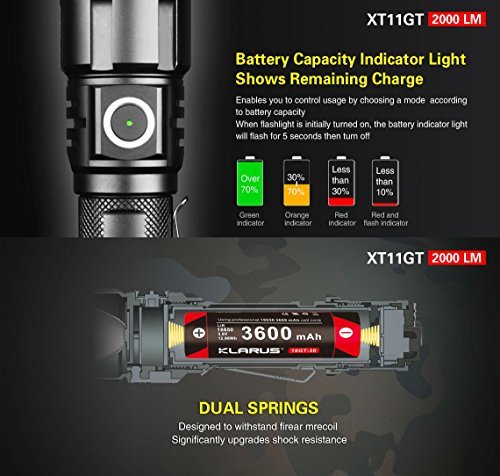
The original, Pro V2, and Pro V4 use an 18650-size battery, not a 21700. Maximum output requires a suitable high-drain rechargeable cell. Two disposable CR123A cells are an alternative in these models, but they deliver reduced output and must never be recharged inside the light.
How to Charge the Flashlight
- Switch off the flashlight.
- Inspect the charging port for dirt or moisture.
- Open the charging-port cover.
- Connect a compatible USB-C cable to the flashlight.
- Connect the cable to a suitable USB power source.
- Allow charging to complete according to the indicator.
- Disconnect the cable and close the charging-port cover securely.
On the Pro V2, the charging indicator is red while charging and green when complete. Battery capacity is shown briefly after switch-on: green above 70%, orange at 30–70%, red below 30%, and flashing red below 10%.
Use only the rechargeable battery type approved for your flashlight, and keep damaged or swollen cells out of service.
Real-World Uses of the Klarus XT11GT Pro
Outdoor Activities

The XT11GT Pro provides useful illumination for hiking, camping, and navigating unlit paths. Medium and Low settings are often more comfortable for routine activities than Turbo.
Emergency Preparedness
A rechargeable flashlight with multiple brightness levels can be useful during power outages, roadside emergencies, and equipment inspections.
SOS and Strobe may also help attract attention when emergency signaling is appropriate.
Professional and Security Work
The Pro’s dual-tail-switch interface can be convenient for users who need quick access to lighting while wearing gloves.
However, whether the flashlight is suitable for a particular professional application depends on the required equipment specifications and operating procedures.
Everyday Carry
The XT11GT series can be carried in a bag, jacket pocket, or holster. However, its body is larger than many compact EDC flashlights.
For lighter alternatives, explore our everyday-carry flashlight buying guide.
Pros and Cons of the Klarus XT11GT Pro
| Pros | Cons |
|---|---|
| Powerful 3,300-lumen maximum output | Turbo brightness decreases as heat builds up |
| Convenient USB-C charging | Battery compatibility differs between versions |
| Dual-tail-switch operation | Controls take time to learn |
| IPX8 water resistance | Not intended for dedicated underwater use |
| Multiple brightness and signaling modes | Larger than many small EDC flashlights |
| Temperature and battery management | Specifications vary by generation |
Klarus XT11GT Pro Video Demonstration
Klarus XT11GT Pro vs. Klarus XT11S
The Klarus XT11S is a lower-output alternative for users who don’t need the Pro’s maximum brightness. It is roughly the same size, rather than a substantially smaller flashlight. This Klarus XT11GT review compares the pre-V4 Pro configurations with the 1,100-lumen XT11S.
| Klarus XT11GT comparison | XT11GT Pro (pre-V4) | XT11S |
|---|---|---|
| Maximum brightness | 3,300 lumens | 1,100 lumens |
| Beam distance | 410m (Pro V2); 380m (later Pro) | 330m |
| Charging | USB-C | USB-C on updated model; micro-USB on original |
| Battery | 18650 lithium-ion | 18650 lithium-ion |
| Water resistance | IPX8 | IPX8 |
| Best for | Higher-output illumination | Lower-output everyday tactical use |
| Price | Check Price | Check Price |

If you mainly need a practical light for camping, household tasks, or occasional nighttime use, the XT11S may be sufficient.
The XT11GT Pro is more appealing if stronger illumination and rear-only controls matter to you. The updated XT11S also has USB-C charging, while its older version uses micro-USB.
What Changes with the Klarus XT11GT Pro V4?
The Pro V4 keeps the 3,300-lumen maximum but extends rated beam distance to 560 meters. It uses a 4,000mAh 18650 battery, dual tail switches, and USB-C charging at up to 5V/2A, with an approximate three-hour charging time.
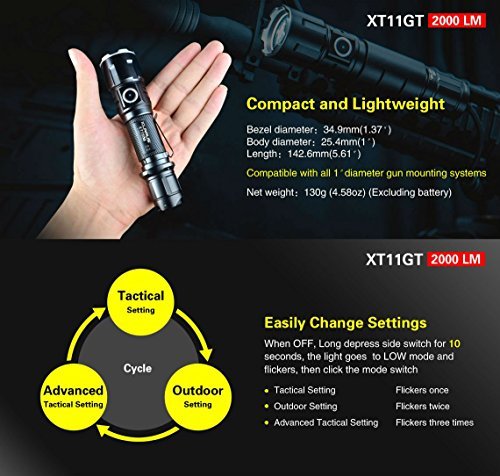
Its rated maximum runtime is 145 hours on the lowest setting, not at Turbo. The body measures 141.3mm long with a 35mm head, weighs about 125g without the battery, and has IPX8 water resistance and a 2-meter impact rating.
These figures belong to the Pro V4. The Pro V2 runtime table and the older Pro’s 380- or 410-meter ratings describe different configurations.
Original Klarus XT11GT: Controls and Construction
Triple-Switch Operation
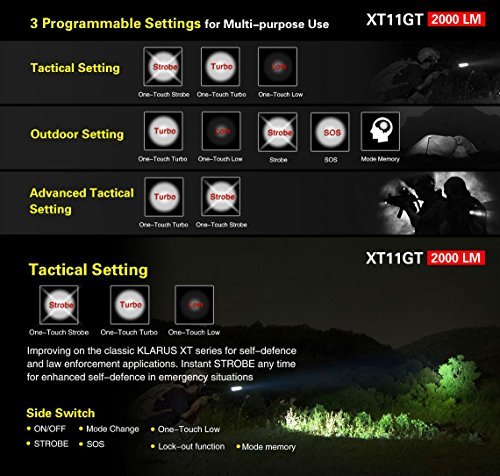
The original XT11GT has two rear switches and a separate side switch. The Pro uses two tail switches instead, with no side control switch.
- Original XT11GT: The rear switches provide quick access to Turbo and Strobe or Low, depending on the setting. The side switch handles everyday brightness changes.
- XT11GT Pro V2: The primary tail switch turns the light on in Turbo. The MODE paddle changes brightness while the light is on.
This difference matters in a Klarus XT11GT review because the control layout affects how you hold and use the flashlight.
Programmable Operating Settings
The original XT11GT offers Tactical, Outdoor, and Advanced Tactical settings. Advanced Tactical limits operation to Turbo and Strobe and disables the side switch.
The Pro V2 has two settings: Tactical and Outdoor. From off, its MODE paddle gives access to Strobe in Tactical or Low in Outdoor. It does not use the original model’s three-setting interface.

Klarus XT11GT Pro Troubleshooting Guide
Flashlight Won’t Turn On
- Check the battery charge and orientation.
- Remove any insulating film supplied with a new battery.
- Make sure the tail cap is properly tightened.
- On the Pro V2, tighten the tail cap to release its mechanical lockout.
- Inspect accessible contacts for dirt or corrosion.
Light Flickers or Shuts Off
A loose tail cap, dirty contact, weak battery, or protective circuitry can cause intermittent operation.
Clean accessible contacts and test with a known-good compatible battery before attempting further repairs.
USB-C Charging Doesn’t Work
- Try a different compatible cable or power adapter.
- Inspect the charging port for damage or moisture.
- Check that the battery is approved for the flashlight.
- Allow an unusually warm battery to return to a safe temperature.
Don’t force the connector or attempt to bypass battery protection circuitry.
Modes Won’t Change
Confirm the flashlight’s operating setting and battery charge. The Pro V2 uses tail-cap lockout: loosen the cap half a turn for storage and tighten it again before use. The original XT11GT’s electronic lock controls only its side switch.
The control sequences can differ between XT11GT generations. Follow the instructions for your exact model rather than using settings from another version.
Battery Drains Quickly
Frequent Turbo use, battery aging, and accidental activation can shorten battery life.
Try a lower brightness level and inspect the condition of the rechargeable battery. Our checks for a flashlight that becomes dim can help separate a weak battery or poor contact from normal thermal step-down.
Frequently Asked Questions
1. How bright is the Klarus XT11GT Pro?
The XT11GT Pro is rated for up to 3,300 lumens with the specified rechargeable battery. Actual brightness and runtime depend on the flashlight generation and battery configuration.
2. What battery does the Klarus XT11GT Pro use?
The Pro V2 runtime figures above use a 3,100mAh 18650 rechargeable battery. Later Pro packages and the Pro V4 include a 4,000mAh 18650. Capacity alone is not enough: the replacement must also meet the flashlight’s discharge requirements.
3. Is the Klarus XT11GT Pro waterproof?
It has an IPX8 water-resistance rating. Follow the immersion limits specified for your model and keep the charging-port cover properly closed.
4. Is the XT11GT Pro suitable for outdoor and professional use?
Its durable housing, multiple brightness levels, and rear controls are useful for outdoor lighting and inspections. Choose the brightness level and operating setting that suit the task.
5. How do I charge the Klarus XT11GT Pro?
Connect a suitable USB-C cable to the flashlight’s charging port and a compatible USB power source. Follow the charging indicator and disconnect the cable when charging is complete.
6. What is the difference between the XT11GT and XT11GT Pro?
The original XT11GT produces up to 2,000 lumens and uses micro-USB charging. The later XT11GT Pro is rated for up to 3,300 lumens and offers USB-C charging, along with other changes to its performance and power system.
Final Verdict: Is the Klarus XT11GT Pro Worth Buying in 2026?
The Klarus XT11GT Pro Tactical Flashlight remains a strong option for buyers who want powerful rechargeable illumination with practical controls.
Its 3,300-lumen maximum output, USB-C charging, durable construction, and multiple operating modes make it useful for outdoor lighting, emergencies, and professional tasks.
However, the exact XT11GT version matters. Battery specifications, beam distance, and runtime can differ between product generations. Always verify the model number before purchasing.
Overall, this Klarus XT11GT review shows that the Pro offers meaningful improvements over the original model, particularly in brightness and charging convenience.
For general outdoor use, the Pro V2 offers useful output and simple rear controls. Choose the Pro V4 if its longer rated reach is a priority; choose the XT11S if lower maximum output is enough.
For more options, explore our Klarus flashlight comparison guide.