Last Updated on November 14, 2026
Having a reliable flashlight matters when you’re checking a property after dark, finding your way back to camp, or looking across an open field. In this Klarus XT11GT vs XT12GT comparison, the original XT11GT is the smaller, brighter-rated light. The original XT12GT has the tighter beam and longer rated reach. Explore our tactical flashlight reviews and comparisons if you’re weighing options from other brands, too.
Klarus company has specialized in creating durable flashlights across several product generations. The original models in this comparison are the 2,000-lumen Klarus XT11GT and the 1,600-lumen Klarus XT12GT tactical flashlights. Their later Pro versions use different emitters and charging hardware. Check the full name on the light or manual before choosing a cable, battery, or replacement part.
Klarus XT11GT vs XT12GT Comparison Table
The table identifies each version by its peak output and rated reach. The figures are Klarus ratings using the specified test batteries. The XT11GT Pro column covers the 3,300-lumen V2.0, since other releases also carry the Pro name.
| Feature | XT11GT original | XT11GT Pro V2.0 | XT12GT original | XT12GT Pro |
|---|---|---|---|---|
| Turbo output | 2,000 lm | 3,300 lm | 1,600 lm | 1,600 lm |
| Rated beam distance | 316 m | 410 m | 603 m | 850 m |
| Peak intensity | 24,964 cd | Compare rated beam distance | 90,902 cd | 160,000 cd in manual |
| LED | Cree XHP35 HD E4 | Luminus SST-70 | Cree XHP35 HI D4 | Luminus SFT40 |
| Battery for rated output | 3,100 mAh high-drain 18650 | 3,100 mAh high-drain 18650 (manual) | 3,600 mAh high-drain 18650 | 5,000 mAh 21700 |
| Backup power | Compatible 18650 or 2 CR123A | 2 CR123A at reduced output | Compatible 18650 or 2 CR123A | 18650 supported. 2 CR123A at reduced output |
| Charging | Micro-USB | USB-C | Magnetic connector | USB-C |
| Charge time | About 4.1 hours by manual formula for 3,100 mAh | Varies with battery and charger | About 4.6 hours by manual formula for 3,600 mAh | Varies with battery and charger |
| Turbo runtime | 50 min rated | 1.8 hr rated | 1.2 hr rated | 2 hr 45 min rated |
| High output and runtime | 400 lm / 3.5 hr | 1,200 lm / 4 hr | 400 lm / 4 hr | 500 lm / 6 hr |
| Medium output and runtime | 100 lm / 12 hr | 200 lm / 12 hr | 100 lm / 14 hr | 100 lm / 27 hr |
| Low output and runtime | 10 lm / 170 hr | 10 lm / 120 hr | 10 lm / 200 hr | 10 lm / 288 hr |
| Steady modes | 4 | 4 | 4 | 4 |
| Signal modes | Strobe and SOS, by profile | Strobe and SOS, by profile | Strobe and SOS, by profile | Strobe and SOS, by profile |
| Body | Hard-anodized aluminum | Hard-anodized aluminum | Hard-anodized aluminum | Hard-anodized aluminum |
| Lens / beam optics | Coated, hardened glass | Smooth reflector | Coated, hardened glass | Smooth reflector |
| Water resistance | IPX8 | IPX8 | IPX8 | IPX8 |
| Drop rating | 1 m | 1 m on Klarus product page | 1 m | 1 m |
| Controls | Dual tail and side switches | Dual tail switches | Dual tail switches | Dual tail switches |
| Lockout | Electronic lockout | Loosen tailcap as directed | Loosen tailcap as directed | Loosen tailcap as directed |
| Weight without battery | 130 g | 124 g | 159 g | 171 g |
| Length × head × body | 142.6 × 34.9 × 25.4 mm | 139.7 × 35 × 25.4 mm | 161.5 × 45.2 × 25.4 mm | 171.2 × 45.2 × 27.5 mm |
| Carry | Clip and holster in manual | Holster in manual | Clip and holster in manual | Clip and holster in manual |
When comparing the Klarus XT11GT vs XT12GT, use the rated distance to judge reach and the lumen rating to judge total output. Both families can step down from Turbo as the light heats up or the battery drops. The quoted Turbo runtime includes that reduction. Fog, rain and the object you’re trying to see can reduce the useful distance.
Klarus XT11GT vs XT12GT Reviews
Klarus Upgraded XT11GT 2000 Lumens Flashlight
The original XT11GT has a 34.9 mm head, a shorter body and a clip. That makes it easier to carry with gloves, tools, or other equipment in a pocket. Its hard-anodized aluminum body is rated for a one-meter drop, and Klarus lists an IPX8 rating under its stated test conditions. Seat the USB cover after charging and leave the port closed when the light is wet or dirty.


The side button gives you another way to work through the modes, alongside the two buttons at the tail. The Tactical profile gives you direct Turbo and strobe. Outdoor makes Low easier to reach and offers an SOS mode. Advanced Tactical limits the controls to Turbo and strobe and disables the side button. Choose the profile before carrying it so you know what the first press will do.
With the specified high-drain 3,100 mAh battery, the Cree XHP35 HD emitter is rated at 2,000 lumens and 316 meters. The manual’s 400-lumen High and 100-lumen Medium settings are more practical for sustained nearby work. If your priority is a broader beam and higher total output for open spaces, the 3000LM Klarus G20 flashlight is a useful model to compare.
Pros:
- More compact than the original XT12GT.
- Side switch and dual tail switches suit different grips.
- Micro-USB charging, battery level indication, and a useful Low setting.
- Electronic lockout, reverse-polarity protection, and output adjustment as the light warms up.
Cons:
- Turbo warms the head and steps down during extended use.
- The older Micro-USB port requires a different cable from the Pro models.
Related article: Fenix VS Klarus: Check the differences and similarities.
Klarus XT12GT Tactical Flashlight
The original XT12GT uses a larger reflector and a Cree XHP35 HI D4 emitter. Klarus rates it for 1,600 lumens and 603 meters with the 3,600 mAh 18650 cell specified in its manual. The concentrated hotspot is useful for picking out a reflective marker, following a trail through a field, or checking a dark fence line. In a small room it can cover less of your surroundings than the XT11GT.
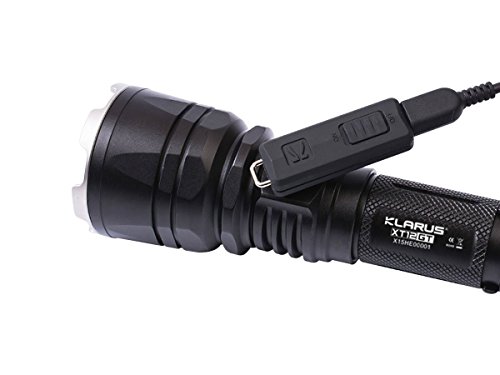
Both controls sit on the tail. The Tactical profile is useful if you want quick access to high output and strobe. The Outdoor profile adds direct access to Low, regular brightness selection, and SOS. A charge-status indicator helps you see when to recharge. Bring the matching magnetic lead for a trip where you’ll need to top up the battery.
Pros:
- Longer rated beam than the original XT11GT.
- Two tail buttons support one-handed operation.
- Magnetic charging and a battery-level indicator.
- Four steady outputs plus strobe and SOS through the operating profiles.
Cons:
- Longer body and larger head take up more space in a pocket or kit.
- The magnetic system needs its own lead. High output can reduce as the light warms up.
What changes with the XT11GT Pro and XT12GT Pro?
The 3,300-lumen XT11GT Pro V2.0 moves to USB-C and puts both switches at the rear. Its rated 410-meter beam is an improvement over the original XT11GT. If you like the original side switch, the Klarus XT11S vs XT11GT comparison shows a second option with that control.


The 1,600-lumen XT12GT Pro uses an SFT40 emitter, USB-C charging, and a 5,000 mAh 21700 in its rated configuration. Klarus rates it to 850 meters. That combination is useful if you’ll mainly be looking at distant objects and want USB-C without carrying the original XT12GT’s magnetic lead. It is heavier than the original and still takes up more room than the XT11GT Pro.
Both Pro models can step down during an extended search. If you are out for several hours, plan around the rated High and Medium settings. Pack the right cable and, where practical, keep a backup light within reach. Keep the original XT12GT’s magnetic connector and charging contact clean and dry before charging.
Summary
In this Klarus XT11GT vs XT12GT comparison, the original XT11GT is the more convenient size for everyday work and campsite lighting. If seeing farther matters most, the original XT12GT offers the stronger center beam. For a Pro version, start with the intended beam distance and the controls you want, then check the battery and charging port for that generation.
To carry a smaller side-switch light for close work, compare the dimensions and AA support in our review of the Klarus Mi7 flashlight.
FAQs
1. What are the key differences between the Klarus XT11GT and XT12GT?
The original XT11GT is rated at 2,000 lumens and 316 meters. The original XT12GT is rated at 1,600 lumens and 603 meters. The XT11GT also has a side button and Micro-USB. The XT12GT uses two rear buttons and a magnetic charger.
2. Which flashlight is better for long-range visibility?
The original XT12GT is better suited to checking something across a field or down a long trail. Its reflector sends more light into the center of the beam. If you regularly work a few meters from the object you need to see, the original XT11GT is easier to carry and aim around your immediate area.
3. Does the Klarus XT11GT or XT12GT have a longer battery life?
At their shared 10-, 100- and 400-lumen levels, Klarus lists longer runtimes for the original XT12GT with its specified 3,600 mAh battery. That comparison uses the batteries in the manuals. A focused beam by itself doesn’t extend power at a chosen level. Battery capacity, driver efficiency, and how much time you spend on Turbo all matter. Use the charger specified for the particular light and battery, and never charge disposable CR123A cells.
4. How do the tactical controls compare?
Both originals have two tail controls and can provide quick access to Turbo and strobe through their Tactical profiles. On the XT11GT, the separate side button is useful when you hold the body instead of resting your thumb on the tailcap. Test the selected profile at home before depending on it outside.
5. Which Klarus flashlight is more suitable for everyday carry (EDC)?
The shorter original XT11GT takes up less room in a pocket or pouch. Its Low mode is handy for reading labels or finding a dropped item without flooding the area with light. If you carry the bigger original XT12GT for night searches, a holster or outer bag pocket makes it easier to reach.