Last Updated on November 10, 2026
A flashlight is useful long before an emergency. Finding a dropped key, checking a dark cupboard, or walking back to the car can be easier with a small light in your pocket. If bulky lights put you off carrying one, the Fenix E12 is worth considering.
This Fenix brand flashlight followed the E11 and added a third brightness level. It is a compact flashlight with powerful illumination for nearby tasks, with straightforward tail-switch controls. The E12 family now includes several versions, so this Fenix E12 review separates their features rather than treating every E12 as the same model.
For an everyday carry flashlight, the useful questions are simple: will it fit comfortably, does it use batteries you already keep, and can you find the right brightness without fuss? The newest version adds conveniences, while an older E12 can still be a useful pocket light.
Upgraded Fenix E12 Flashlight Review in 2026
The original Fenix E12 flashlight reaches a rated 88 meters and uses a Cree XP-E2 LED. It runs on one AA battery, which is easy to replace. Its recessed tail switch reduces the chance of accidental operation. The Fenix e18r belongs to a separate model family, rather than being a later version of the E12.
Before making a final decision, compare the versions and their practical trade-offs below. This Fenix E12 flashlight review covers brightness, battery choice, portability, and the differences from the E11. Here are the notable features:
Technical Specs: Fenix E12 Versions Compared
| Fenix E12 | Output and reach | Carry and controls | Lowest setting |
|---|---|---|---|
| 1. E12 V3.0 | 200 lumens; 78 m | 81.5 mm; magnetic tail; two-way clip; output memory | 5 lumens; up to 100 hours with the specified alkaline battery |
| 2. E12 V2.0 buy Fenix E12 |
160 lumens; 68 m | 77.6 mm; two-way clip; starts on Low | 5 lumens; up to 70 hours with alkaline |
3. Original E12 Check Price |
130 lumens; 88 m | 90 mm; 28.5 g without battery; starts on Low | 8 lumens; 22 hours with alkaline or 40 hours with the specified NiMH |
All three use one compatible AA battery and have three steady brightness settings. None has built-in USB charging, strobe, or SOS. Beam distance and total lumens measure different things: more lumens do not automatically mean a farther-reaching beam. Runtime is also battery-specific and is measured to a standard, rather than promising unchanged brightness for the whole period.
1. Fenix E12 V3.0: the most convenient everyday option
The V3.0 adds a magnetic tail, which is useful when a suitable steel surface is available near your work. A two-way clip provides another hands-free option on a compatible cap brim. Those features can matter more in daily use than the higher peak output.
Its Luminus SST20 LED offers 5, 30, and 200 lumens. The manufacturer’s alkaline-battery chart lists 100 hours on Low, 15 hours on Medium, and one hour on High. These are laboratory figures; cold weather, battery condition, and the chosen cell affect performance.
The V3.0 is 81.5 mm long and weighs 53.9 g with its battery. Do not compare that directly with older models’ bare-light weights. It remembers the last output, so set Low before switching off if you want a dim start next time. Fully press the tail switch for on/off and tap it while on to change brightness.
For someone buying an E12 in 2026, the V3.0 is the most versatile of these three for everyday tasks. Its main attraction is the added carrying and mounting flexibility. If you prefer a light that always starts Low, the earlier models behave differently.
2. Fenix E12 V2.0: small size and a predictable low start
The V2.0 is shorter than both the original and V3.0. Its 160-lumen maximum is paired with 30-lumen Medium and 5-lumen Low settings. The beam is designed for balanced nearby illumination, with a rated maximum reach of 68 meters.
A two-position clip makes it easier to carry on a pocket edge or attach to a suitable cap. Bare-light weight is 27.3 g. It uses a MATCH CA18 cool-white LED and an optical lens that differs from the original E12’s design.
The V2.0 always turns on at Low rather than remembering the previous level. That is handy for finding something inside a bag without an unexpected bright flash. Its tail switch controls power and brightness, so you do not need to locate a separate side button.
3. Original Fenix E12: the 130-lumen model
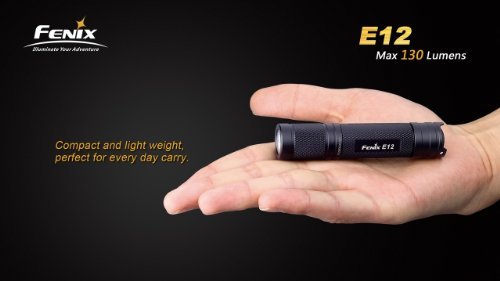
The original model remains a straightforward choice for owners who already have one. Its 8-, 50-, and 130-lumen settings cover close tasks and short outdoor checks. The body is 90 mm long and 19 mm in diameter, with a bare weight of 28.5 g.
The original E12 has no standard pocket clip, magnetic tail, or output memory. A lanyard helps keep it secure, and the recessed switch allows tail-standing on a stable flat surface. Its appeal is simple operation and an easy-to-replace AA cell.
General Features of the Fenix E12 LED Flashlight
Across the family, the common idea is a small aluminum light with one tail control and three useful output levels. The original version uses a total internal reflection lens, reverse polarity protection, and digitally regulated output. Keep those features separate from the V3.0’s magnet and memory, or the V2.0’s shorter body and clip.
Is the flashlight durable enough?
The hard-anodized aluminum body provides a practical combination of strength and low weight. Texturing helps with grip, while the recessed tail switch reduces accidental presses. Neither feature makes the light impossible to drop or damage.
Tail-standing can provide temporary room lighting by bouncing the beam off a pale ceiling. Place the light on a stable surface and keep the lens uncovered. For a long job that needs both hands, a clipped light or headlamp can be more convenient.
 Check Price
Fenix E12 Review – Compact Power for Everyday Use
In this Fenix E12 review, the strongest reason to choose the family is its convenient size. A flashlight you comfortably carry is useful more often than a larger light left at home. The E12 suits quick jobs, walking, and backup lighting; it is less suited to lighting a large open area or searching at long distances.
Bright light with 3 light modes
The three-level design keeps operation simple. Low works for nearby tasks, Medium gives more useful working light, and High is there when you need extra reach. There is no strobe or SOS to cycle past. Whether that is a drawback depends on your intended use.
On the original E12, fully press the tail switch to turn the light on at Low. While it is on, lightly tap the switch to cycle Low, Medium, and High. A partial press from off is not a momentary-on feature on this reverse-clicky design.
For the original 130-lumen E12, the runtime chart separates battery chemistry. With the specified alkaline cell, High is rated for one hour, Medium for 3 hours 30 minutes, and Low for 22 hours. With the specified rechargeable NiMH cell, those figures are 1 hour 30 minutes, 6 hours 30 minutes, and 40 hours. They describe different test batteries, rather than conflicting settings on the light.
NiMH or Alkaline: Two battery options
A compatible 1.2V NiMH AA is a sensible option for repeated use; recharge it outside the flashlight in a suitable charger. A 1.5V alkaline AA is easy to find when traveling or replacing a depleted cell. Never attempt to recharge an ordinary alkaline battery.
Do not substitute a 3.7V rechargeable 14500 lithium-ion cell just because it is a similar size. E12 V2.0 and V3.0 explicitly prohibit it, and it is not an approved substitute for the original E12. Choose a battery chemistry and voltage supported by your exact model.
Carry a spare with its terminals protected, and remove the cell before long storage. A mechanically switched-off light does not prevent an alkaline cell from leaking with age. Our guide to flashlight battery types explains why physical size alone is not enough to establish compatibility.
What are the special features?
The E12 AA light has some special features, but they are practical rather than complicated. Reverse polarity protection helps guard against incorrect insertion. Regulated output helps control brightness as the battery discharges, although it does not mean High remains unchanged until the battery is empty.
Standard packages commonly include a battery, lanyard, spare O-ring, and instructions. The V2.0 and V3.0 have two-way body clips; the original does not. Treat seller bundles as separate from standard model features.
Is the Fenix E12 an EDC flashlight?
Yes. Its short body fits easily in many pockets or small bag compartments. The original is 90 mm long, the V2.0 is 77.6 mm, and the V3.0 is 81.5 mm. These are flashlight dimensions, rather than the dimensions of a shipping box.
Clip-equipped versions make pocket access easier. If you carry the original loose in a bag, keep it where you can find it by feel. Try changing brightness with the hand and grip you normally use before deciding whether the tail-only arrangement suits you.
Built for tough situations
The original E12 has an IPX8 immersion rating; V2.0 and V3.0 are rated IP68, which also specifies dust protection. Their stated water limit is two meters for 30 minutes, and impact resistance is one meter. Those limits do not guarantee survival from every fall or make the E12 a diving light.
Keep the O-ring intact, clear dirt from the threads, and dry the outside before opening the battery compartment. The LEDs are long-life components, but they are not indestructible. Lens damage, worn seals, and battery leakage can still affect a flashlight before the LED reaches its rated service life.
 Check Price
Warranty
Fenix Lighting USA advertises a limited lifetime guarantee, subject to its terms. Repair periods and service arrangements depend on the product, country, and seller. Keep the purchase receipt and use the relevant authorized service channel if the switch or electronics fail.
Related: Fenix LD22 Flashlight Review
Fenix E12 vs. LD12
The LD12 is a separate family, so its output depends on the generation. The earlier LD12 G2 comparison uses a 125-lumen maximum and an 87-meter reach, with a 105 mm body and 21.5 mm diameter. The original E12 is shorter and narrower at 90 by 19 mm, reaches 88 meters, and has three steady outputs.
The LD12’s separate side control and additional outputs offer a different handling experience. Choose on size, controls, and your actual tasks rather than a small difference in maximum lumens. Later LD12 and LD12R specifications should not be applied to that earlier comparison.
Compared with Fenix E11 Flashlight
The E12 is the more flexible general-purpose light compared with the 105-lumen E11 described in its original manual. That E11 offers 105-lumen High and 32-lumen Low with a 72-meter reach. Its head twist selects brightness, while the tail switch handles power and momentary use.
The original E12 adds a dimmer 8-lumen setting and an intermediate 50-lumen setting, with all functions on the tail control. It is also shorter: 90 mm versus 97 mm for that E11. The trade-off is that the E12’s reverse-clicky operation differs from the E11’s momentary-capable switch.
If you mainly need an easy light for nearby tasks, the E12’s third setting is more useful than the modest increase in peak output. If you already have an E11 that meets your needs, those differences alone do not require replacing a working light.
Simple checks if your E12 stops working
Try a fresh compatible AA with its positive end toward the head, then check the cap is properly tightened. Dirty contacts can cause flickering; remove the battery, clean contact points carefully, and let them dry before reassembly. Do not open the sealed head as a routine repair.
If output levels look similar, the battery may be too depleted to support High. Test with a known-good cell before assuming the switch has failed. If there is leakage, corrosion, or damage that prevents safe battery removal, seek service rather than forcing the parts apart.
Summary
The Fenix E12 is a useful everyday light because it keeps size, battery replacement, and operation simple. The V3.0 adds a magnet and memory, the V2.0 offers the shortest body and a predictable Low start, and the original is a straightforward 130-lumen light for existing owners.
Compared with the E11, the extra low setting and compact body make the E12 more adaptable for close work. This Fenix E12 review favors choosing the version whose carrying features and switch behavior suit your habits, rather than treating the highest lumen figure as the only reason to buy.
Frequently Asked Questions
Is the Fenix E12 flashlight waterproof?
The original is IPX8 rated; the V2.0 and V3.0 are IP68 rated. Keep the seals in good condition and stay within the stated immersion limits.
Can the Fenix E12 be recharged by USB?
No. These E12 versions have no built-in charging port. Remove a rechargeable NiMH AA and use a compatible external charger.
Does the Fenix E12 have a pocket clip?
The original model does not include a standard clip. The V2.0 and V3.0 have two-way clips, and the V3.0 also adds a magnetic tail.
Does it remember the last brightness?
The original and V2.0 start at Low. The V3.0 recalls the previously selected output.
Is a 14500 battery suitable?
A 3.7V rechargeable 14500 is not suitable. Use the AA battery types and voltages approved for your model.
Does the light remember the last brightness setting?
No
Mine lasted only about 6 months before the medium and high settings don’t work and only the low works and not all the time either. I’m very disappointed in this and will never buy one. I got this one from winning a contest on a web site so fortunately I didn’t pay anything for it.