Last Updated on November 17, 2026
When it comes to everyday carry (EDC) flashlights, size matters as much as the number on the box. The Klarus Mi7 is short enough for a pocket and can run on a regular AA battery when you are away from a charger. A compatible 14500 lithium-ion cell gives it more punch for checking a dark yard or walking back to the car.
The Mi7 comes in aluminum and titanium versions. Both use a side switch and the same basic set of modes. The titanium Mi7 Ti feels more substantial in the hand, while the aluminum Mi7 makes more sense if you count every gram on your keyring. This Klarus Mi7 review covers both versions and explains what changes when you switch between AA and 14500 power.
If the Mi7’s AA and 14500 battery options aren’t right for you, compare other compact models in our best EDC flashlight buying guide.
Klarus Mi7 Technical Specifications and Build Quality
The standard Mi7 uses hard-anodized 6061-T6 aluminum and weighs 26.4 grams before you add the battery. The Mi7 Ti uses TC4 titanium alloy and weighs about 40 grams without a cell. The extra weight is noticeable on a keyring, even though either version fits into a small pocket. Hard anodizing applies to the aluminum body. The titanium version has its own bare-metal finish.
For a smaller rechargeable keyring option from Klarus, the shopping link below goes to the Klarus Mi2, a 40-lumen light with a built-in battery.

- LED and optics Cree XP-L HI V3, a textured orange-peel reflector, and an anti-reflective mineral glass lens.
- Size 87.2 mm long, with a 19 mm head and a 17.6 mm body diameter.
- Power One alkaline AA, rechargeable NiMH AA, or compatible 3.7 V 14500 lithium-ion cell. The Mi7 has no charging port.
- Peak beam rating 3,025 candela and 110 meters in the manufacturer’s specifications.
- Protection IPX8 water resistance at a rated depth of 2 meters and a 1-meter impact rating.
- Controls A stainless steel electronic side switch, three steady settings, strobe, SOS, lockout, and a battery-level indicator.
The textured reflector softens the transition between the central hotspot and the light around it. That helps when you move the beam from the ground directly in front of you to a door or tree farther away.
Performance, Lighting Modes, and Battery Options
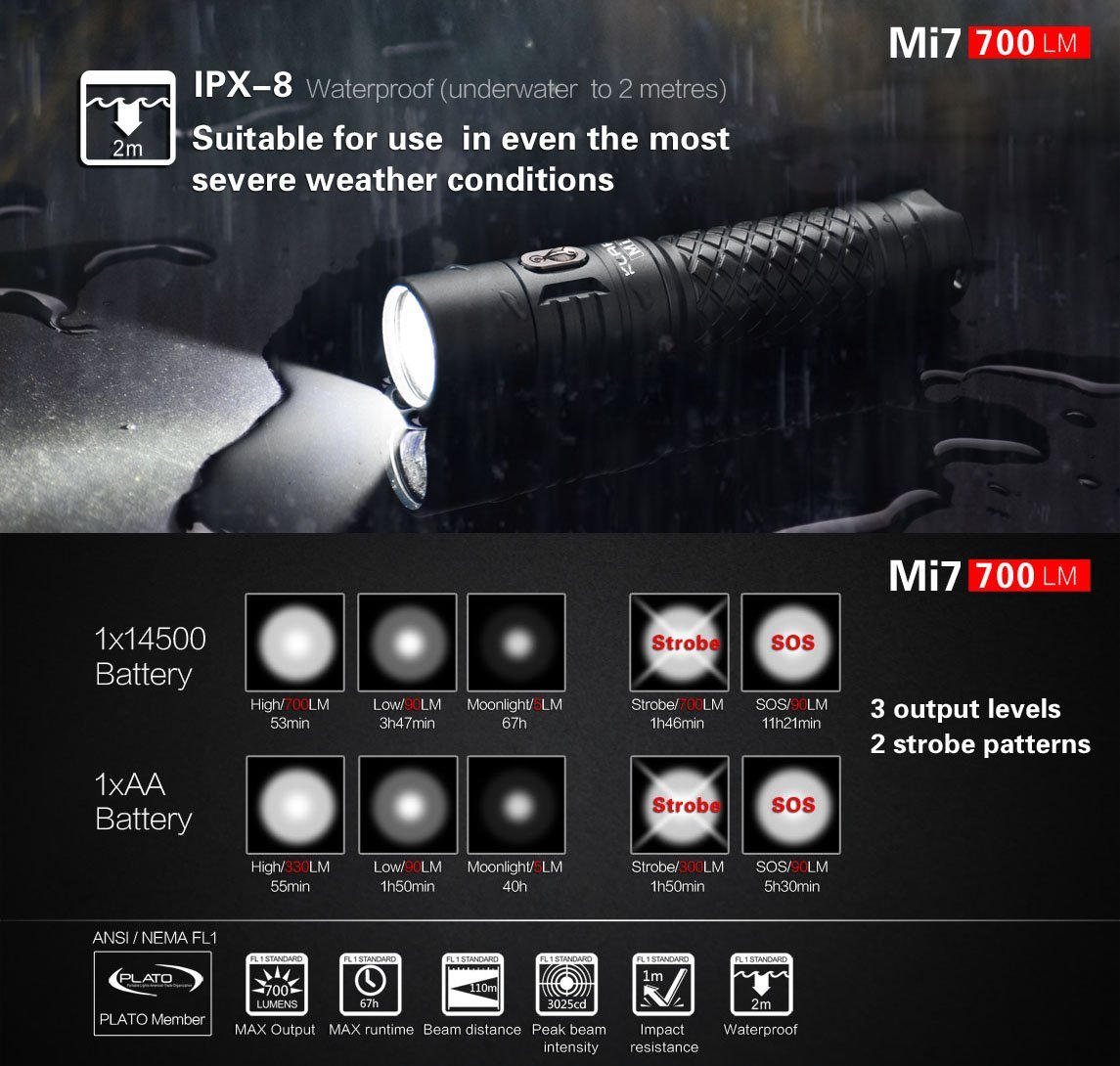
The cell you fit changes how the Klarus Mi7 behaves on High. Klarus rates it for up to 700 lumens with a compatible 14500 and up to 330 lumens with AA power. Low and Moonlight have the same rated brightness on either battery type, so a regular AA still gives you useful settings for walking indoors or working within arm’s reach.
If you’re comparing everyday-carry models that use AA power, our best aa flashlight edc guide covers compact alternatives, battery types, and pocket carry.
| Mode | With 14500 Li-ion | With AA |
|---|---|---|
| High | 700 lumens, 53 min total with step-down | 330 lumens, 55 min |
| Low | 90 lumens, 3 hr 47 min | 90 lumens, 1 hr 55 min |
| Moonlight | 5 lumens, 67 hr | 5 lumens, 40 hr |
| Strobe | 700 lumens, 1 hr 46 min | 300 lumens, 1 hr 50 min |
| SOS | 90 lumens, 11 hr 21 min | 90 lumens, 5 hr 30 min |
Klarus specifies a timed drop in output after about three minutes on High with a 14500. The 53-minute rating covers the rest of that discharge as the beam dims. If you want to keep both hands free while working in one spot, start with Low. Save High for the short stretches when you need more reach.
The 14500 and AA have similar dimensions and different voltages. Use a 14500 only when the light is rated for it and the cell fits without force. Recharge a NiMH AA or a 14500 outside the light with a charger rated for that battery chemistry. An alkaline AA makes a practical backup when traveling. For a dedicated alkaline or NiMH option with a tail switch, see the Fenix E12 version comparison.
The Olight S1A Baton also accepts AA or a compatible 14500. Its broad TIR beam and side-switch controls give it a different feel for close-up work. Related reading on that model is our Olight S1A Review.
Key Features, Durability, and Practical Use Cases
The shopping link on the image below goes to the Klarus XT21X Pro, a larger tactical flashlight built around a 21700 battery.
 Check Price
At 87.2 mm, the Mi7 feels closer to a short pocket light than a tiny twist-head keychain light. It is easy to find by feel if you keep it in one pocket and use the keyring for a short lanyard. The side button sits near the head, so you can reach it without shifting your grip.
Body, Lens, and Battery Contacts
The compact head and glass lens suit pocket carry, and the IPX8 rating is useful in rain or if you drop the light in shallow water. Keep the threads clean and inspect the O-ring if you open the light often. IPX8 refers to the maker’s water test. Worn seals or a loose body can affect the protection.
The image link below also goes to the Klarus XT21X Pro.
 Check Price
Side Switch and Lockout
From off, click once to start on High, click again to go to Low, and click a third time to turn the light off. For Moonlight, start with the light off and hold the button until the dim beam appears. A quick click turns it off again. Double-click for Strobe, then double-click again for SOS. A single click returns you to the previous state.
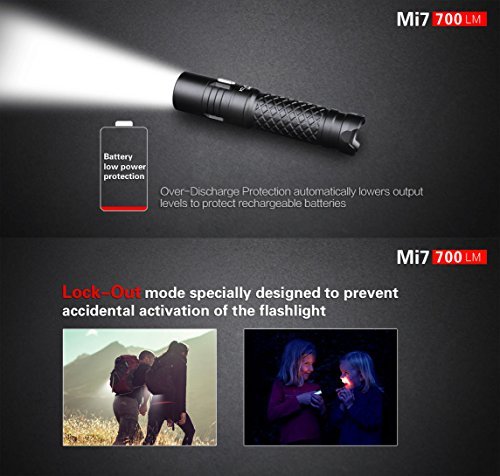
If you carry the Mi7 next to keys, use its electronic lockout. Hold the button for more than five seconds until it flashes twice. Three quick clicks unlock it. With the unlocked light off, a triple-click also checks the battery. The indicator uses three flashes above 70%, two between 30% and 70%, and one below 30%. These are rough ranges, so carry a spare if you are relying on the light for a long trip.
What to Check If the Light Flickers
The circuit includes reverse-polarity protection and lowers output as the cell voltage falls. If the light will not turn on after carrying it in a bag, try the lockout release, then check battery orientation and tighten the body. If a fresh compatible cell still flickers, the push-button flashlight troubleshooting guide shows how to check accessible contacts before considering a switch fault.
Where the Mi7 Works Best
- Night walks Use Low for a lit path and High when you need to check a darker stretch ahead.
- Camping AA power is handy when several people already carry spare AAs. Moonlight is useful inside the tent.
- Reading and close-up work Start from off with the long press so the beam comes on at 5 lumens.
- Signaling Strobe and SOS are available when you need a flashing pattern.
- Daily carry Use lockout in a crowded pocket or keep the light in its own slot in a small bag.
For more reach and a tail switch, the 2000 Lumen Flashlight Klarus XT11GT Review covers the original XT11GT and its newer Pro version. They are better comparisons if you are shopping for a full-size light to use outdoors.
Klarus Mi6 vs Klarus Mi7 Comparison Table:
| Feature | Klarus Mi6 | Klarus Mi7 |
|---|---|---|
| Maximum brightness | 120 lumens | 700 lumens (14500) or 330 lumens (AA) |
| Battery | 1 × AAA | 1 × AA or 1 × compatible 14500 Li-ion |
| Weight without battery | 8 g (0.28 oz) | 26.4 g (0.93 oz) aluminum or 40 g (1.41 oz) titanium |
| Modes | 2 steady settings | 3 steady settings, Strobe and SOS |
| Length | 60 mm (2.36 in) | 87.2 mm (3.43 in) |
| Head diameter | 13.6 mm (0.54 in) | 19 mm (0.75 in) |
| Switch | Twist head | Side button with electronic lockout |
| Rated beam distance | 40 meters | 110 meters |
Choose the Mi6 if you want to forget the light is on your keys. At roughly 60 mm and 8 grams before adding the AAA, it takes up less room and uses a simple twist head. The Mi7 has more beam reach, a lower 5-lumen setting, and controls you can work one-handed. It also has more ways to power it. Those advantages matter most if this will be the light you use every day.
Pros of Klarus Mi7:
- Strong burst output for a single-cell pocket light.
- Easy access to Moonlight and High from off.
- Common AA batteries work when you do not have a charged 14500.
- Side switch includes electronic lockout and a rough battery check.
- Water-resistant body with a glass lens and replaceable O-ring.
Cons of Klarus Mi7:
- Top output requires a compatible 14500 and steps down after a few minutes.
- Rechargeable cells need their own charger.
- The titanium body weighs more than the standard aluminum version.
- There is a sizeable gap between the 5-lumen and 90-lumen settings.
Final Verdict:
The Klarus Mi7 is a good fit for someone who wants a compact light that can fall back on a common AA. If you mainly read, sort gear or check a breaker panel, Moonlight and Low will do most of the work. A 14500 is worth carrying when you occasionally need the extra brightness outside. Pick the lighter aluminum version for a loaded keyring or the Mi7 Ti if you like the finish and do not mind the added weight.
Klarus Mi7 Review: Frequently Asked Questions (FAQs)
Q1: How bright is the Klarus Mi7 flashlight?
It is rated for up to 700 lumens with a compatible 14500 Li-ion cell or up to 330 lumens on High with AA power. Output drops from the 14500 peak during the run.
Q2: What type of batteries does the Klarus Mi7 use?
It takes one alkaline or rechargeable NiMH AA, or one compatible 14500 Li-ion cell. The light itself does not charge the battery.
Q3: Is the Klarus Mi7 waterproof?
Klarus gives it an IPX8 rating at 2 meters. Inspect the O-ring and tighten the body after changing batteries.
Q4: How many lighting modes does the Klarus Mi7 have?
Three steady settings, High, Low and Moonlight, plus Strobe and SOS.
Q5: How long does the Klarus Mi7 battery last?
Klarus rates Moonlight for up to 67 hours on 14500 and up to 40 hours on AA. High with a 14500 has a 53-minute total runtime rating, including the time after step-down.
Q6: What material is the Klarus Mi7 made from?
The standard Mi7 is 6061-T6 aluminum. The Mi7 Ti uses TC4 titanium alloy.
Q7: Is the Klarus Mi7 suitable for daily carry (EDC)?
Yes. It fits easily in a pocket and gives you three steady levels, a side switch and an AA backup option.
Q8: Does the Klarus Mi7 have a lock-out function?
Yes. Hold the side button for more than five seconds to lock it. Press three times quickly to release it.
Q9: How durable is the Klarus Mi7 flashlight?
The manual specifies a 1-meter drop rating and IPX8 at 2 meters. Check the lens, threads and seal after a hard drop.
Q10: How does Klarus Mi7 compare to Klarus Mi6?
The Mi6 is lighter and simpler, with a twist head and a single AAA. The Mi7 gives you more output and more control in a slightly larger body.