Last Updated on November 11, 2026
Fenix UC35 V2.0 Tactical Flashlight Review: Reliable EDC Illumination
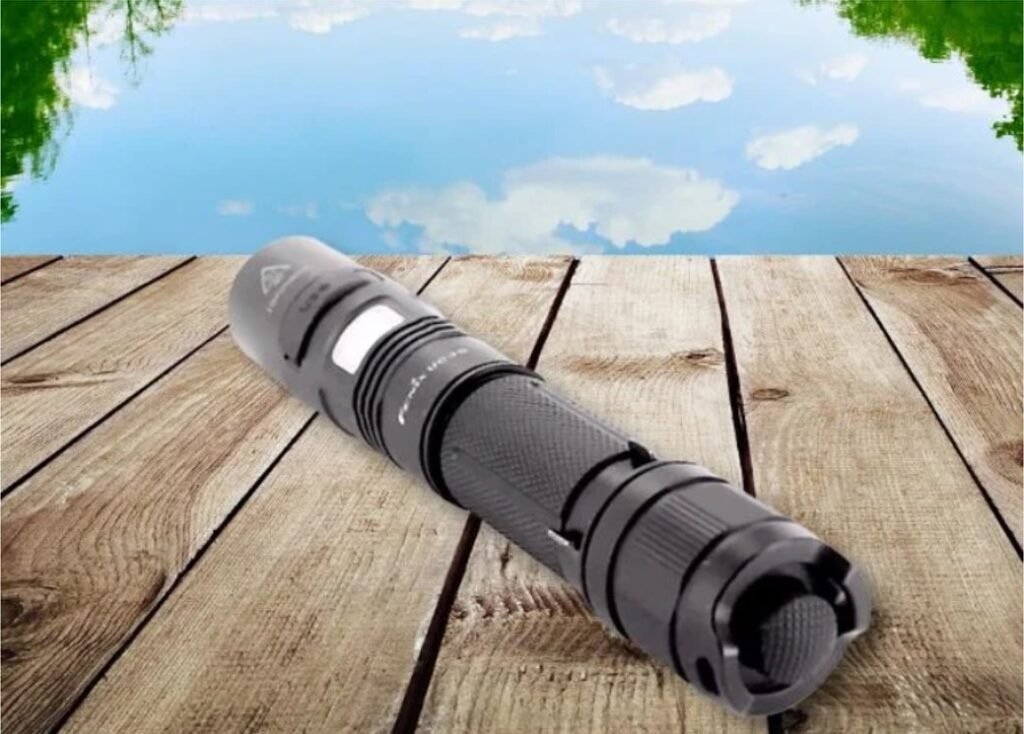
A flashlight earns its place in an everyday carry bag by being easy to use when you need it. The Fenix UC35 V2.0 combines a replaceable battery, a rear power switch, and built-in Micro-USB charging in a slim body. This Fenix UC35 review explains its strengths and compromises for outdoor trips, power cuts, and regular jobs around the home.
The main attractions are its useful range of outputs and the ability to recharge without removing the battery. The main compromise in 2026 is the Micro-USB connector: if the rest of your gear uses USB-C, you will need to carry a different cable. Peak brightness is only part of the decision; low-light usability and charging habits matter just as much.
Compare it with other tactical flashlights if you want a different switch layout or charging connection. Check Price
Built for Tactical and Outdoor Professionals
The UC35 V2.0 suits camping, walking, inspections, and emergency backup. A tail switch makes activation easy to find by feel, while the side switch handles brightness. Its aluminum body and sealed construction are practical for outdoor carry, although the light still needs sensible maintenance after wet or dirty use.
Download Fenix UC35 User Manual
Technical Features of the Fenix UC35 Flashlight
| Fenix UC35 | Output and beam | Lowest setting | Charging and size |
|---|---|---|---|
1. UC35 V2.0 (2018) Check Price |
1000 lumens; 266 m | 1 lumen Moonlight; up to 800 hours on the original runtime chart | Micro-USB; 140 mm long; 89 g without battery; IP68 |
| 2. Original UC35 (2014) | 960 lumens; 200 m | 14 lumens Eco; up to 150 hours | Micro-USB; 150 mm long; 99 g without battery; IPX8 |
These runtime figures describe the lowest settings, which have very different brightness. They do not mean the light can deliver its maximum output for hundreds of hours. Battery capacity, temperature, and the selected setting affect actual runtime.
Fenix UC35 Review: Compact Power with Tactical Precision
Looking for a flashlight that balances power, portability, and tactical performance? This Fenix UC35 review breaks down why it’s a favorite among law enforcement, campers, and everyday users. From its 1000-lumen output to USB rechargeable convenience, the UC35 delivers reliability when it matters most.
1. Fenix UC35 V2.0: the compact rechargeable option
The V2.0 is the version to focus on if you want the UC35’s built-in charging with a much dimmer setting for close tasks. Its Moonlight level can be more useful inside a tent or dark room than another increase in peak lumens. A low setting also keeps reflected light from overwhelming your eyes when you are looking at something nearby.
The 2018 redesign shortened the original body by 10 mm and extended beam reach. For owners of the earlier UC35, those are more meaningful differences than the small change from 960 to 1000 lumens. If the original already handles your usual tasks, an upgrade is mainly about size, low-light control, and the charge indicator.
Durable Construction & Premium Design
The UC35 V2.0 uses a hard-anodized aluminum body and a toughened glass lens with an anti-reflective coating. Textured areas help with grip, and the clip reduces rolling on a flat surface. They cannot prevent every slip or stop the flashlight from moving down a slope.
A clip is convenient for quick access; a holster is often more comfortable when walking or working for longer periods. Before relying on a pocket fit, remember that the tail switch can be pressed by other objects in a bag. A lanyard is useful when you might drop the light near water.
Brightness and Light Output
The Cree XP-L HI V3 LED delivers up to 1000 lumens with a rated 266-meter reach. Its concentrated beam helps when checking along a trail or across a yard. That distance is a laboratory rating, rather than a promise of clear identification at 266 meters.
- Turbo: 1000 lumens — for brief checks at greater distances.
- High: 350 lumens — for outdoor tasks needing a stronger beam.
- Medium: 150 lumens — a useful starting point for general work.
- Low: 50 lumens — for nearby tasks with less glare.
- Moonlight: 1 lumen — for moving around a dark room or reading close up.
- Strobe: 1000 lumens — a separate flashing output.
The original 3500mAh runtime chart gives Turbo 2 hours 15 minutes, High 4 hours 10 minutes, Medium 10 hours 40 minutes, Low 28 hours 10 minutes, and Moonlight 800 hours. Turbo time includes reduced output as protection takes effect. Battery packages changed over the product’s life; a 3400mAh package can have different runtime figures, including a 750-hour Moonlight rating.
For most ordinary jobs, start below Turbo and increase only when needed. A lower output can make details easier to see up close, keep the body cooler, and save battery power. Strobe should not be treated as guaranteed protection against an attacker.
Rechargeability and Battery Options
The Fenix UC35 V2.0 uses one compatible rechargeable 18650 lithium-ion battery or two disposable 3V CR123A lithium batteries. Earlier packages included a 3500mAh cell; later manufacturer packages specify 3400mAh. Choose a recommended compatible button-top cell: flat-top 18650s do not work in this light.
CR123A cells are an operating backup, not a charging option. Never connect the charging cable with disposable CR123A batteries installed. Use two matching fresh cells rather than mixing brands, ages, or charge levels. Rechargeable 16340/RCR123 batteries are not interchangeable with disposable CR123A cells unless the manufacturer explicitly approves them.
- Install the compatible rechargeable 18650 with its positive end toward the head, tighten the tailcap, and switch the light off.
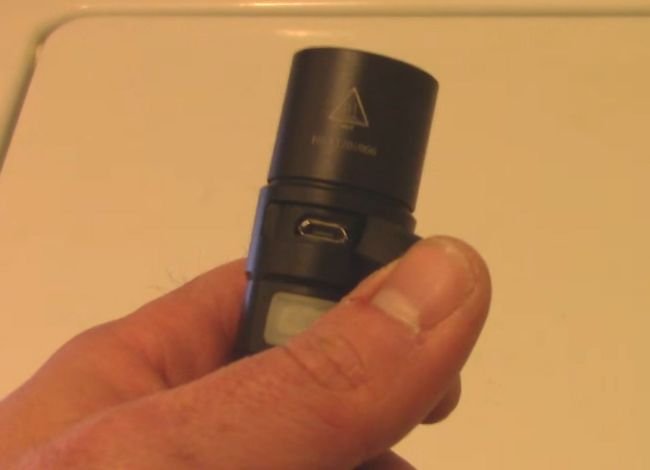
- Open the port cover and connect a Micro-USB cable to a suitable USB supply.
- Look for red while charging and steady green when charging is complete.
- Unplug the cable and close the cover after charging.
Allow roughly three to four hours for a normal full charge, depending on the cell and power source. Only Low output is available during charging, and using it extends charging time. For a more detailed walkthrough, see charging your UC35 and fixing common charging problems.
Tactical Features for Emergency Use
Half-press the tail switch for momentary light and release to turn it off. Fully press it for constant-on, then press again to switch off. With the light on, tap the side switch to move through the steady brightness levels. Hold that switch for about half a second to enter strobe, then tap to return to ordinary lighting.
The UC35 V2.0 remembers the last steady brightness level. If you last used Turbo, expect a bright start the next time you turn it on. Set a lower level before switching off when you know your next task will be indoors.
Related article: Fenix UC30 Review: USB Rechargeable LED Flashlight For a closer look at the differences in handling and charging, our UC30 and UC35 comparison covers those two families.
Polarity Protection and Safety Functions
Reverse polarity protection helps guard against incorrect battery insertion. It does not make every battery chemistry or size suitable. Digitally regulated output helps control brightness, while thermal protection reduces output when the light becomes too hot. Low charge can also cause a step down.
A gradual reduction during a long Turbo session can therefore be normal. Let the light cool before trying a higher setting again, and recharge a depleted cell. Avoid covering the lens while the flashlight is on inside a pocket or bag; high output produces heat.
Built-in Battery Status Indicator
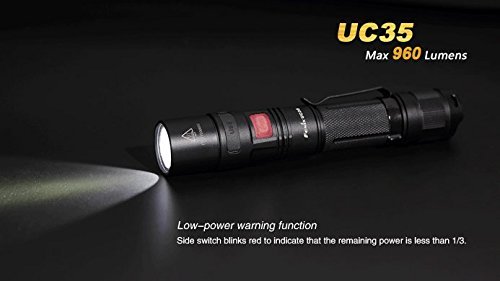
With a compatible 18650 fitted, the side-switch indicator shows charge status briefly at startup. Steady green means a high charge, flashing green means sufficient charge, steady red means low charge, and flashing red means the battery needs attention soon. The indicator and rechargeable-cell low-voltage warning do not operate normally with disposable CR123A batteries.
Treat the colors as a quick guide rather than an exact runtime forecast. Before a long walk or an evening job, recharge and carry a suitable backup if losing light would leave you stranded.
 Check Price
Waterproof and Impact Resistant for Rugged Use
The Fenix UC35 V2.0 has an IP68 rating and a specified immersion limit of two meters for 30 minutes. It is also rated for one-meter impacts. These are test limits; a drop onto a sharp surface can still damage the lens or seals.
Inspect the O-ring and keep the threads clean. Dry the outside before opening the battery compartment, and close the charging cover after use to keep dirt out of the port. This is a practical rain-and-splash light, rather than a dedicated diving flashlight.
Compact and Ideal for Everyday Carry
The UC35 V2.0 measures 140 mm long with a 25.4 mm head and weighs 89 g without its battery. Add the battery when judging carry weight. Its shape suits a jacket pocket, belt holster, or backpack side compartment, although smaller lights may be more comfortable in light trousers.
It is useful for walking the dog, checking a dark cupboard, or lighting a roadside repair. If you need both hands free for a long task, a headlamp may be more convenient. For a handheld light, practice finding both switches before you need them in darkness.
Troubleshooting Common Issues
Start with the battery, contacts, and tailcap before assuming the electronics have failed. Check that any shipping insulation has been removed. Avoid opening the sealed head or adjusting internal retaining parts as a routine repair.
| Problem | First checks | What to do |
|---|---|---|
| Will not turn on | Battery orientation, charge, compatibility, and tailcap tightness | Fit a known-good compatible cell with positive end toward the head. |
| Will not charge | Rechargeable 18650 installed; cable and USB supply working | Switch off and try a known-good cable and supply. Do not force the connector. |
| Flickers | Loose cap or dirty contacts | Remove the battery, clean contact points, and let them dry before reassembly. |
| Drops from Turbo | Heat or low charge | Allow cooling and recharge as needed. |
| Battery runs down quickly | High output, worn cell, or accidental activation | Use a lower level; test a compatible replacement cell. Remove the battery for extended storage. |
A green charging indicator does not by itself diagnose a failed battery. If basic checks do not resolve the problem, contact the seller or authorized service center. For transport, loosen the tailcap enough to break electrical contact or remove the battery.
2. Original Fenix UC35: what changes from V2.0?
The original 2014 UC35 uses a Cree XM-L2 U2 LED and reaches 960 lumens with a 200-meter beam. Its lowest Eco output is 14 lumens, rather than the V2.0’s 1-lumen Moonlight mode. That makes the earlier model less suited to very dim close-up lighting, even though it is still useful for ordinary outdoor tasks.
Its body is 150 mm long and weighs about 99 g without the battery. It also charges through Micro-USB and accepts a compatible 18650 or two CR123A cells for operation. Use the original model’s manual for charging and controls rather than assuming every instruction for the V2.0 is identical.
Fenix PD35 V2.0 vs. Fenix UC35 V2: Quick Comparison
| Fenix UC35 comparison | UC35 V2.0 | PD35 V2.0 |
|---|---|---|
| Maximum output | 1000 lumens | 1000 lumens |
| Beam distance | 266 m / 873 ft | 250 m / 820 ft |
| Built-in USB charging | Micro-USB | No |
| Lowest output | 1 lumen | 3 lumens |
| Length; bare weight | 140 mm; 89 g | 138 mm; 88 g |
| Rechargeable battery | Compatible 18650; standard manufacturer package includes one | Compatible 18650; package contents vary |
Choose the UC35 V2.0 if charging the battery inside the flashlight matters to you. Choose the PD35 V2.0 if you already have a suitable charging arrangement and prefer that model. The newer PD35 V3.0 is a separate comparison; see our PD35 version-by-version review before applying its specifications to the V2.0.
Final Verdict: Should You Buy the Fenix UC35 V2.0?
The Fenix UC35 V2.0 makes sense if you want replaceable-battery convenience, a rear power switch, and a genuinely dim Moonlight setting. Its Micro-USB connection is the main point to weigh against your current charging gear. If USB-C or a much smaller body is essential, compare other options before choosing.
 Check Price
This Fenix UC35 review comes down to everyday usability: enough reach for outdoor checks, low outputs for close tasks, and a battery you can replace. Existing owners with a healthy light and battery need not upgrade simply because newer models advertise more lumens.
Related: EDC flashlight buying guide
Frequently Asked Questions (FAQs)
How bright is the Fenix UC35 V2.0?
Its maximum is 1000 lumens, with a rated reach of 266 meters. Use lower outputs for nearby tasks; Turbo is affected by heat and battery condition.
Does the UC35 V2.0 use USB-C?
No. It has a Micro-USB charging port. Use the correct cable and a compatible rechargeable 18650, and never try to recharge disposable CR123A cells.
How many lighting modes does it have?
It has five steady levels plus strobe. Moonlight is the 1-lumen setting, which is different from the original UC35’s 14-lumen Eco level.
Can I use any 18650 battery?
No. The cell must meet the manufacturer’s compatibility requirements; flat-top cells do not work in the UC35 V2.0. Capacity alone does not establish compatibility.
Is the Fenix UC35 V2.0 waterproof?
It is IP68 rated with a two-meter, 30-minute immersion specification. Keep seals intact and inspect the light after damage; that rating does not make it a diving light.