Last Updated on November 12, 2026
If you hike, camp, or use a flashlight around the house, you probably want a light you can get working quickly. In this Coast HP7 review, I’ll explain why I’ve kept using this flashlight on trips. The slide focus lets you widen the beam around camp and narrow it when you need to check the path ahead. You can do both with one hand.
The HP7 keeps things simple with a rear switch, an aluminum body, and four replaceable AAA batteries. Coast has sold the HP7 with several output ratings, so a runtime or beam distance only makes sense alongside the brightness rating for that version. I’ve kept the 530-lumen and 730-lumen figures separate below.

Coast HP7 Review: Technical Specifications
Coast’s 530-lumen catalog version reaches a rated 175 meters on High and runs up to nine hours on Low. The 730-lumen version reaches a rated 202 meters on High and runs up to eight hours on Low. To compare the two versions in this Coast HP7 review, start with the mode you use most. Low on the 730-lumen version is brighter, so the eight- and nine-hour ratings are for different light levels.
| Feature | 530-lumen HP7 | 730-lumen HP7 |
|---|---|---|
| High | 530 lumens 175 m 1 hr 30 min | 730 lumens 202 m 2 hr 30 min |
| Medium | 250 lumens 120 m 5 hr | 390 lumens 147 m 3 hr 15 min |
| Low | 70 lumens 60 m 9 hr | 115 lumens 79 m 8 hr |
| LED and focus | White LED with Pure Beam optics, Slide Focus and Beam Lock | |
| Controls | Tail switch for three steady output levels | |
| Batteries | Four AAA cells in a removable cartridge. Four cells supplied in the documented kits. | |
| Body | Aluminum | |
| Length | 5.6 in (14.2 cm) | |
| Weight | 7.2 oz (204 g) | |
| Water resistance | IPX4 for the 530-lumen model | IP54 for the 730-lumen model in Coast’s Finnish specifications |
If your package says 360 lumens, use its own ratings. Coast’s chart for that version gives a 226-meter beam and 1 hour 45 minutes on High, and up to 19 hours at 50 lumens on Low. A 410-lumen HP7 has also been sold with a rated 229-meter beam and two hours on High. Coast’s older two-mode HP7 was rated at 251 lumens on High. The name HP7 alone won’t tell you which settings or ratings apply. Comparing lumens alone can give you the wrong idea about which HP7 reaches farther or lasts longer.
Before using the figures in this Coast HP7 review, check the lumen rating on your package and count the brightness settings with a fresh set of batteries. Older catalogs used some of the same item numbers for HP7s with different ratings, so the brightness on the packaging is a better guide than the item number alone. A rated beam distance is measured under test conditions. On a trail, how far you can make out a root or trail marker also depends on the surface, weather and the amount of light around you.
Coast HP7 Review 2026: Features and Field Use
Sturdy Aluminum Construction
The HP7’s aluminum body has enough room for a full grip, and the textured surface helps when your hands are damp. The shape of the tail cap helps keep the light from rolling when you set it down. Look for a flat spot before standing it on end, especially on a picnic table or a rock.
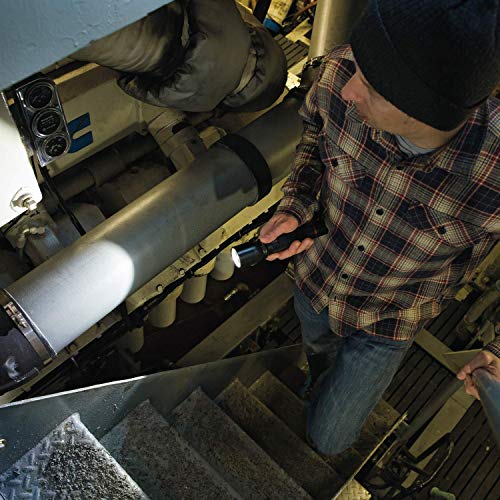
The rear switch is easy to find by feel. You can turn the light on with your thumb and slide the head with your other fingers. That’s useful when your other hand is holding a map or working a tent zipper.
Pure Beam Focusing Optic
Slide the head forward to narrow the beam into a spot. Pull it back for a wide flood beam. The flood is useful when looking around a campsite or sorting gear. A tighter spot is better for checking a trail sign or the far side of a yard. The slider changes where the light falls. The tail switch changes how much light the flashlight puts out. Try the middle of the slider’s travel for a walk where you need to see both the ground by your feet and the next bend.
On HP7 versions with Beam Lock, set the beam first, then twist the head to the left to hold it there. Twist right to release the lock before sliding it again. You can lock an in-between position if you want some reach and enough spill to see the ground in front of you.
Three Light Output Modes
The 530- and 730-lumen versions above have High, Medium and Low. Use High for a brief look into the distance, Medium for general walking, and Low when you need the light to last. Even 70 lumens can feel bright when it’s pointed straight at a map inside a dark tent. Widen the beam and aim near the edge of the page to cut the glare.
Use the tail switch to cycle through the settings. On units with momentary operation, a partial press lights the beam while you hold the button, and a full click keeps it on. Some earlier HP7 instructions describe only High and Low, with the switch returning to High after more than five seconds off. If you want Low on that two-mode switch, cycle through High, then Off, then Low without pausing. If your light cycles through two settings, check its own instructions before assuming the switch is faulty.

Real-World Performance
I’ve stood the HP7 on its tail cap as a small upward light during overnight hikes. In flood mode it’s useful for sorting gear around camp. On the trail, a wide beam lets you see your footing, and a spot helps when you need to see farther. The white beam is cool in tone. Wet ground can reflect a strong spot back toward you, so try Medium or a wider beam when High makes it harder to see.
If you’re comparing another slide-focus light, the PeakPlus Super Bright LED flashlight offers a different battery setup with a removable rechargeable cell and a separate charger. For a dedicated long-distance beam, the Nitecore P12GT Review covers a fixed reflector that concentrates more light into a smaller spot.
Compact and Lightweight Design
At about 5.6 inches and 7.2 ounces, the HP7 is easy to grip and fits in a daypack or tool bag. It’s a tight fit in some slim jeans, particularly at the wider head. If you carry it every day, try it in the pocket or sheath you actually use. For a light that shares a pocket with keys, our comparison of smaller AAA flashlights covers options that use fewer cells.
 Check Price
Impact and Water Resistance
I’ve used the HP7 in rain and dropped it a few times on rocky ground without damage. Those are observations from my own light. The IPX4 rating of the 530-lumen version describes splash resistance. The IP54 rating published for the 730-lumen version in Finland also addresses dust ingress. Both water ratings are for splashes. Keep the tail cap closed in the rain and avoid immersion.
If the light gets muddy, wipe the outside with a damp cloth and dry the area around the tail cap before opening it. If the head feels stiff, check that Beam Lock is released and clear any visible grit before trying the slider again.

Power Source and Battery Efficiency
The standard HP7 uses four AAA alkaline cells in a removable holder. To change them, switch the light off, unscrew the tail cap and slide out the cartridge. Fit a fresh set according to the polarity marks. On the holder with a red end, slide that end in first, then tighten the cap. Our guide to changing the batteries in a Coast HP7 shows the cartridge steps in more detail.
The four-AAA HP7 has no charging port for the cells in its holder. Use the battery type specified for your unit. If Coast explicitly approves rechargeable cells or a pack for your version, charge them as their instructions specify. The HP7R has its own rechargeable system and instructions. A battery pack listed for the HP7R can look like a shortcut, so check the exact model name on the compatibility list before buying a spare.
Medium lasted several hours on one of my weekend hikes. For a long outing, use the runtime for your usual setting when packing batteries. The listed runtime is a test rating, and the beam can grow weaker before the light goes out. When the path ahead becomes harder to read, swap in a fresh set before you need to depend on High. Carrying a spare set of AAAs can keep the light running away from an outlet. Replace all four batteries together, and remove alkalines if you’ll store the light for months. If it still flickers with fresh cells, check the cartridge orientation and that the tail cap is fully seated. The Coast flashlight troubleshooting guide covers what to check next if the switch or contacts still give you trouble.
Customer Support & Warranty
Coast’s U.S. limited lifetime flashlight warranty covers manufacturing defects for the original purchaser. Wear, misuse and battery-related damage such as leakage fall outside that coverage. If you need to file a request, have the model details and a short description of the problem ready for Coast’s warranty form. The claim takes a few steps, so I’d check the batteries and the holder first if the light suddenly goes out.
Conclusion – Coast HP7 Review Verdict
After using the HP7 on hikes and around camp, I’d choose it for the adjustable beam and the ability to carry spare AAAs. The light makes sense for a daypack, a toolbox or a home emergency drawer. If you want a much smaller light or one you can recharge between jobs, our Coast flashlight comparison covers the pocket-sized HX5 and the rechargeable HP3R penlight alongside the HP7.
Pros
- Aluminum body with a textured grip and anti-roll tail cap.
- One-handed Slide Focus and a lock for keeping the beam where you set it.
- Three useful steady settings on the 530- and 730-lumen versions.
- Replaceable AAA cells and a Low mode for longer use.
Cons
- The four-AAA configuration has no in-body USB charging.
- The wide head can feel bulky in a slim pocket.
- The versions in the table have no dedicated strobe or SOS setting.
- Output and runtime ratings vary between HP7 versions.
See the Coast HP7 on Amazon.
Frequently Asked Questions (FAQs)
1. How bright is the Coast HP7 flashlight?
The two versions in this Coast HP7 review are rated at 530 and 730 lumens on High. Their corresponding beam distances are 175 and 202 meters. Look for the lumen rating on your own packaging before using the chart.
2. Is it waterproof?
Use it in rain or around splashes with the cap secured. The IPX4 and IP54 ratings listed above do not cover immersion.
3. Can I use rechargeable batteries?
Coast specifies four AAA alkaline batteries for the standard cartridge. Use rechargeable power only if the instructions for your specific HP7 approve it, and use the charging method for that cell or pack.
4. How many light modes does it have?
The 530- and 730-lumen versions in the table have High, Medium and Low. Some earlier HP7 instructions describe a two-mode High/Low switch.
5. Is it suitable for tactical or emergency use?
It’s useful for a power outage, a roadside inspection or a walk in the dark. If your work depends on direct access to a specific brightness or a dedicated strobe, check the switch layout before choosing a light for that job.
6. Does it come with batteries included?
Coast included four AAA batteries in the kits documented for both versions in the table. Match the polarity marks on the holder when fitting the batteries.
7. Is there a belt holster or carrying case?
Coast included a sheath with some older boxed HP7 kits. Its U.S. specifications name the S40 as a compatible sheath for the 730-lumen version. Check the contents of your particular kit if you need one for belt carry.