Last Updated on November 11, 2026
If you’re looking for a compact, durable flashlight that works for everyday carry and outdoor activities, the Fenix LD22 V2.0 deserves your attention. This upgraded model produces up to 800 lumens, reaches 214 meters, and offers something particularly useful: a choice between a rechargeable battery pack and ordinary AA batteries.
That’s a meaningful improvement over older LD22 models. You can use the rechargeable pack for maximum brightness and keep AA batteries as a backup when charging isn’t convenient.
In this Fenix LD22 V2.0 review, we’ll examine its brightness, battery life, controls, construction, strengths, weaknesses, and how it compares with older flashlights. We’ll also look at whether it’s still a worthwhile purchase in 2026.
Why Choose the Fenix LD22 V2.0?
The LD22 V2.0 stands out because it combines the convenience of a rechargeable flashlight with the flexibility of replaceable batteries.
Many compact lights rely entirely on proprietary rechargeable cells. The LD22 V2.0 gives you another option when you’re camping, traveling, or preparing an emergency kit.
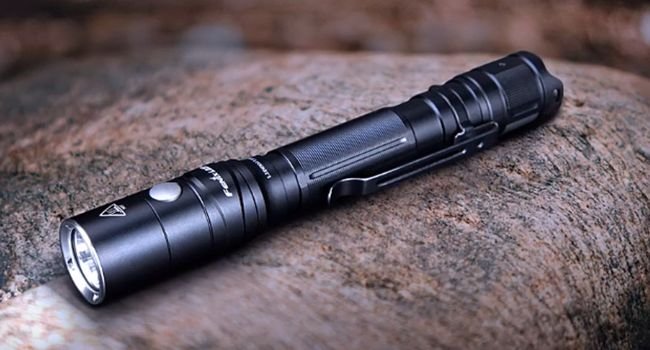
It also features a slim aluminum body, a reversible pocket clip, and separate switches for turning the light on and changing brightness.
If you prefer an even smaller flashlight powered by a single AA battery, read our Fenix E12 review.
Fenix LD22 V2.0 Technical Specifications
| Feature | Fenix LD22 V2.0 |
|---|---|
| Maximum Brightness | 800 lumens with compatible rechargeable battery pack |
| Maximum Output With AA Batteries | 350 lumens |
| Maximum Beam Distance | 214 meters |
| Maximum Runtime | Eco: up to 319 hours with 1600mAh pack; 220 hours with original 1100mAh pack |
| LED | Luminus SST20 WXS |
| Color Temperature | Approximately 6000K |
| Light Modes | Eco, Low, Medium, High, Turbo, Strobe, SOS |
| Battery | Rechargeable Li-ion pack or two AA alkaline/NiMH batteries |
| U.S. Rechargeable Pack | Fenix ARB-L14-1600U2, 1600mAh |
| Charging | USB-C port on removable battery pack |
| Switches | Tactical tail switch and functional side switch |
| Material | A6061-T6 aluminum alloy |
| Waterproof Rating | IP68 |
| Impact Resistance | 1 meter |
| Length | 148 mm (5.83 inches) |
| Head Diameter | 21.5 mm (0.85 inches); body diameter 18 mm (0.71 inches) |
| Weight | About 99g (3.49 oz) with 1600mAh pack; original 1100mAh configuration about 96g (3.39 oz) |
| Carrying Options | Reversible pocket clip, holster, lanyard |
| Warranty | Fenix limited lifetime service policy; conditions apply |
The Fenix LD22 V2.0 uses a long, removable battery pack that occupies the space otherwise taken by two AA cells. Earlier packs are labeled ARB-L14-1100U; the 1600mAh version is ARB-L14-1600U2. Read that label before comparing battery life or buying a spare. The battery choice changes runtime, while the flashlight’s basic controls remain the same.
Fenix LD22 V2.0 Review: Performance and Everyday Use
The Fenix LD22 V2.0 is a versatile flashlight with enough brightness for many common jobs. Its slim design makes it easy to carry, while the different power options give it an advantage over rechargeable-only models.
The combination of a focused central hotspot and surrounding spill makes it useful for walking trails, checking around a house, or searching inside a vehicle.
Dual-Switch Operation
One of the most useful features of the LD22 V2.0 is its two-switch design.
The tail switch turns the flashlight on or off and supports momentary activation. The side switch changes brightness while the flashlight is on.
You can cycle through five regular settings: Eco, Low, Medium, High, and Turbo.
Holding the side switch for approximately half a second activates the flashing modes. Another click switches between Strobe and SOS. Hold it for another half second to return to the previously used steady mode.
Unlike some tactical flashlights, the LD22 V2.0 does not use separate Tactical and Duty operating groups.
The memory function recalls the previously selected regular brightness setting, excluding Strobe and SOS. If you prefer a gentle start indoors, select Eco or Low before switching it off. Momentary operation is a light press on the tail button; a full click keeps the flashlight on until you click it again.
Compact Design and Build Quality
The LD22 V2.0 uses an A6061-T6 aluminum body with a hard-anodized finish. This helps protect it against daily wear and scratches.
The 148 mm length is easy to accommodate in a work pocket or bag, while the 18 mm body keeps the grip slim. It is still longer than a single-AA pocket light. The head is 21.5 mm across, so check both the length and head size when deciding whether it will fit your usual pocket.
The reversible pocket clip is another practical detail. It lets you change the carrying orientation depending on where you want to attach the flashlight.
Brightness and Beam Performance
The maximum 800-lumen output is impressive for a flashlight with this narrow body.
Fenix rates its maximum beam distance at 214 meters. However, this is a standardized measurement, not a guarantee that you’ll clearly identify every object at that distance.
Its combination of hotspot and spill provides useful lighting for everyday activities without requiring a large reflector.
Fenix LD22 V2.0 Brightness Modes and Runtime
Battery type makes a significant difference to the LD22 V2.0’s output. With the appropriate rechargeable pack, Turbo can reach 800 lumens. Two ordinary AA batteries limit maximum output to 350 lumens.
| Mode | Output | Two AA alkaline cells | ARB-L14-1100U pack | ARB-L14-1600U2 pack |
|---|---|---|---|---|
| Eco | 2 lumens | 190 hours | 220 hours | 319 hours |
| Low | 30 lumens | 19 hours 45 minutes | 22 hours 20 minutes | 32 hours |
| Medium | 100 lumens | 5 hours 50 minutes | 7 hours | 10 hours |
| High | 350 lumens | 1 hour 15 minutes | 1 hour 40 minutes | 2 hours 30 minutes |
| Turbo | 800 lumens with pack; unavailable with AA | Unavailable | 54 minutes | 1 hour 20 minutes |
| Strobe | 350 lumens with AA; 800 with pack | Not specified | Not specified | Not specified |
| SOS | 100 lumens | Not specified | Not specified | Not specified |
The 1100mAh and AA figures describe the original battery configuration; the 1600mAh figures describe the higher-capacity pack. These are rated total runtimes, not promises of unchanged brightness until the battery is empty. In particular, Turbo includes reduced output as heat or battery voltage limits performance. Battery age, temperature and repeated high-output use affect what you get on a trip.
For most daily tasks, Medium provides a sensible balance of illumination and power consumption. Eco is useful when you only need a little light for an extended period. A long Eco rating refers to just 2 lumens, so it should not be compared directly with another light running at a much brighter minimum setting. Choose the setting that gives you enough detail for the task, then keep the higher levels for brief checks farther away.
Rechargeable Battery vs. AA Batteries
Battery flexibility is one of the strongest reasons to consider this flashlight.
USB-C Rechargeable Battery Pack
The current U.S. model includes a Fenix ARB-L14-1600U2 lithium-ion battery pack with a USB-C charging port.
To recharge it, remove the battery pack from the flashlight and connect a USB-C cable directly to the battery.
The indicator on the battery is red during charging and blue when the process is complete. The original 1100mAh pack has an approximately four-hour charging estimate. Use the indicator and instructions supplied with the particular pack rather than applying that estimate to every battery capacity.
Important: The flashlight body itself does not have a USB-C charging port.
Using Two AA Batteries
The LD22 V2.0 can also use two AA alkaline or NiMH batteries.
That’s useful when you’re away from a charging source or want easily available replacement batteries for emergencies.
However, Turbo mode is unavailable with ordinary AA batteries, and maximum output is approximately 350 lumens.
Never attempt to recharge disposable alkaline batteries. Recharge NiMH cells only with a compatible external charger.
Fenix LD22 V2.0 vs. Earlier LD22 Models
The updated flashlight brings several improvements over previous LD22 generations. The biggest changes are the higher maximum brightness, longer beam distance, and rechargeable battery option. The older family includes several revisions; the 300-lumen 2015 model is the one compared in the table below.
| Feature | LD22 2015, 300-Lumen Version | LD22 V2.0 |
|---|---|---|
| Maximum Brightness | 300 lumens | 800 lumens with rechargeable pack |
| Battery | Two AA | Rechargeable pack or two AA |
| Charging | External AA charger if using NiMH | USB-C on rechargeable battery pack |
| Maximum Beam Distance | 120 meters for the 300-lumen 2015 model | 214 meters |
| Water Resistance | IPX8 | IP68 |
| Controls | Tail and side switches; separate Outdoor and Tactical groups | Tail power switch and side output switch; one regular output sequence |
The LD22 V2.0 makes more sense for buyers who want modern rechargeable convenience but still value standard AA battery compatibility.
Earlier LD22 G2 and 300-lumen versions
The earlier LD22 G2 and the 300-lumen LD22 are different from the 800-lumen V2.0. Their AA power and familiar shape remain useful for owners, but their controls, brightness and battery requirements should be matched to the particular revision. The earlier G2 promotional image below belongs to that older family.
 View Original LD22 Listing
The 300-lumen 2015 LD22 has Outdoor and Tactical operating groups. In Outdoor mode, the side switch selects the regular brightness levels. Tactical mode uses the tail switch for Turbo, Strobe and Mid; holding the side switch for about three seconds changes operating groups. That group-switching procedure is for the older model, rather than the V2.0 described above.
The V2.0 rechargeable pack should not be assumed compatible with an earlier LD22 simply because both bodies hold two AA batteries. Use the battery types approved for the generation you own.
Fenix LD22 V2.0 vs. Fenix LD20
The older Fenix LD20 is another popular AA-powered model, but it belongs to an earlier flashlight generation.
The LD20 came in several LED revisions, with different maximum-output ratings. It is an earlier two-AA design rather than an 800-lumen rechargeable-pack light. Match the emitter and manual if you are comparing an LD20 you already own.
The LD22 V2.0 also offers a modern rechargeable battery option and additional lighting flexibility.
However, the LD20 may still serve as a simple backup flashlight if you already own one.
Original LD20 and LD22 product images:
 View Original LD20 Listing
 View Original LD22 Listing
Fenix LD22 V2.0 vs. Nitecore MT2A and MT2A Pro
The Nitecore MT2A is another slim AA-powered flashlight worth considering. Both designs offer the convenience of commonly available batteries.
However, MT2A specifications vary by generation, so comparing an older 345-lumen MT2A with a newer model can be misleading.
The newer MT2A Pro also combines a removable USB-C rechargeable battery with two-AA compatibility. Its NL1416R pack supports a 1000-lumen maximum and rated 255-meter reach. It has three brightness levels selected with one tail switch. That makes the rechargeable-plus-AA arrangement a shared feature, rather than a unique LD22 advantage.
The LD22 V2.0 instead offers separate power and output switches, a 2-lumen Eco setting, and Strobe/SOS. Choose it if those controls and very low output are useful to you. Compare the MT2A Pro if you prefer a simpler three-level interface and a stronger maximum beam. Each rechargeable pack belongs to its own supported flashlight system; do not swap packs between brands.
For more comparisons between the brands, see our Fenix vs. Nitecore flashlight guide.
Where Does the Fenix LD22 V2.0 Work Best?
- Everyday Carry: Its slim body and pocket clip make it easy to keep in a bag or work pocket.
- Camping: Multiple brightness settings provide flexible lighting around a campsite.
- Hiking: The 214-meter rated beam offers useful reach along dark trails.
- Emergency Kits: AA compatibility provides an alternative when USB charging isn’t available.
- Home Maintenance: Medium and High settings help illuminate darker work areas.
- Nighttime Work: The tail switch provides quick momentary lighting when needed.
Durability and Waterproof Performance
The LD22 V2.0 has an IP68 rating, providing dust protection and resistance to immersion under the manufacturer’s specified conditions, including depths of up to two meters. This does not replace checking that the cap is fully seated and its sealing ring is intact.
Its aluminum body is also impact-resistant to one meter.
That makes it suitable for rain and ordinary outdoor use, but damaged seals or loose battery caps can compromise protection.
Inspect the O-rings periodically and avoid opening the battery compartment while the flashlight is wet. Dry the outside before changing batteries so that droplets do not fall into the tube. Replace a damaged seal with an approved spare, and keep dirt off the cap threads when opening it outdoors.
Common Fenix LD22 V2.0 Problems and Troubleshooting
| Problem | Possible Cause | What to Check |
|---|---|---|
| Flashlight won’t turn on | Low battery or incorrect installation | Charge or replace batteries and verify polarity. |
| Turbo unavailable | Using ordinary AA batteries | Use the compatible rechargeable pack for full output. |
| Light flickers | Weak battery or dirty contacts | Inspect accessible contacts and battery condition. |
| Brightness drops automatically | Overheating or low voltage | Allow cooling or recharge the battery; falling voltage can also limit selectable output. |
| Charging indicator doesn’t respond | Cable, power source, or battery issue | Check the USB-C connection on the removable pack. |
| Modes don’t change | Incorrect switch operation or possible fault | Check the side-switch instructions and contact Fenix if necessary. |
Low-voltage warning and missing Turbo
On a supported lithium-ion pack, low voltage can make the flashlight step down through the brightness levels. Once it reaches Eco, three flashes about every five minutes warn that the battery needs attention. This warning is not a dependable charge gauge for AA alkaline or NiMH cells, so do not wait for the same flashing signal with those batteries.
Missing Turbo is normal when two ordinary AA cells are installed. If Turbo is unavailable with the approved pack, first recharge it and let the flashlight cool. Avoid repeatedly forcing a high setting when the light is already hot or the battery is nearly depleted.
Fenix’s overheat protection reduces output when internal temperature reaches about 60°C. A reduction after extended high-output use can therefore be normal regulation rather than a failed LED. Persistent flickering with a charged battery and clean, dry contacts is a different symptom and may need service.
Installing batteries and preventing accidental activation
Switch the flashlight off before unscrewing its tail cap. Insert the approved pack, or a matched pair of AA cells, with the positive ends toward the head. Do not mix old and new batteries or combine different chemistries. Start the cap gently so its threads line up before tightening it.
For transport, loosen the tail cap enough to interrupt power, or remove the batteries. This helps prevent the tail switch turning the light on inside a bag. Fully tighten the cap again before normal outdoor use so it can provide reliable contact and sealing.
If the light still will not turn on after a battery and contact check, our guide to checking flashlight buttons and connections explains the basic symptoms. Keep the sealed head intact rather than treating it as a user-serviceable part.
Maintenance and Warranty
Keep the flashlight clean and inspect the battery compartment regularly. Remove batteries before long-term storage and never mix cells of different ages, brands, or chemistries.
Fenix warns against disassembling the sealed head because it can damage the flashlight and void warranty coverage.
Keep the receipt and warranty card, and check the terms supplied by your authorized seller. Fenix’s free-repair period, later paid maintenance, battery coverage and accessory coverage are different parts of its service policy. A lifetime service statement does not mean every repair or battery replacement remains free indefinitely.
Fenix LD22 V2.0 Pros and Cons
| Pros | Cons |
|---|---|
|
|
Is the Fenix LD22 V2.0 Worth Buying in 2026?
The LD22 V2.0 is worth considering if you want a flashlight that combines rechargeable performance with the option to use disposable or rechargeable AA batteries.
Its slim body, practical controls, and water-resistant design make it suitable for both everyday tasks and outdoor activities.
However, if you always have access to USB charging and never use AA batteries, another rechargeable EDC flashlight may be smaller or more convenient.
The LD22 V2.0 makes the most sense for buyers who specifically value its flexible battery system. If you want to compare its size and charging arrangement with other models, our Fenix flashlight range comparison covers the different families.
Frequently Asked Questions
How bright is the Fenix LD22 V2.0?
It produces up to 800 lumens using a compatible rechargeable battery pack. With two ordinary AA batteries, maximum output is approximately 350 lumens.
Can the Fenix LD22 V2.0 use regular AA batteries?
Yes. It supports two AA alkaline or NiMH batteries, although some brightness settings are unavailable compared with the rechargeable pack.
Does the LD22 V2.0 have USB-C charging?
Yes, but the USB-C port is on the removable rechargeable battery pack, not on the flashlight body.
How many lighting modes does the Fenix LD22 V2.0 have?
It has five regular brightness levels—Eco, Low, Medium, High, and Turbo—plus Strobe and SOS.
Is the Fenix LD22 V2.0 waterproof?
It has an IP68 rating and is designed for water resistance under Fenix’s stated test conditions. Keep the battery compartment properly sealed.
Is the Fenix LD22 V2.0 better than the original LD22?
It offers higher maximum output, a rechargeable battery option, and improved lighting flexibility. However, users who only need a basic AA flashlight may still find an older model sufficient.
Final Verdict: Fenix LD22 V2.0 Review
The Fenix LD22 V2.0 flashlight offers a practical balance of brightness, portability, durability, and battery flexibility.
Its 800-lumen maximum output and 214-meter beam distance are useful for outdoor activities, while its AA compatibility makes it particularly attractive for emergency preparedness.
The main drawbacks are the need to remove the rechargeable pack for charging and the reduced maximum brightness when using ordinary AA batteries.
Overall, this Fenix LD22 V2.0 review shows that the flashlight is a solid choice for people who want one dependable light with more than one battery option.
Can Ni-MH Rechargeable AA Batteries be used in Fenix LD42 Flashlight.
Yes, you can do that.