Last Updated on November 11, 2026
LED technology has helped create small, portable flashlights, and now there are plenty of brands to choose from. That makes selecting the flashlight of your choice a bit more challenging. Browse our flashlight reviews and buying advice. Fenix and Nitecore flashlights are two names you’re likely to come across. The Fenix vs Nitecore comparison is easier when you start with the job you need the light to do.
Think about how you’ll carry it and where you’ll use it. A hiker checking trail markers may want a tight beam with some spill. A camper working close to a tent may prefer a wider beam and a very low setting. For an emergency light, consider which batteries you can keep on hand and how easily you can operate the switches in the dark.
But which brand of flashlight should I buy?
I lean toward Fenix when I want a familiar tail switch for power and a side button for brightness. The PD35 V2.0’s 3-lumen Eco mode also gives it a useful step below the regular Low setting. I’d choose the Nitecore P12GT between these two if I needed more reach from the same 1,000-lumen peak, or if a 1-lumen setting mattered more to me.
For value, compare the full setup: the flashlight, a compatible battery, and whatever you need to charge it. A light that fits a charger you already have may make more sense than a cheaper light that requires a new battery and cable.
Flashlight Comparison: Fenix VS Nitecore
Both brands make compact lights for everyday use and larger lights for outdoor work. To see where the designs actually differ, compare the exact version, then look at beam distance, the brightness you’ll use most, and how you recharge it. You’ll get a much clearer answer than comparing the two logos.
Nitecore P12 vs Fenix PD35: Which Versions Are We Comparing?
The P12 and PD35 are familiar names, but several different flashlights use them. The photo below shows the early Nitecore P12 and Fenix PD35. The P12 with the 950-lumen box was rated for 222 meters. The later 1,000-lumen P12 was rated for 232 meters. The early PD35 line also changed: Fenix rated the 2013 PD35 at 850 lumens and 185 meters, and the 2014 Edition at 960 lumens and 208 meters.
The table compares the Fenix PD35 V2.0 and the Nitecore P12GT. Both have a rated peak of 1,000 lumens. The V2.0 reaches 250 meters and the P12GT reaches 320 meters, so the difference shows up more in where the light goes than in how much light each puts out.
| Feature | Fenix PD35 V2.0 | Nitecore P12GT |
|---|---|---|
| Peak output | 1,000 lumens (Turbo) | 1,000 lumens (High) |
| Rated beam distance / intensity | 250 m / 15,600 cd | 320 m / 25,700 cd |
| Steady modes | 5: 3, 50, 150, 350 and 1,000 lumens | 4: 1, 55, 280 and 1,000 lumens |
| Special modes | Strobe | Strobe, location beacon and SOS |
| Rated runtime at higher outputs | 1,000 lm Turbo: 2 h 50 min with step-down 350 lm High: 5 h 10 min |
1,000 lm High: 1 h 280 lm Mid: 5 h 15 min |
| Rated runtime at lower outputs | 150 lm Medium: 12 h 25 min 50 lm Low: 29 h 30 min 3 lm Eco: 430 h |
55 lm Low: 28 h 1 lm Ultralow: 520 h |
| Battery | 1 compatible button-top 18650 or 2 CR123A | 1 compatible 18650 or 2 CR123A |
| Switches / charging | Tail power, side mode switch; no built-in port | Tail power, side mode switch; no built-in port |
| Length / weight without battery | 138 mm / 88 g | 140 mm / 91 g |
| Body | Hard-anodized aluminum | Hard-anodized aluminum |
| Water resistance | IP68, rated for 2 m | IPX8, rated for 2 m |
| LED | Cree XP-L HI V3 | Cree XP-L HI V3 |
| Photos and product links |
Pictured: PD35 TAC, rated for 1,000 lumens and 200 m. Linked: PD35 V2.0, rated for 1,000 lumens and 250 m. |
Pictured and linked: Nitecore P12GT, rated for 1,000 lumens and 320 m. |
 Check Price
 Check Price
The figures are manufacturer ratings with the respective rechargeable test batteries. The V2.0’s 2-hour-50-minute Turbo rating includes reduced output after step-down. The P12GT also adjusts output as it heats up. For an hour of walking or working, use the table’s middle levels as a starting point. The V2.0’s 150-lumen Medium is rated for 12 hours 25 minutes, while the P12GT’s 280-lumen Mid is rated for 5 hours 15 minutes. Compare those figures with the brightness you actually need for the job.
What the controls feel like in use
On either light, press the tail switch partway for a quick look or click it fully to keep the light on. Use the side switch to change brightness. The V2.0 recalls your last steady setting and leaves Strobe out of memory. The P12GT can remember Strobe. Before putting either flashlight back in your kit, set it to the steady brightness you’d want the next time you turn it on.
If you’re comparing a 3-lumen Eco setting with a 1-lumen setting, think about the task. One lumen can help you find a zipper inside a dark tent. Three lumens is useful for a little more light on nearby gear, and you can go straight from there through the V2.0’s regular levels. For a longer look down a path, the P12GT puts more intensity in the center of the beam. Our guide to flood and throw beams explains how to read those numbers and why a rated distance can be farther than the distance at which you can recognize detail.
Battery fit and charging
Both flashlights accept a compatible rechargeable 18650 or two compatible disposable CR123A cells. Fenix specifies a button-top 18650 for the PD35 V2.0. Check the manual for the exact version before swapping cells between lights. Neither body has a USB port. Use a suitable external charger for an ordinary rechargeable cell, or use the port on a compatible USB-equipped battery if it has one. Keep disposable cells out of the charger.
If you want to recharge the battery inside the light, the Fenix PD32R review covers a different 18650 design with a built-in USB-C port and a single multifunction tail switch. That changes both the charging routine and the controls compared with the PD35 V2.0.
History of these two brands:
About Fenix Brand
Fenixlight Limited was founded in 2001 in China. It designs and manufactures Fenix lighting products, including flashlights, headlamps, bike lights and camping lanterns. Fenix Lighting USA is a U.S. distributor for the brand. If warranty service matters to you, check which distributor covers the light where you live and keep the purchase details.
About Nitecore Brand
Nitecore dates its founding to 2007. Its range grew from portable lighting to products such as headlamps, battery chargers and power banks. The P12GT manual identifies SYSMAX Innovations as the company behind the product. The brand offers a mix of controls and power systems, from a tail-and-side-switch design like the P12GT to newer lights that recharge by USB-C.
A number of series are available:
Fenix
The PD line covers compact handheld lights. The TK series includes models with different tactical controls, and the E series includes smaller lights for everyday carry. Fenix also makes headlamps and bike lights if you need to keep both hands free.
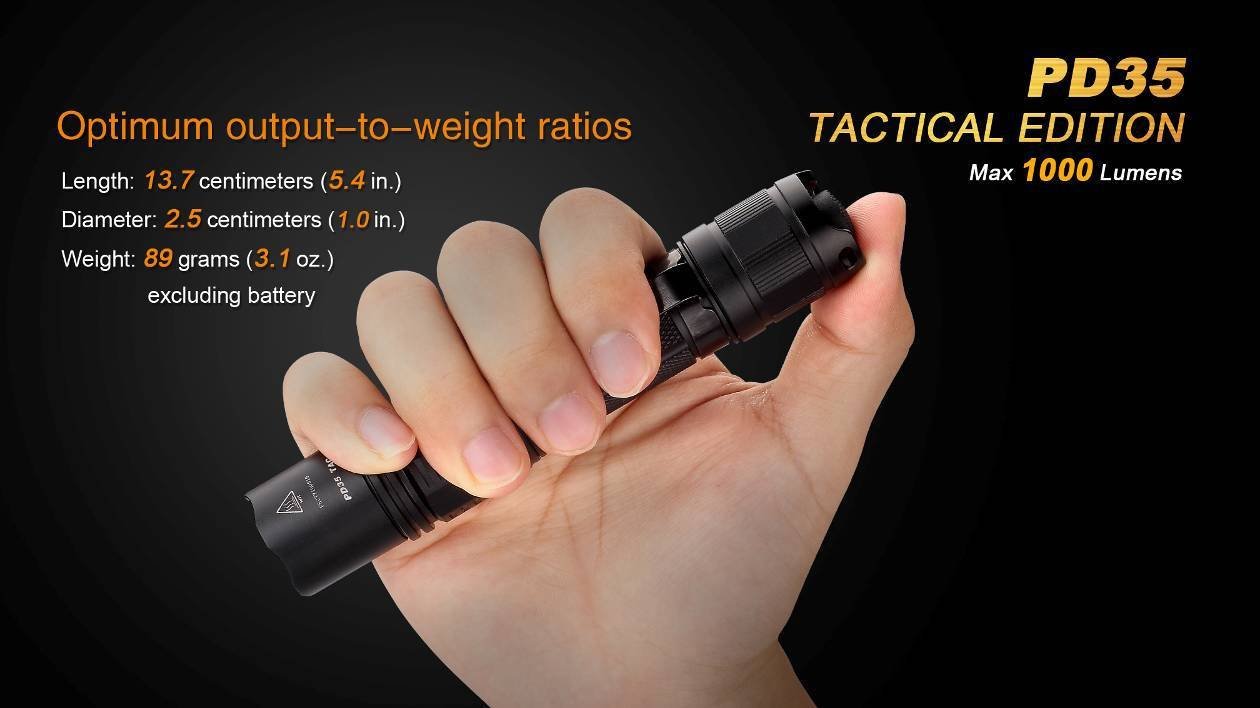
Pictured: Fenix PD35 TAC (Tactical Edition). The TAC is rated for 1,000 lumens and 200 meters. It has an Outdoor mode with side-switch output selection and a Tactical mode that uses the tail switch. The photo opens the PD35 V2.0, which is rated for 1,000 lumens and 250 meters and has a dedicated side button for output selection.
 Check Price
There’s also a PD35 V3.0, rated for 1,700 lumens and 357 meters. It retains the tail-and-side switch layout and has a 5-lumen Eco mode. The USB port on the supplied USB-equipped battery is on the cell, so it still comes out of the flashlight for charging. Our Fenix PD35 version comparison goes into the differences between TAC, V2.0 and V3.0.
Nitecore
The P series includes both the P12GT and newer duty-style lights. The MH series includes rechargeable handheld models. Similar model names can cover different batteries, beam patterns and switches, so look for the complete model name on the body or box.
Pictured and linked: Nitecore P12GT. The beam photo shows the P12GT’s focused hotspot. Its rated peak is 1,000 lumens at a beam distance of 320 meters. The early chart shown in the photo lists 1.5-meter impact resistance. Nitecore’s later P12GT manual lists a 1-meter drop rating, which is the more conservative figure to use.
 Check Price
The NEW P12 is a different model rated for 1,200 lumens and 238 meters, with a 21700 battery as its main power source. For more on the older model’s side switch, modes and beam, see our Nitecore P12GT review. The “V3” in its Cree XP-L HI V3 specification refers to the LED.
For a Fenix vs Nitecore comparison where charging matters, check where the USB port is before you choose. The Nitecore MH12 Pro charges through a USB-C port on the body and is rated for 505 meters. The Nitecore P20iX is rated for 4,000 lumens and 221 meters, giving you a wider beam and a different battery requirement. For rechargeable use it takes a Nitecore 21700 i-Series cell. A brighter peak does not automatically give you a longer beam or let you use the same spare cells.
Summary
My Fenix vs Nitecore choice still comes down to where I’ll use the light. Between the two models in the table, the PD35 V2.0 offers an extra steady level and a lower peak beam intensity for mixed indoor and outdoor tasks. The P12GT is the better fit when I want more reach and a 1-lumen option. For longer outings, I’d compare runtime at the level I’ll actually walk with, then check whether the battery and charger fit what I already carry.
Related You Must Read:
FAQs About Fenix VS Nitecore Flashlights
1. Which is better for tactical use: Fenix or Nitecore?
For tactical use, the Fenix vs Nitecore decision starts with the switch layout. Both the PD35 V2.0 and P12GT have momentary-on at the tail and a side switch for modes. If you need a dedicated rear mode switch or direct access to Strobe, look for that feature on the exact model you’re considering.
2. Are Fenix flashlights more durable than Nitecore?
Compare the impact rating and water-resistance rating on the specific models. Also look at the condition of the seals, switch boot and threads if you’re comparing two older flashlights.
3. Which brand offers better value: Fenix or Nitecore?
Compare the total cost with a battery and charger, along with what the warranty covers through your seller. A feature you use often, such as a direct-to-Low shortcut or a body-mounted charging port, matters more than having extra modes you rarely touch.
4. Which flashlight brand is best for EDC (Everyday Carry)?
Measure the pocket you’ll actually use and check head diameter, clip placement and weight with the battery. The PD35 V2.0 and P12GT have heads about 25.4 mm wide, so their carry sizes are close.
5. Do Fenix or Nitecore flashlights have better battery life?
In a Fenix vs Nitecore runtime comparison, match the brightness and battery first. A 1-lumen setting will usually run longer than a brighter setting. For a power cut or a walk, compare the medium outputs and the amount of light you need rather than just the longest number in the chart.
6. Which flashlight brand offers more advanced features?
Both offer thermal regulation on specific models. Features such as built-in USB-C, power indicators and special modes depend on the model. The original P12GT can show battery voltage by flashing the side indicator. The PD35 V2.0 shows a battery-level indication at startup with a compatible rechargeable cell.
7. Are Fenix and Nitecore both waterproof?
Water resistance is rated by model. The PD35 V2.0 is rated IP68 and the P12GT is rated IPX8, both with a specified 2-meter immersion depth. The X in IPX8 means the rating does not state a dust-protection level. Check the seals and use a purpose-built dive light for diving.
8. Which brand is better for long-distance illumination?
The P12GT is rated for 320 meters versus 250 meters for the PD35 V2.0, even though both are rated at 1,000 lumens. The PD35 V3.0 is rated at 357 meters. Check candela and beam distance for the exact version. Those figures tell you more about long-distance use than peak lumens alone.