Last Updated on November 11, 2026
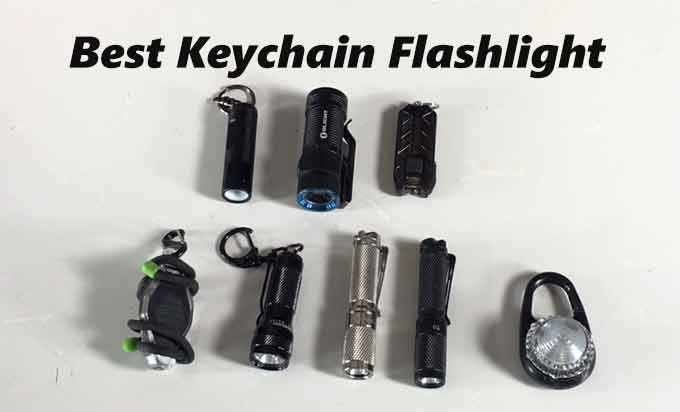
If you always carry keys, a keychain flashlight gives you one more thing you can reach for in the dark. It’s useful when your porch light goes out, you drop something between the seats, or you need to see a lock while holding a bag. I still like a mini LED flashlight for longer jobs. A light on the keys is the one you’ll have even when the bigger light is at home.
The best keychain flashlight for the money depends on how much you ask of it. A few lumens are plenty to find a dropped screw under a desk. A wider beam and a useful middle setting make more sense if you regularly walk from a dark parking lot to your door. Look at the size with the battery installed, the way the light switches on, and what you’ll have to carry to power it again. These details matter more on a key ring than they do in a toolbox.
Best Keychain Flashlight Comparison Chart
The chart compares the versions described in the reviews. Where a photo and its linked light differ, I’ve identified both. Start with the Power and Best use columns to find the best keychain flashlight for your routine. The peak numbers tell you how bright the lights can start. Read the mode and runtime details below if you expect to leave one on for more than a quick check.
| Keychain Flashlights | Photo and link | Peak output and modes | Power | Best use |
|---|---|---|---|---|
| SureFire Sidekick Read review |
 Check Price |
300 lm peak; three levels | Built-in Li-polymer, Micro-USB | Wide beam for a short walk or a quick job |
| Streamlight Nano Light 73001 family Read review |
 Check Price |
10 lm initially; one level | 4 × LR41 button cells | Smallest option for a lock or bag; table link is the black Nano multipack |
| Nitecore Tube, original Read review |
 Check Price |
45 lm peak; variable output | Built-in Li-ion, Micro-USB | Flat, light carry; both links are Tube-family lights |
I find it helps to picture the job before choosing the beam. A wide patch of light is useful for a car footwell or an open bag. A more concentrated beam makes it easier to check something farther away, but the bright center can be distracting when the light is inches from a page.
Top 10 Best Keychain Flashlights of 2026
Here’s how I’d choose among these ten lights. The Sidekick is my best keychain flashlight pick here for its easily reached push button and three useful levels. The tiny Nano makes more sense if I just want to find a lock or a zipper. For a light I use every day and can’t always charge, I’d go with a replaceable AAA model. Check the review that fits your routine before choosing on lumens alone.
SureFire Sidekick Ultra-Compact Keychain Light (Our Top Pick)
The SureFire Sidekick is my top pick here for a keychain light that can handle both a quick look at the front door and a short walk along a dark path. Its faceted reflector gives it a broad beam, so you can see around the keyhole or the spot you’re aiming at. The fob-shaped polymer body is about 2.5 inches long. It takes up more room than a Nano, so try to picture it alongside the car fob and keys you already carry.
With the default switch sequence, the Sidekick starts at 5 lumens after it has been off for more than a second. Cycle it off and back on quickly for 60 lumens, then repeat for 300. The low start is handy if you’re reading a label or looking under a seat without shining a bright hotspot back at yourself. The 300-lumen rating is the starting output on High. SureFire rates that mode for 1 hour and 15 minutes under its runtime test. For a longer job, the 60-lumen setting is the one I’d try first.
The rechargeable cell stays inside the light and takes a Micro-USB lead. I’d keep a cable where I normally empty my pockets so it’s easy to top up. If you like a broad beam and would rather swap in a cell, the SureFire Titan Plus review covers a different three-level light that runs on one AAA.
| Feature | Details |
|---|---|
| Output and rated runtime | 5 lm / 45 h, 60 lm / 4 h, 300 lm / 1 h 15 min |
| Beam | 66 m and 1,100 cd at peak |
| Power | Built-in lithium-polymer battery; Micro-USB charging |
| Controls | Push button; three levels; low-first by default |
| Body and size | Weather-resistant polymer body; 2.5 in; 1.2 oz |
| Product photo and link | 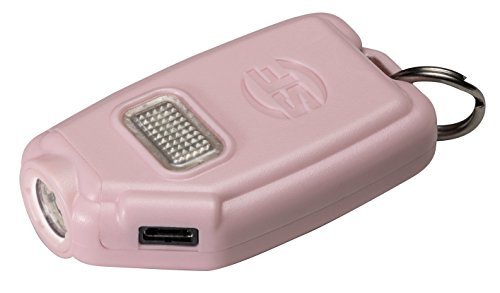 Check Price |
Pros
- Wide beam makes it easy to see around the spot you’re working on.
- Low, medium and high levels cover different jobs without adding a separate mode button.
- Split ring and compact body make it easy to carry with keys.
Cons
- The built-in battery needs a Micro-USB lead and can’t be swapped in the field.
- The housing is weather resistant. I’d keep it out of standing water.
Streamlight 73001 Keychain LED Flashlight Review
The original Streamlight Nano Light is about as small as I’d want a flashlight to be. At roughly 1.47 inches long, it may be the best keychain flashlight on this list for a crowded key ring. Its aluminum body has a twist head and the black 73001 produces a single 10-lumen beam. The comparison photo and link are for the black Nano multipack. The link in this review is for the 73001 version.
Four LR41 alkaline button cells power the original Nano. Streamlight’s eight-hour figure refers to declining usable output, so think of it as a light for short bursts when you need to read a lock, see an inside pocket or find a fuse label. If you use a light most nights, a rechargeable fob or a standard AAA model saves the trouble of keeping four matching button cells on hand.
The Nano Light II is a different model. It uses a single AAAA alkaline battery and is rated for 20 lumens for one hour. The original Nano’s cells and replacement procedure don’t carry over. The Streamlight Nano Light 73001 review goes into more detail on the original model’s twist control and battery compartment.
| Feature | Details |
|---|---|
| Output | 10 lm initially, single steady level |
| Runtime | Up to 8 h of declining usable output |
| Power | Four replaceable IEC LR41 alkaline button cells |
| Controls | Twist the head to turn the light on or off |
| Body and size | Anodized aluminum; 1.47 in; 0.36 oz with cells |
| Protection | Weather-resistant body |
| Product photo and link |  Check Today’s Price |
Pros
- Very small aluminum body with a snap hook.
- One brightness setting means no modes to remember.
- Enough light for a keyhole, glovebox or drawer at arm’s length.
Cons
- Changing four tiny cells takes more care than swapping one AAA.
- Ten lumens are best for near work, especially as the batteries fade.
Nitecore Tube Keychain Light T Series Flashlight
The original Nitecore Tube is a flat, lightweight light that sits alongside keys with less bulk than many round models. The polycarbonate body contains a rechargeable battery and the little front LED spreads light across a broad area. The original Tube has a 1-lumen Low and a 45-lumen High with variable brightness in between. A single button handles the controls, and the lockout is worth using if keys or a fob regularly press against it.
The original’s high setting is rated for one hour. The 48-hour figure is for Low, which works for finding a bedside item or getting your bearings in a dark room. At that level I’d hold it close to a lock or label. High is more useful when you want to see across the front steps. There’s no loose coin cell to change. The original Tube charges through Micro-USB.
The later Tube V2.0 reaches 55 lumens. Earlier examples charge through Micro-USB, and the USB-C version has its own connector. Check the port on the light before choosing a cable. The photos show the familiar Tube shape, and both links are for the Tube family. Use the original Tube figures below and check for the V2.0 marking if you’re comparing the later light.
| Feature | Details |
|---|---|
| Output and rated runtime | 1 lm / 48 h, 45 lm / 1 h; variable brightness between the two |
| Beam | 24 m rated beam distance on High |
| Power | Built-in Li-ion battery; Micro-USB charging on the original Tube |
| Controls | Single button with lockout |
| Weight | 9.6 g (0.34 oz) with battery |
| Product photo and link |  Check Price |
Pros
- Flat shape and roughly 10-gram weight suit a crowded key ring.
- Variable output lets you use just enough light for a close task.
- The switch has a lockout to help with pocket carry.
Cons
- The integral battery needs a cable to recharge.
- Its wide beam is more useful close by than across a large yard.
Olight 90 Lumens i3E EOS Keychain Flashlight
The i3E EOS may be the best keychain flashlight here for someone who wants a bright beam and no modes to cycle through. Twist the light closed to turn it on and back it off slightly to turn it off. I’d choose it for regular use at the garage or on the stairs if I wanted to swap a battery and get back to work. If you spend a lot of time looking at things only a few inches away, the lack of a lower level is the main trade-off.
The black i3E EOS shown here is the 90-lumen model. It uses a single AAA alkaline cell or a supported AAA NiMH or L92 primary lithium cell. In Olight’s 90-lumen chart, the tested alkaline runs for 45 minutes and the tested 900 mAh NiMH runs for 70 minutes. Those figures depend on the cell and test conditions. The beam is rated for 44 meters, which is handy for orientation but isn’t the distance at which I’d expect to read a label.
The i3E is a different light from the multi-mode i3S. The tube may look similar in photos, so use the name printed on the light and the number of output settings to tell them apart. To recharge a supported NiMH AAA, remove it and use a NiMH charger.
| Feature | Details |
|---|---|
| Output | 90 lm, one steady level |
| Rated runtime | 45 min with the tested alkaline, 70 min with the tested 900 mAh NiMH |
| Beam | 44 m; 500 cd |
| Power | One AAA alkaline, supported NiMH or L92 primary lithium |
| Controls and body | Twist on/off; aluminum body; 1.5 m rated impact resistance |
| Size and weight | 60.5 × 14 mm; 19.4 g with battery |
| Product photo and link | 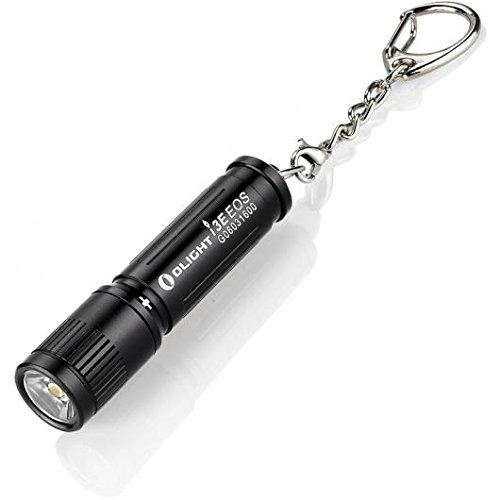 Check Price |
Pros
- One setting and a simple twist make operation straightforward.
- Runs on a single replaceable AAA, with both disposable and rechargeable options.
- Small aluminum body with an optic that produces a usable center beam.
Cons
- No lower brightness level to save power or reduce glare.
- Turning the light on can take both hands if the keys are already in use.
ThruNite Ti3 NW EDC Flashlight Review
The ThruNite Ti3 NW is a good fit if your idea of the best keychain flashlight includes a genuinely dim setting. Firefly is 0.04 lumen, enough to read something held close once your eyes have adjusted. Low is 12 lumens and is more practical for a bag or drawer. High is rated at 120 lumens, which I’d save for checking ahead of me or illuminating a larger area briefly.
The Ti3 takes one AAA. It has a twist head that turns the light on and off. Rapid off-and-on twists cycle the three steady levels. The extra twists access the hidden strobe, so you don’t have to cycle through strobe every time you want a brighter beam. NW describes the neutral-white version. Choose based on the color of the light you prefer and the controls you can use without looking, especially if your other hand is holding keys.
ThruNite’s chart rates the light for about 30 minutes on High and 115 hours on Firefly. That long Firefly runtime is helpful at a nightstand or in a tent, where you need just enough light to find something. It has little bearing on how long you can use the bright setting outside.
| Feature | Details |
|---|---|
| Output and rated runtime | 0.04 lm Firefly / 115 h; 12 lm Low / 6.3 h; 120 lm High / 30 min |
| Strobe | Hidden 120 lm strobe; 1 h rated runtime |
| Beam | 50 m rated beam distance |
| Power | One supported AAA; remove rechargeable cells to charge them |
| Controls and body | Twist head; aluminum; IPX8 rating; 12 g before battery |
| Product photo and link | 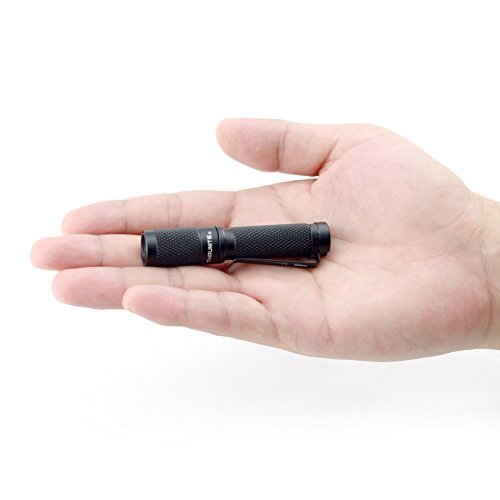 Check Price |
Pros
- Very low Firefly mode for close work in the dark.
- Three steady levels and a strobe that stays out of the normal cycle.
- Common AAA format and a compact, 12-gram body before the battery.
Cons
- Getting to High takes more than one twist when starting from Firefly.
- The small body and battery limit the time you can spend on High.
Fenix E15 450 Lumens EDC Flashlight
The 2016 Fenix E15 is the light pictured in this review. It’s a short aluminum twist-head model with four levels. Its 450-lumen Turbo comes from one compatible rechargeable 16340 Li-ion cell. With one CR123A lithium primary, its maximum is 270 lumens. The 16340 comes out for charging in a compatible charger. That distinction matters if your aim is to use the same cable you carry for your phone.
The 450-lumen figure is a burst rating. The E15 lowers Turbo output during extended use, so I’d use a lower setting when I wanted time to finish a job. A short bright burst is useful to check something ahead. The modest levels are easier to use when the light is in your hand for several minutes. The short body works on a ring, although its wider head and battery make it a bigger carry than a single-AAA twist light.
The link in this review goes to the Fenix E12 V3.0. That’s a longer AA-powered light with a tail switch, a clip, a magnetic tail and up to 200 lumens. If easy battery replacement is the feature you want, read the Fenix E12 V3.0 review for the AA model’s controls and how it differs from earlier E12 versions. If you want a compact Fenix that charges by cable, the Fenix E05 and E05R comparison explains the difference between the AAA E05 and Micro-USB E05R.
| Feature | Details |
|---|---|
| Output on 16340 | 8 / 50 / 110 / 450 lm; Turbo reduces output as it runs |
| Output on CR123A | 8 / 50 / 110 / 270 lm |
| Beam | Up to 132 m on the 16340 chart |
| Power | One compatible 16340 Li-ion or one CR123A primary; external charging for the 16340 |
| Controls and size | Twist head; four steady levels; 64.8 mm long |
| Linked light in this review | Fenix E12 V3.0; 200 lm peak, one AA, tail switch |
| Pictured E15 · linked E12 V3.0 | 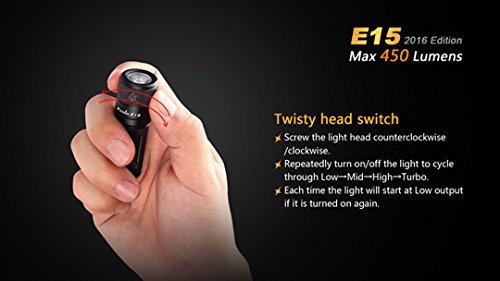 Check Price |
Pros of the pictured E15
- Four levels and a simple twist-head control.
- High initial output for its size with an approved 16340.
- Can also use a CR123A primary cell at lower peak output.
Cons
- The short body warms up on Turbo and output drops.
- Recharging the 16340 takes a separate charger. The linked AA model has different power and controls.
Lumintop Tool AAA Best Keychain Flashlight
I’d pick the Lumintop Tool AAA over a single-setting twist light when I want a tail click and several levels. The original Cree XP-G2 version is rated at 110 lumens on High, 32 on Mid and 5 on Low. Lumintop has also offered the Tool AAA with a Nichia emitter and different output. Check the emitter and mode chart for the version you have when comparing brightness.
The clicky tail on the original Tool lets you use it with one hand. The optional magnetic-tail set has a separate cap and gives you a way to park the light on a steel surface. With the magnetic cap fitted, use the twist control instead. For a key ring, I’d keep the clicky tail on if I needed to turn the light on while carrying something. If you’ll use it around a metal workbench or a car, the optional cap has a clear purpose.
One AAA runs the light. The older Cree chart gives about 30 minutes on High, 4 hours on Mid and 36 hours on Low. That makes Mid a sensible setting for an extended look in a cabinet. Use a supported alkaline or NiMH AAA and follow the battery directions for the exact version. For more replaceable-battery options, see Best AAA Flashlight: Easy to Carry Top 10 Option, which also covers the Cree Tool and the Ti3.
| Feature | Details |
|---|---|
| Output and rated runtime | 5 lm / 36 h, 32 lm / 4 h, 110 lm / 30 min |
| Beam | Up to 47 m on the Cree version |
| Power | One compatible AAA battery |
| Controls | Clicky tail; optional magnetic cap uses twist control |
| Size and weight | About 15 g without battery on the original Cree model |
| Product photo and link |  Check Price |
Pros
- Three usable levels with a mechanical clicky tail switch.
- Knurled body and two-way clip make it easy to grip or attach.
- One replaceable AAA and a useful 5-lumen low on the Cree version.
Cons
- The magnetic tail is a separate configuration and changes the controls.
- High has much less runtime than the 36-hour Low rating.
Streamlight 73200 KeyMate USB Light
The Streamlight KeyMate USB looks more like a key than a conventional flashlight. Its light bar gives you a broad patch of light for working close up. The spring clip attaches to keys, a zipper pull or a lanyard. If you mostly need to see the contents of a bag or check a switch on the wall, that shape and beam can be handier than a tiny spotlight.
High is 35 lumens for a rated hour. Low is 16 lumens for a rated two hours, and there’s a flash mode. The built-in lithium-polymer battery charges through Micro-USB, and the indicator helps you keep track of charging. The IPX4 rating covers splashes. I’d use it around a wet doorstep and keep it out of puddles. If you like this charging routine but need longer runtime and a bigger beam, compare the charging options in the rechargeable flashlight guide.
Use the KeyMate as a second light if you already carry something with a narrower, longer beam. The light bar can show the area around your hands while you search a compartment. For a longer walk, pick the main light according to how far ahead you need to see and how long you’ll have it on.
| Feature | Details |
|---|---|
| Output and rated runtime | 16 lm Low / 2 h; 35 lm High / 1 h; separate flash mode |
| Power | Built-in lithium-polymer battery; Micro-USB charging |
| Controls | Push button and charge indicator |
| Body and size | Key-shaped light with spring clip; 2.9 in long; about 0.5 oz |
| Protection | IPX4 splash resistance; 1 m rated impact resistance |
| Product photo and link | 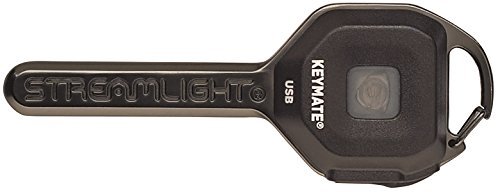 Check Price |
Pros
- Flat shape and built-in clip suit a key ring or zipper.
- Wide beam illuminates things near your hands.
- Rechargeable battery with two steady levels and a flash mode.
Cons
- Short rated runtime on High and limited reach.
- Needs a Micro-USB cable and has splash-level protection.
Ztuo Yong Mini LED Keychain Light Review
These flat mini lights make the most sense as spares for places where you regularly need a brief bit of light. Clip one to a zipper or a set of secondary keys and use it to find a tag or read a latch. The small body and simple control are the reasons I’d choose one. For a path or a longer power cut, I’d take one of the brighter models with a documented beam and runtime.
The pictured style uses a small replaceable coin-cell compartment. Check the markings in the compartment or on the cell before fitting replacements. Coin cells that look similar can be different thicknesses. Keep loose cells away from children, and take a light out of use if its battery compartment won’t stay closed. A securely closed battery compartment matters more than the small saving in pocket space.
If you put these on spare keys, check them occasionally. The point of a backup is that it works when you reach for it after a long time in a drawer. For a set you use every night, a replaceable AAA light may be easier to keep ready because you only have to keep one familiar cell format on hand.
| Feature | Details |
|---|---|
| Form | Flat mini light with a key ring attachment |
| Power | Replaceable coin cells; use the type marked on your light |
| Best use | Brief, close-range light for a lock, zipper or tag |
| Product photo and link | 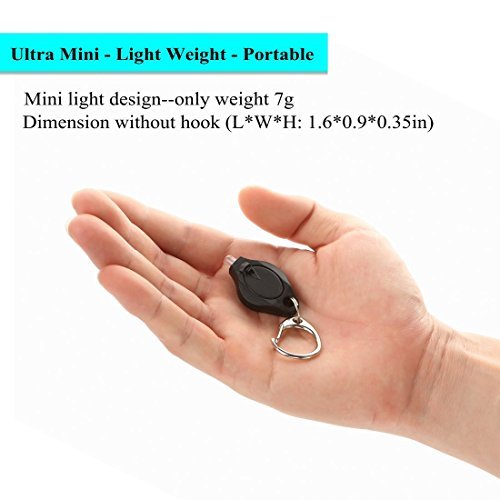 Check Price |
Pros
- Flat shape takes up little space on a spare set of keys.
- Simple close-range light for a bag, drawer or lock.
Cons
- Small cell compartment and limited usefulness beyond arm’s reach.
- For regular use, choose a light with a published runtime at the level you need.
GLAREE E03 Keychain Flashlight Review
The GLAREE E03 has the familiar shape of a single-AAA twist light. It gives you several steady levels and a separate strobe. Its lower levels are helpful in a tent or when you’re looking into a bag, and the clip lets you carry it off the key ring when you need to. I’d choose it for its size, simple construction and replaceable battery.
Turn the head to switch it on and cycle it quickly off and on to change levels. If you regularly need more light straight away, compare the feel of that control with the mechanical tail switch on the Tool AAA. A twist light is easy to carry, though gloves or a cold hand can make repeated twists more awkward. Use the AAA type permitted for the exact light and check the polarity when you change it.
Think of the E03 as a close-range companion. If you want a dependable lower setting for a specific task, use the mode it normally starts on a few times at home. That tells you much more about whether it fits your routine than a peak rating alone.
| Feature | Details |
|---|---|
| Output settings | Three steady levels and a separate strobe |
| Power | One compatible AAA battery |
| Controls | Twist the head to turn on or change levels |
| Carry | Small aluminum body with a clip and key ring attachment |
| Product photo and link | 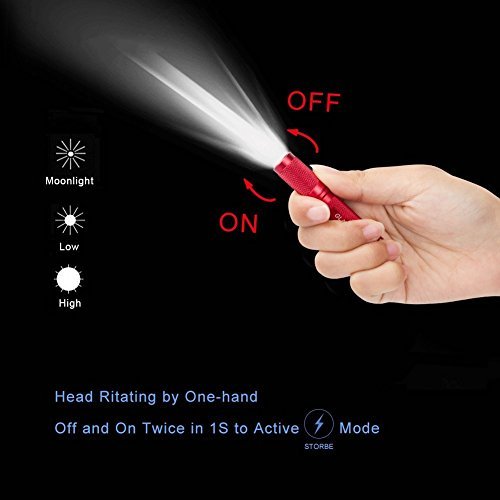 Check Price |
Pros
- Compact body, a pocket clip and a replaceable AAA.
- Several steady levels for different close-up jobs.
Cons
- Getting to a brighter mode requires repeated twists.
- Use a model with a documented output curve if you need a specific level for a fixed period.
Importance of having a keychain flashlight
The light helps you to feel secure
A keychain light is useful when the entryway bulb is out or when you’ve dropped the keys in the grass. A low setting lets you look down and find what you need without filling your view with glare. If you expect to walk a longer unlit stretch, bring a light you can hold comfortably with a useful medium setting. The best keychain flashlight for a lock and the best light for a long walk can be different choices.
What makes the best keychain flashlight durable?
Check the ring hole and fastener first. It’s the spot that takes the tug when you pull the keys from a pocket. Aluminum resists everyday wear, and molded bodies can save weight and keep the light flat. For a light that stays on a bag in the rain, use the specific water-resistance rating. A splash rating is useful in rain. An immersion rating applies under its own specified test conditions.
They are portable and compact
Length only tells part of the story. A short light with a wide head may be more awkward next to a car fob than a slim AAA tube. If your keys share a pocket with a phone, the best keychain flashlight may be one with a smooth edge and a short attachment. Try arranging the ring so you can pick out the light by feel. A flat fob is easy to pinch between two fingers, while a slim cylindrical light may fit a side pocket better. Check how easily you can operate it while the keys stay in the same hand.
It assists you in being ready for any emergency
A small light can help you find the main flashlight, open a gate, or see what you’re doing at the car when the overhead light goes out. Give it a quick check before you leave on a trip, particularly if it usually sits with spare keys. For a push-button light, use the lockout when available. For a twist light, leave the head just loose enough to switch off and keep it securely threaded.
Replaceable batteries or a built-in rechargeable cell
Choose power based on how often you use the light and what you already keep at home. A replaceable AAA makes sense if you keep spares for other devices. An integral rechargeable pack is handy for a light you use daily and can charge regularly. A button-cell light earns its place when keeping the ring tiny is your main concern. With a removable 16340, you need a charger that supports that cell’s chemistry. The flashlight battery types guide explains how common primary and rechargeable formats differ.
Check the connector on the light or cell before packing a cable. Micro-USB and USB-C look and fit differently, and a USB-equipped light can still have a built-in cell that is unsuitable for field replacement. If you don’t usually carry a charging lead, a light that can take a spare approved battery may be the better fit. Keep loose spare cells in a case so their terminals stay away from keys and other metal.
Summary
The best keychain flashlight is the one you’ll leave on your keys and can turn on easily when you need it. I’d pick the Sidekick if I wanted a broad beam and a choice of brightness, and the Nano if I needed the smallest light for the occasional keyhole. The Olight i3E is my simple replaceable-AAA option. I’d pick the Ti3 for a very dim Firefly mode or the Tool AAA for a clicky tail switch. Choose according to the job you’ll do most often and the way you want to keep the battery ready.
FAQ
Which flashlight bulb should I choose, LED or incandescent? For this size, an LED usually gives you more useful light from a small battery and a range of brightness settings. Once you choose an LED light, look at the beam and the lowest usable mode. Those are what you’ll notice most when you aim it at something up close.
How much do I need to spend on a flashlight? Start with the job you want it to do. A single-mode AAA light can be the best keychain flashlight for a lock or a drawer. Spending more makes sense if it buys a control you’ll use, a more useful lower setting, or a charging arrangement you already have. Include the cost of a charger or replacement cells when you compare models.
Is the warranty important when choosing a flashlight? Yes, especially if it’s a light you rely on every day. Check how the maker handles the built-in battery or switch and how it distinguishes a defect from ordinary wear. Keep the purchase record and check the light when it arrives. Make sure it cycles through its modes and that the clip or ring is secure.
How many lumens does the best keychain flashlight need? A few lumens are often enough for an object within arm’s reach. A broad beam at a useful middle level is easier to work with when you want to see a larger area. Pay attention to the runtime at that level. A high peak is helpful for a quick look, while a mode you can leave on matters more if you expect to use it for several minutes at a time.