Last Updated on November 11, 2026
The tough and versatile Klarus XT11S flashlight is designed for security work, hunting, emergency use, and outdoor activities. The original version pictured here uses a Cree XP-L HI V3 LED and a rechargeable 18650 battery. Klarus rates it at 1,100 lumens and up to 330 meters of beam distance.
Despite its compact size, the XT11S gives you two tactical tail switches, a separate side switch, and three programmable operating settings. You can go straight to Turbo to check a dark yard or start on Low when you only need enough light to read a map. Klarus rates the 10-lumen Low setting for up to 260 hours with its test battery.
This Klarus XT11S review covers the original Micro-USB light and compares it with the original 2,000-lumen XT11GT. The XT11GT Pro models use different controls and charging hardware, so it helps to know which version you’re comparing.
For more models from the same manufacturer, explore our Klarus flashlight reviews and buying guide.
Klarus XT11S vs. XT11GT: Similarities and Differences
Both the Klarus XT11S and the original XT11GT belong to the company’s XT tactical flashlight family. They share a rechargeable 18650 format, direct Micro-USB charging, and a tail switch layout that makes sense when you’re wearing gloves or working one-handed.
The original XT11GT puts out more total light on Turbo with the right battery. The XT11S has the slightly longer rated beam: 330 meters vs. 316 meters. That distinction matters if you’re comparing reach instead of overall brightness.
Similarities
- Three selectable operating settings, with dual tactical tail switches and a side switch.
- Four steady brightness levels plus Strobe and SOS, with access depending on the selected setting.
- Side-switch mode memory, an electronic side-switch lockout, and a battery indicator in supported settings.
- One protected 18650 rechargeable battery or two CR123A primary cells for backup power.
- Intelligent Temperature Control System (ITS), an aluminum body, and an IPX8 water-resistance rating.
- Compatibility with some optional tactical accessories. Check the fit for your exact model.
Klarus XT11S vs. XT11GT Comparison Table
| Feature | Original Klarus XT11S | Original Klarus XT11GT |
|---|---|---|
| LED | Cree XP-L HI V3 | Cree XHP35 HD E4 |
| Maximum brightness | 1,100 lumens | 2,000 lumens with a suitable high-drain 18650 |
| Maximum beam distance | 330 meters | 316 meters |
| Peak beam intensity | 27,225 candela | 24,964 candela |
| Turbo rated runtime | 2 hours* with a 3,400 mAh test cell | 50 minutes* with a 3,100 mAh high-drain test cell |
| Primary battery | One protected 18650 or two CR123A for backup power | One protected 18650 or two CR123A for backup power |
| Charging connection | Micro-USB | Micro-USB |
| Length | 139 mm | 142.6 mm |
| Weight without battery | 115 g | 130 g |
| Water resistance | IPX8 | IPX8 |
*Klarus lists these as Turbo-mode runtimes with the specified test batteries. Both lights can reduce output during the run. In the FL1 test, runtime ends when output falls to 10% of the level measured 30 seconds after switch-on.
The Klarus XT11S flashlight is a little shorter and 15 grams lighter before you add the battery. Its 27,225-candela peak intensity is higher than the original XT11GT’s 24,964 candela. The GT’s higher lumen rating is useful when you want more overall light. For distance, compare the candela and beam ratings alongside lumens.
Battery choice makes a bigger difference on the original XT11GT. Its 2,000-lumen rating requires the Klarus 3,100 mAh high-drain 18650 or an equivalent high-drain cell that meets the light’s requirements. Klarus specifies up to 1,300 lumens with an ordinary protected 18650 or a pair of CR123A cells. Both original models let you use CR123A for light in a pinch. Take those cells out before connecting a charging cable.
For a closer look at the original model and its controls, see our Klarus XT11GT 2,000-lumen review.
Where the XT11GT Pro Fits In
Look for the full model name when comparing an XT11GT Pro. The Pro series moved to USB-C and a dual-tail-switch layout. The charging indicator near the port serves a different purpose from the side control button on the original XT11GT and XT11S.
- Early XT11GT Pro: The 2,200-lumen version is rated for 320 meters. It has USB-C charging and a pair of tail controls.
- XT11GT Pro V2: The 3,300-lumen, 410-meter version uses a 3,100 mAh 18650 in Klarus’s rated configuration. Its two operating settings are Tactical and Outdoor.
- XT11GT Pro V3: The 3,300-lumen, 380-meter configuration pairs USB-C with a 4,000 mAh 18650.
- XT11GT Pro V4: This version is rated for 3,300 lumens and 560 meters. It uses a 4,000 mAh 18650 in the supplied configuration, supports USB-C charging at up to 5 V/2 A, and has a programmable shortcut on the auxiliary tail switch.
Three Pro versions share the same peak output figure. Beam distance, the controls, and the exact version are better ways to tell those lights apart.
Klarus XT11S Flashlight Technical Specifications
The original XT11S uses a smooth reflector for a focused beam and a toughened glass lens with an anti-reflective coating. The specifications below are for the pictured Cree LED model with the covered Micro-USB port.
| Specification | Klarus XT11S Tactical Flashlight |
|---|---|
| Maximum output | 1,100 lumens |
| Minimum output | 10 lumens |
| Maximum runtime | 260 hours on Low |
| Beam distance | 330 meters |
| Peak beam intensity | 27,225 candela |
| LED | Cree XP-L HI V3 |
| Brightness settings | Turbo, High, Medium, Low |
| Special modes | Strobe and SOS |
| Controls | Dual-tail switches and side switch |
| Compatible batteries | One protected rechargeable 18650 or two non-rechargeable CR123A cells |
| Charging | Micro-USB, up to 5 V/1 A |
| Body material | 6061-T6 aluminum |
| Water resistance | IPX8, 2 meters |
| Impact resistance | 1 meter |
| Length | 139 mm |
| Weight | 115 g without battery |
| Price |  Check Today’s Price |
The runtime figures come from Klarus’s testing with a 3,400 mAh 18650. The kit pictured above shows a 2,600 mAh battery. Expect less time per charge from the smaller cell under comparable conditions.
For the complete operating instructions for this version, see the official Klarus XT11S user manual.
Klarus XT11S Flashlight Video Review
Benefits of Using the Klarus XT11S LED Flashlight
The XT11S offers several features that make it convenient for professional work and outdoor activities. The most useful one is being able to choose what the tail buttons do when the light is off.
1. Three Programmable Operating Settings
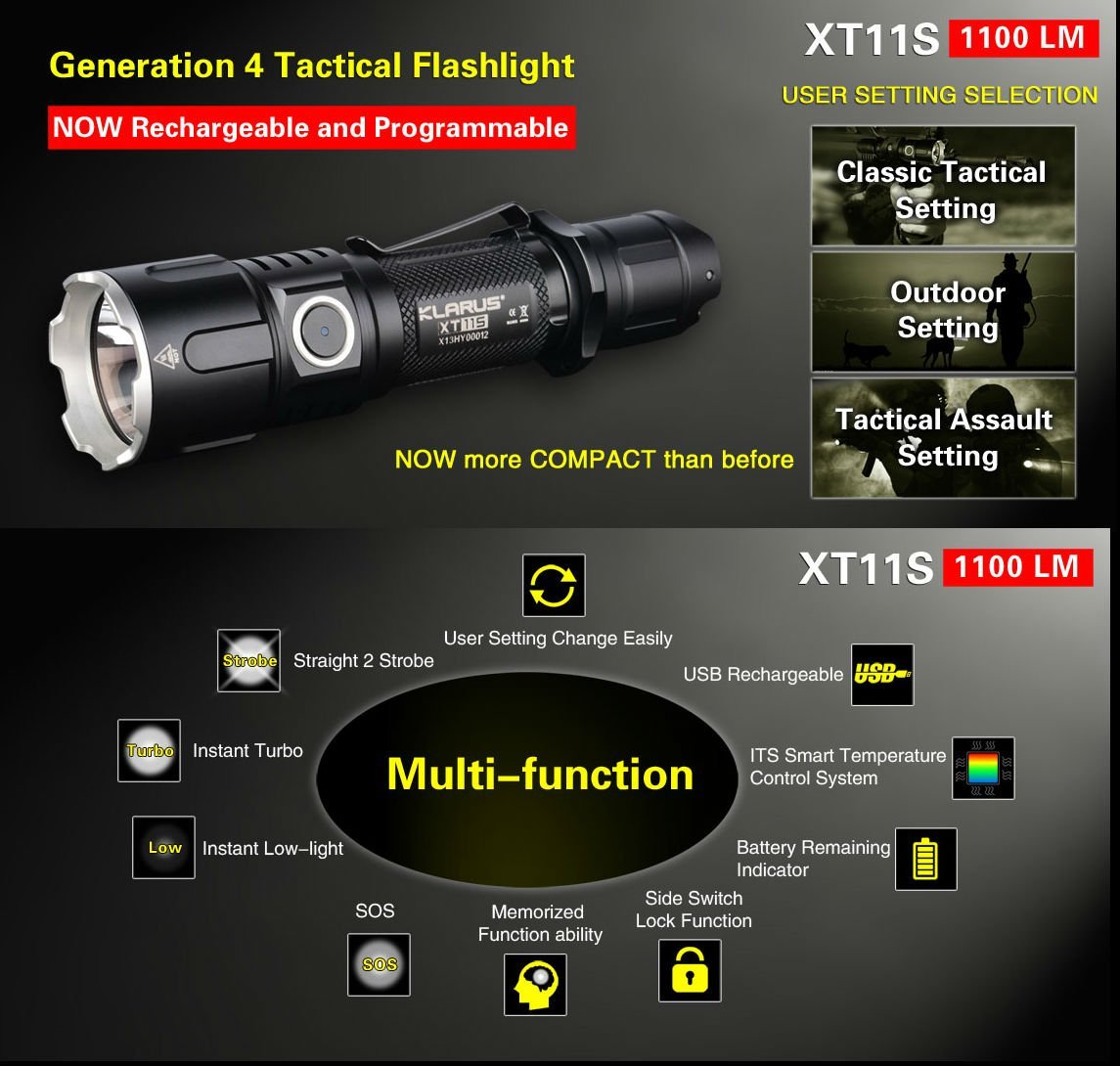
Classic Tactical Setting: The factory setting gives you Turbo from the main tail switch and instant Strobe from the smaller mode switch. The side switch lets you choose brightness and start directly on Low with a short hold while the light is off.
Outdoor Setting: The main tail switch still starts on Turbo, but the mode switch starts on Low instead of Strobe. This is useful for checking a trail marker or finding gear without washing out your night vision. With the light already on, the mode switch can cycle brightness levels.
Tactical Assault Setting: The main tail switch gives momentary or steady Turbo and the smaller tail switch gives Strobe. The side switch no longer operates the beam in this setting, which also disables the normal battery-level display at turn-on.
To change settings, start with the light off and the side switch unlocked. Hold the side switch for about 10 seconds until the beam flickers quickly. Keep it held while pressing the tail mode switch to cycle through the settings. One, two, or three flashes indicate Classic Tactical, Outdoor, or Tactical Assault. Release the side switch to confirm.
 Check Today’s Price
2. Durable Aluminum Construction
The XT11S uses 6061-T6 aluminum alloy with a Type III hard-anodized finish. Its stainless steel bezel helps protect the front of the flashlight, while the textured body improves grip. Springs at both ends help keep the battery seated during a knock or drop.
At 115 grams without the battery, the Klarus XT11S flashlight is light enough for regular carry. Its 34.9 mm head is wider than the 25.4 mm body, which is worth keeping in mind if you carry it in a slim pocket rather than a holster.
For a smaller side-switch light that runs on AA or 14500, see our Klarus Mi7 flashlight review.
3. Six Lighting Modes for Different Activities
The XT11S offers four steady brightness levels, along with Strobe and SOS. The lower settings are useful for reading or walking at close range. Start with Medium or High for a longer inspection, then use Turbo briefly when you need to see farther across an open area.
| Mode | Output | Rated Runtime |
|---|---|---|
| Turbo | 1,100 lumens | 2 hours* |
| High | 400 lumens | 4 hours |
| Medium | 100 lumens | 18 hours |
| Low | 10 lumens | 260 hours |
| Strobe | 1,100 lumens | 4 hours |
| SOS | 100 lumens | 54 hours |
*Klarus tested the XT11S with a 3,400 mAh 18650. The two-hour Turbo rating includes time at reduced output. Temperature, airflow, battery charge, and cell capacity affect real use.
4. Bright 1,100-Lumen Output
With a smooth reflector and a focused hotspot, the 1,100-lumen XT11S is useful for picking out a fence line or trail marker. There is also some spill around the hotspot to help you see the ground closer to you.
The 330-meter figure is the standardized distance at which the center of the beam is calculated to deliver 0.25 lux. Seeing that light reach a surface is easier than recognizing a person or reading a sign at the same distance.
5. Convenient Three-Switch Interface
The larger tail button gives you momentary light with a partial press or steady Turbo with a full click. In Classic Tactical or Outdoor, the side button is handy when you hold the light by the body. The side switch can recall a steady brightness level when used to turn the light on and off. The main tail button is the shortcut to Turbo.
Side-switch lockout is available in Classic Tactical and Outdoor. With the light off, hold the side button for about five seconds until the beam flashes twice, then release. Three quick presses unlock it. The lockout applies to the side switch, so check how you stow the light if the tail buttons could be pressed in a bag.
6. Intelligent Temperature Control System
Klarus uses its ITS system to adjust output as the flashlight heats up. The aluminum body can still become warm, especially on Turbo. A gradual or stepped reduction during high-output use is expected. Timing depends on how warm the light is, airflow around it, and the battery’s condition.
Think of Turbo as a short burst for checking what is ahead. On the XT11S, High is rated at 400 lumens. It is a more useful starting point for a task that needs steady light for longer, such as walking a trail or inspecting several areas in succession.
7. Convenient Micro-USB Rechargeability
The original Klarus XT11S flashlight has a Micro-USB port under a protective cover. Use a compatible protected 18650 lithium-ion battery and seat the tail cap fully. With the light off and the port dry, plug in the Micro-USB cable. Klarus specifies up to 1 A of charging current.
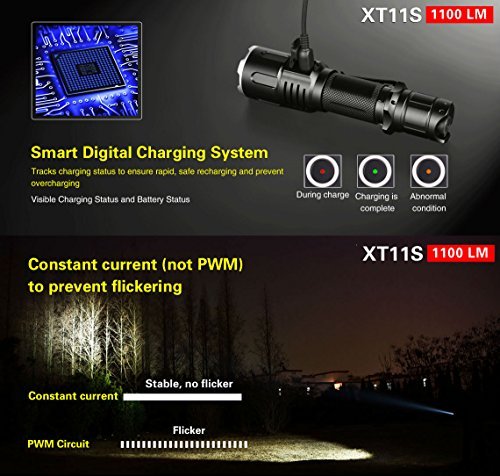
- Red: Charging is in progress.
- Green: Charging is complete. Disconnect the cable and close the cover.
- Flashing orange: Disconnect the cable and check the battery, its orientation, and the connections before trying again.
Those are the charging indications. With a compatible 18650 installed and the cable unplugged, the side switch briefly shows remaining charge when the light turns on in Classic Tactical or Outdoor. Green is roughly 70% or more, orange is roughly 30% to 70%, and red means under 30%. Flashing red means the charge is below 10%.
Important: Two matching CR123A primary cells can power the flashlight, but they must never be charged in it. The original XT11S manual also warns against 16340 cells. Use an approved protected 18650 for onboard charging and install it with the positive end facing the head.
 Check Today’s Price
If you’re looking for other lights that use this format, see our comparison of 18650-powered flashlights. Match the battery to the particular flashlight before reusing a cell in another model.
8. Waterproof and Impact-Resistant Design
Klarus rates the original XT11S for IPX8 water resistance at 2 meters under its test conditions and for a 1-meter drop. That is useful for rainy walks and outdoor work. Keep the charging-port cover closed and check the O-rings after a battery change. Use a purpose-built dive light for diving.
Shortcomings of the Klarus XT11S Flashlight
No flashlight is perfect, and the original XT11S has some limitations worth considering before buying.
1. Older Micro-USB Charging Port
The XT11S pictured here and the original XT11GT need a Micro-USB cable. The USB-C plug used on the XT11GT Pro has a different shape. If you pack one cable for several lights, check the socket under the cover first and keep the Micro-USB port clean and dry.
2. Turbo Output Doesn’t Stay Constant
If you are choosing a light for a full shift, compare the brightness you can use after the initial Turbo step-down. Battery age matters too. A light that drops brightness unusually early on a cool start is worth checking with a charged, compatible cell.
3. Multiple Switches Require Familiarity
The three-switch design provides flexibility, but it takes practice to remember what the smaller tail button will do. Try the selected setting before heading out. Outdoor gives you Low from that button, which is often the more convenient setup when you need light around other people.
4. Battery and Accessory Compatibility
The original XT11S uses an 18650. A larger 21700 cell from another light in the XT family needs its own compatible model, and mounts, holsters, and remote switches can differ between versions. Our Klarus XT12GT and XT12GT Pro comparison compares two longer-range options: the original XT12GT with magnetic charging and the XT12GT Pro with USB-C and a 21700 battery.
How to Maintain the Klarus XT11S
Proper maintenance helps prevent charging problems, accidental shutdowns, and premature battery wear.
- Clean the contacts: Turn off the light, remove the battery, and wipe dirt from accessible contacts with a clean, dry cloth.
- Protect the charging port: Keep the cover seated after charging. Let the port dry before connecting a cable if the flashlight was out in the rain.
- Check O-rings: Replace worn or damaged seals with compatible parts.
- Use approved batteries: Follow the battery type and protection requirements for the exact model.
- Store it properly: Let the light cool after heavy Turbo use. Keep it in a cool, dry place and remove the battery for long-term storage.
If the light flickers or will not turn on, start with a known-good, charged 18650 and check that the tail cap is fully tightened. Try the main tail button. If the tail button works but the side switch does not, check for side-switch lockout or Tactical Assault mode. If the charging light flashes orange, unplug it and check the cable, power source, and battery fit. Our push-button flashlight troubleshooting guide covers the basic tail-cap and contact checks you can do before seeking service.
Klarus XT11S Warranty and Support
Klarus specifies a five-year warranty for qualifying flashlight defects in materials and workmanship under normal use. The rechargeable battery has separate coverage. Accidental damage, misuse, and unauthorized alterations are generally excluded.
For service, contact the original dealer or Klarus with proof of purchase, the serial number, and a short description of what happens. Note whether the fault occurs with both the tail and side controls and what the charging indicator shows. Terms may vary by country or distributor.
Frequently Asked Questions About the Klarus XT11S
1. What is the maximum output of the Klarus XT11S flashlight?
The original Cree XP-L HI V3 version is rated for up to 1,100 lumens on Turbo. For a longer job, try the 400-lumen High setting first.
2. How far can the Klarus XT11S beam reach?
Klarus rates the beam at 330 meters with a peak intensity of 27,225 candela. The original 2,000-lumen XT11GT is rated at 316 meters.
3. Is the Klarus XT11S rechargeable?
Yes. The built-in Micro-USB port charges a compatible protected 18650 without removing the battery.
4. What batteries does the XT11S use?
The original supports one protected rechargeable 18650 or two non-rechargeable CR123A cells. Its manual rules out 16340 cells. Remove the CR123A pair before connecting the charger.
5. Is the Klarus XT11S waterproof?
The original is rated IPX8 for immersion up to 2 meters under Klarus’s test conditions. Make sure the charging cover is fully closed and the seals are in good condition.
6. How long does the Klarus XT11S battery last?
Klarus rates it for up to 260 hours at 10 lumens with a 3,400 mAh test battery. The 100-lumen Medium setting is rated at 18 hours under the same test conditions. Actual runtime varies with the cell and how you use the light.
7. Can I lock the Klarus XT11S to prevent accidental activation?
In Classic Tactical or Outdoor, hold the side switch for about five seconds while the light is off to lock that switch. Press it three times quickly to unlock it. The tail controls are separate.
8. Does the Klarus XT11S include a warranty?
Klarus specifies five years for qualifying flashlight defects. Keep your proof of purchase and check the service terms in your region.
Final Verdict: Is the Klarus XT11S Still Worth Buying in 2026?
The Klarus XT11S flashlight is a capable choice if you want a focused beam, a separate side switch, and immediate access to either Low or Strobe from the tail. The 10-lumen Low is useful around camp, while Turbo gives you a quick look across a clearing. The pictured original version needs a Micro-USB cable.
Choose the original XT11GT if you want the same three-switch idea with more peak light and have the high-drain battery to get the full 2,000 lumens. If you prefer USB-C and rear-only controls, compare the Pro versions by their beam distance and shortcuts. Those differences matter more in everyday use than the name on the body.