Last Updated on November 17, 2026
When it comes to tactical flashlights that combine durability, brightness, and ease of use, the ThruNite TN12 has remained a popular choice among flashlight enthusiasts. In this ThruNite TN12 review, we’ll examine the original 2016 model, its performance, and how it compares with newer ThruNite flashlights available in 2026.
Whether you need a flashlight for camping, hiking, emergencies, or everyday carry (EDC), the TN12 offers a useful combination of brightness and portability. However, the original TN12 and newer TN12 V6 have different specifications, so choosing the correct version matters.
In this guide, we’ll cover construction, brightness, battery performance, usability, advantages, disadvantages, and comparisons with similar ThruNite models.

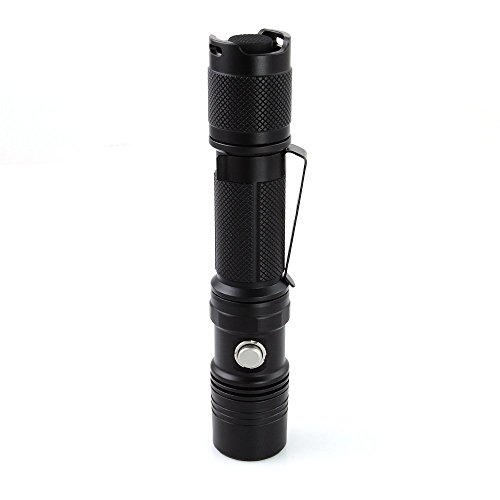
The flashlight I’m reviewing here is the ThruNite TN12 2016 model, which uses a CREE XP-L V6 LED and produces up to 1100 lumens. It features a durable aluminum body, separate tail and side switches, and several brightness settings.
The original TN12 runs on one rechargeable 18650 lithium-ion battery or two compatible CR123A batteries. Unlike newer rechargeable models, it doesn’t have a built-in USB charging port.
Technical Features of the ThruNite TN12 Tactical Flashlight
The following specifications apply to the 2016 ThruNite TN12 XP-L V6, not the newer TN12 V6 model.
| Features | ThruNite TN12 (2016) |
|---|---|
| Maximum Brightness | 1100 lumens |
| Minimum Brightness | 0.4 lumens |
| Maximum Runtime | 74 days (Firefly) |
| Turbo Runtime | 95 minutes (rated) |
| Peak Beam Intensity | 12,800 candela |
| Maximum Beam Distance | 226 meters |
| LED | CREE XP-L V6 |
| Body | Aircraft-grade aluminum |
| Battery Type | 1 × 18650 or 2 × CR123A |
| Water Resistance | IPX8 |
| Length | 143 mm |
| Weight | 86 g without battery |
| Lighting Modes | Firefly, Low, Medium, High, Turbo, and Strobe |
| Built-in Charging | No |
| Battery Included | Depends on package |
I’ve found the TN12 useful for everyday activities such as changing a tire and walking the dog in the evening. Its practical controls and multiple brightness settings are especially helpful when you need different amounts of light.
ThruNite TN12 Review in 2026
Sturdy Construction
This is one of those flashlights designed to handle demanding conditions. The TN12 has an aircraft-grade aluminum body that feels sturdy without being too heavy.
Its premium Type III hard-anodized finish provides resistance against scratches and everyday wear. The toughened, ultra-clear glass lens protects the LED, while the smooth reflector produces a focused beam with useful surrounding illumination.
Compared with the larger multipurpose Nebo Slyde, the TN12 is slimmer and easier to carry in a pocket or holster. The Slyde’s separate work light makes more sense if you want broad hands-free lighting for repairs.
Easy Operation
Despite its sturdy construction, the ThruNite TN12 is simple to operate. It has two switches: a tail-cap switch for turning the flashlight on and off and a stainless steel side switch for selecting brightness modes.
Press the tail switch halfway for momentary illumination or fully until it clicks for continuous lighting. Press it again to turn the flashlight off.
Once the flashlight is on, use the side switch to cycle through the regular brightness settings. Strobe is accessed separately through the side-switch controls.
This two-switch arrangement makes the TN12 practical for everyday use because you don’t need to cycle through several brightness levels just to turn the light on.
Related Product: SureFire G2X Pro Tactical Flashlight Review.
Powerful Flashlight with Multiple Brightness Modes
One feature that makes the original TN12 useful is its wide range of lighting modes. You can select a very dim setting for reading or a powerful beam for outdoor visibility.
Here are the manufacturer’s rated outputs and runtimes for the 2016 version using a 3400mAh 18650 battery.
| Lighting Mode | Brightness | Rated Runtime |
|---|---|---|
| Firefly | 0.4 lumens | 74 days |
| Low | 18 lumens | 5.5 days |
| Medium | 175 lumens | 11.8 hours |
| High | 435 lumens | 4.2 hours |
| Turbo | 1100 lumens | 95 minutes |
| Strobe | 1100 lumens | 3.8 hours |
Actual runtimes depend on battery condition, temperature, and brightness regulation. Turbo output may decrease as the flashlight heats up.
At up to 1,100 lumens, the TN12 works for checking your yard, walking outdoors, and handling roadside emergencies. The 226-meter figure measures beam reach under standardized conditions. How far you can identify an object also depends on its size, color, and surroundings.
Firefly mode is excellent for reading a map without disturbing others. Medium mode works well for ordinary tasks, while Turbo is useful when you briefly need maximum visibility.
The CREE XP-L V6 LED has a manufacturer-rated lifespan of approximately 50,000 hours. The original TN12 was offered in cool-white and neutral-white configurations.
If you’re comparing lighting performance across brands, our Streamlight ProTac HL USB review covers another capable rechargeable flashlight.
Water Resistance and Impact Protection
Do you intend to use this flashlight in rain, snow, or dusty outdoor conditions? The TN12 is designed to withstand challenging environments.
It carries an IPX8 water-resistance rating, with the original model rated for immersion up to 2 meters under specified conditions. It also offers impact resistance up to 1.5 meters.
However, IPX8 doesn’t mean the flashlight is suitable for diving or prolonged underwater operation. The rating also doesn’t independently certify dust protection.
Always inspect the O-rings and tighten the flashlight properly before using it in wet conditions.
Powered by an 18650 Rechargeable Battery
After using different batteries, I’ve come to appreciate flashlights powered by rechargeable 18650 cells. These batteries offer good capacity and can reduce the need to purchase disposable batteries regularly.
The original TN12 uses one compatible 18650 rechargeable battery. Alternatively, it can operate with two suitable primary CR123A batteries.
The 2016 model does not have built-in charging, so you’ll need an external charger for its rechargeable battery. Never attempt to recharge disposable CR123A batteries.
The flashlight also includes reverse-polarity protection. Check the battery wrapper before fitting it, and keep spare cells in a case so the terminals cannot contact keys or tools. For additional options, see our guide to 18650-powered flashlights.
Wide Range of Uses
Whether you’re looking for a flashlight for camping, hiking, walking the dog, power outages, or general home use, the TN12 can handle many everyday situations.
Its adjustable brightness makes it useful both indoors and outdoors. The focused beam is particularly helpful when you want to inspect something at a distance.
For hands-free work, though, a dedicated headlamp is usually more convenient.
Easy Storage
The original TN12 weighs approximately 86 grams without its battery, making it relatively lightweight for a tactical-style flashlight.
You can carry it in a backpack, keep it in a vehicle emergency kit, or attach it to a pocket using the included clip.
If you’re putting together a kit for power outages and want a zoom beam that can run on household batteries, see the GearLight S1200 Zoomable Flashlight Review. The smaller TN12 is easier to clip to a pocket.
Reliable Flashlight Brand
ThruNite makes several lines that cover different kinds of carry. If a 143 mm light is more than you want for daily errands, our ThruNite T10 review covers smaller AA models. The TN12 gives you an 18650 battery and a longer beam for outdoor use.
The TN12 series has gone through several updates, allowing buyers in 2026 to consider both the older design and more modern rechargeable versions.
ThruNite TN12 V6: What’s Different in 2026?
The newer ThruNite TN12 V6 improves on the original TN12 by offering greater brightness and more convenient charging.
According to ThruNite’s published specifications, the TN12 V6 delivers up to 1950 lumens and reaches approximately 259 meters. It uses a rechargeable 3400mAh 18650 battery and supports USB-C charging.
The manufacturer also lists Firefly output at 0.5 lumens with a maximum runtime of 41 days. Like the original TN12, it features dual switches, multiple brightness modes, IPX8 water resistance, and 1.5-meter impact resistance.
One important improvement is its battery-level indicator, which helps you monitor remaining power.
If you’re purchasing a TN12 today, check the exact model designation because the 2016 TN12 and TN12 V6 differ in brightness, battery package, and charging features.
 Check TN12 V6 Price
 See the USB-C TN12 V6
Pros of the ThruNite TN12 Flashlight
- Durable aircraft-grade aluminum construction
- Up to 1100 lumens on the original 2016 version
- CREE XP-L V6 LED with a focused beam
- Five regular brightness settings plus Strobe
- Toughened glass lens with anti-reflective coating
- Premium Type III hard-anodized finish
- Convenient tail switch and side switch
- Rechargeable 18650 battery compatibility
- Reverse-polarity protection
- Pocket clip and lanyard compatibility
- IPX8 water-resistance rating
- Impact resistance up to 1.5 meters

Cons of the ThruNite TN12 LED Flashlight
No built-in charging on the older model: The original TN12 requires an external battery charger. This is less convenient than newer USB-C rechargeable flashlights.
Switch durability concerns: Some owners have reported loose or unreliable switches over time. Keeping the contacts clean and avoiding unnecessary impact may help reduce problems.
Heat generation: Like many high-output LED flashlights, the TN12 becomes warm during extended Turbo operation. Brightness may automatically decrease to manage temperature.
Older design: The 2016 TN12 lacks newer features such as USB-C charging and a modern battery-level indicator.
ThruNite TN12 vs. TC12 vs. TC15: Full Comparison
If you’re trying to choose between these models, the following comparison highlights their main differences. Specifications refer to the listed versions, and performance may vary between generations.
| Feature | TN12 (2016) | TN12 V6 | TC12 V2 | TC15 V2 | TC15 V3 |
|---|---|---|---|---|---|
| Peak output | 1,100 lm | 1,950 lm | 1,100 lm | 2,531 lm | 2,403 lm |
| Rated beam distance | 226 m | 259 m | 240 m | 243 m | 223 m |
| Battery | 18650 or 2 CR123A | 3,400 mAh 18650 supplied | 3,400 mAh 18650 supplied | 3,100 mAh 18650 supplied | 3,100 mAh 18650 supplied |
| Charging | External charger for 18650 | USB-C | Micro-USB | Built-in USB | USB-C |
| Modes | 5 levels + strobe | 5 levels + strobe | 5 levels + strobe | 5 levels + strobe | 5 levels + strobe |
| Firefly output | 0.4 lm | 0.5 lm | 0.5 lm | 0.5 lm | 1 lm |
| Rated Firefly runtime | 74 days | 41 days | 49 days | 41.5 days | 30 days |
| Body | Aluminum | Aluminum | Aluminum | Aluminum | Aluminum |
| Water resistance | IPX8 | IPX8 | IPX8 | IPX8 | IPX8 |
| Switches | Tail and side | Tail and side | Tail and side | Side | Side |
| Weight without battery | About 86 g | Varies by configuration | 87 g | 71 g | 74 g |
Which one should you choose? The original TN12 remains useful if you already own it and prefer replaceable batteries with an external charger. The newer TN12 V6 is a better option for buyers who want USB-C charging and greater brightness. The TC12 V2 is the closest step sideways from the original TN12 if you want the same rated peak output with onboard charging. The TC15 V2 and V3 are smaller side-switch models. The V2 has the higher published beam distance of the two, and the V3 gives you USB-C.
Final Verdict: Is the ThruNite TN12 Worth Buying in 2026?
Our ThruNite TN12 review shows why this flashlight continues to be a practical everyday-carry flashlight, particularly for owners who appreciate straightforward controls and dependable construction.
The original model provides a strong 1100-lumen beam, several lighting modes, and durable water-resistant housing. Its biggest limitation is the lack of built-in charging.
For a new purchase in 2026, I’d generally lean toward the TN12 V6 because of its higher output, USB-C charging, and battery indicator. However, the older TN12 is still a capable flashlight if you already have one in good condition.
Whichever version you choose, confirm the specifications and included accessories before buying.
Frequently Asked Questions
1. What makes the ThruNite TN12 a good EDC flashlight?
The ThruNite TN12 offers a durable aluminum body, convenient dual-switch operation, adjustable brightness, and a pocket-friendly design. The original model produces up to 1100 lumens, making it suitable for many everyday and outdoor activities.
2. How long does the ThruNite TN12 battery last?
Runtime depends on the brightness mode, battery capacity, and flashlight version. The original TN12 is rated for up to 95 minutes on Turbo and 74 days on Firefly using a 3400mAh 18650 battery. These are rated figures, not guaranteed continuous output at maximum brightness.
3. Is the ThruNite TN12 waterproof and impact-resistant?
Yes. The original TN12 has an IPX8 water-resistance rating and is rated for impacts up to 1.5 meters. It can handle rain and accidental water exposure under its specified limits, but it isn’t intended for diving.
4. How does the TN12 compare with newer tactical flashlights?
The original TN12 still offers useful brightness and reliable controls, but newer flashlights often provide higher lumen output, USB-C charging, and battery indicators. The TN12 V6 is a good example of these improvements.
5. What battery is recommended for the ThruNite TN12?
A compatible, high-quality rechargeable 18650 lithium-ion battery is recommended for the original TN12. Two suitable primary CR123A batteries can also be used. Always follow the instructions for your particular TN12 version and avoid mixing batteries of different ages or charge levels.
6. Does the ThruNite TN12 have USB-C charging?
The original 2016 TN12 does not have built-in USB-C charging. The newer TN12 V6 supports USB-C charging, making it more convenient for travel and daily use.
7. Does the ThruNite TN12 get hot on Turbo mode?
Yes. The flashlight can become warm during extended use at maximum brightness. This is normal for powerful LED flashlights, but you should avoid covering the flashlight head or leaving it running unattended on Turbo.