Last Updated on November 17, 2026
I bought the GearLight S1200 as a backup for camping, evening walks and power outages. After more than three years with it, the adjustable beam is still the feature I use most. I can light the floor when I’m working in the garage and tighten the beam to see farther along a path. It feels solid in my hand, and I can run it on ordinary AAs when I’m away from my charger.
This GearLight S1200 review covers how the beam and tail switch work, what to check before buying batteries and where the larger body makes sense. I’d keep it in a daypack or by the back door. For a light I have to carry in a front pocket all day, I’d choose something slimmer.
GearLight S1200 Review and Specifications
Start with the instruction sheet in the box. The v7 GearLight manual documents three steady settings and two battery setups. Some store listings mention five modes or a 26650 cell. Use the mode list and supported cells on the paperwork for your actual kit.
| Beam | LED with a sliding head for a wide beam or a concentrated spot |
|---|---|
| Control | Red tail switch for power and mode changes |
| Modes in v7 | High, Medium and Low |
| Power in v7 | Three AA cells in the carrier or one protected 3.7 V 18650 in the clear tube |
| Charging | Remove rechargeable cells and charge them in a compatible external charger |
| Body and size | Aluminum body, about 5.9 × 2 × 2 in. in the product listing |
| Listed weight | About 10.1 oz. Carry weight varies with the cells and holder. |
| Water resistance | Rain and splashes in my use. Keep it above water. |
| Box contents | Light, AA carrier, 18650 tube, wrist strap and paperwork. Buy batteries separately. |
| Warranty | One-year limited warranty in the v7 guide |
| Price |  Check Price |
What the GearLight S1200 Is Like to Use
Build quality and grip
The metal body feels sturdy, and the wider head gives me something to grip when I change the focus. Mine has taken a few accidental drops and kept working. That’s my experience with one light. On a workbench I’d use the wrist strap or set the light where it can’t roll onto the floor. A case or a separate pocket also helps keep the lens clear of keys and loose tools.
The size makes it easy to find in a camping bag or a drawer during an outage. The head takes up more room than the body, so I’d check the opening of a holster before buying one. If you prefer a smaller fixed-beam light, the Fenix PD35 review explains the controls and battery setup on the different PD35 versions.
Tail switch and brightness settings
Press the red tail button all the way until it clicks to turn the light on or off. On the v7 setup, a light press cycles through High, Medium and Low. Turning the light off and back on quickly advances the mode as well. Leave it off for more than about ten seconds and it starts at High again. Try that sequence at home so you know what to expect the next time you switch it on in the dark.
Start on Medium for a garage or a short walk. Use High for a quick check farther away and switch down if the body gets hot. I judge brightness by how easily I can see the thing I’m looking for. If a purchase depends on a measured lumen or runtime figure, ask for a test sheet for the exact version. The v7 operating guide gives the switch sequence and supported batteries.
Zoom and beam shape
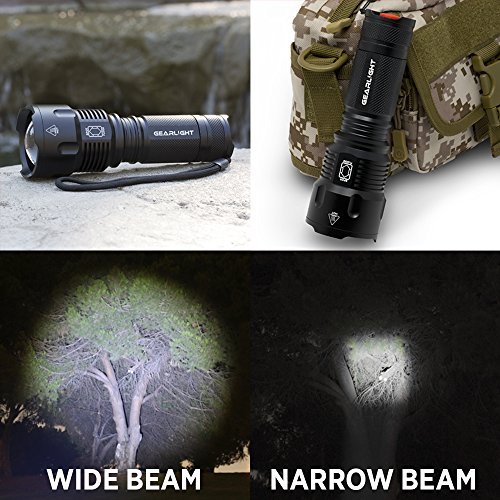
Hold the body and gently pull the head forward to narrow the beam. Push it back to spread light across a larger area. On a trail, start wide so you can see edges and roots near your feet. Tighten the beam to check a marker or a gate, then widen it again while walking. Both settings are useful in a garage, where a tight spot can reflect off light-colored surfaces and make it harder to see what is around the spot.
For a handheld alternative with a similar slide-focus design, the Coast HP7 with Slide Focus takes four AAA cells in the version covered in that review. If your main job is to light a bench while both hands are busy, the NEBO SLYDE work light adds a side work light and a magnetic base for a suitable steel surface.
 Check Price
Rain and outdoor use
I’ve used my S1200 on rainy walks and in light snow. Keep it out of standing water and dry the tail cap and surrounding threads before opening the battery compartment. After a wet outing, wipe it down before storing it. If water gets inside, take the light out of use and follow GearLight’s service instructions.
Battery Choice, Runtime and Troubleshooting
Using the AA holder or 18650 tube
- For AA power, take out the carrier and fit three matching cells according to its polarity marks. Insert the loaded carrier with its positive end toward the head.
- For rechargeable lithium-ion power, use a protected 3.7 V 18650 approved for the kit. Put it in the clear tube and insert the assembly positive end first. Charge the cell outside the flashlight in a charger approved for it.
- Seat the tail cap fully, then test each steady level before packing the light. Keep the AA carrier with the light if you plan to switch to AAs while you’re away.
AAs are handy for a backup because you can keep a fresh set nearby. A compatible 18650 is useful for regular use if you already have a suitable charger. For other value-focused options with compatible rechargeable cells, our best budget 18650 flashlight guide compares several designs; check current pricing and included accessories before buying. Runtime varies with the setting, the cell and how much time you spend on High. Before a trip, test the light on your usual setting with the cells you plan to carry. Carry spare cells in a case that keeps their terminals away from metal, and remove the installed cells before long-term storage.
If the light flickers, dims or stays off
Switch the light off and check the simple things first. Confirm that the cells face the right way, the contacts are clean and the tail cap is seated. Try a fresh matching AA set or a charged compatible 18650. If the light changes modes when you tighten the cap, recheck that the holder is fully seated. When the light is warm from using High, switch down and let it cool before judging the beam.
If the switch is still intermittent after testing with known-good cells, stop using the light and contact GearLight. Its limited warranty covers defects in materials or workmanship for one year from purchase. Keep the receipt and include the model and battery setup when asking for service. GearLight responded quickly when I had a minor issue with mine.
Pros and Cons of the GearLight S1200
Pros
- The sliding head makes the light useful both at arm’s length and farther down a path.
- The AA carrier is useful when I need replacement cells away from home.
- The aluminum body feels solid and the tail button is easy to find by feel.
- It works well as a household or camping backup for the price I paid.
Cons
- The wide head and mid-size body take up room in a pants pocket.
- Rechargeable cells require a separate charger.
- Rapid off/on cycling can change the setting you expect at startup.
- Check the operating guide for the exact kit if a particular mode or battery type matters to you.
Comparison With Similar Flashlights
The original Fenix TK20R and the original Klarus XT11GT make sense if you want a fixed beam and charging in the flashlight. Both have newer versions, so check the model suffix when comparing features. The S1200’s appeal is its adjustable head and AA carrier.
Swipe or scroll to see all three models.
| Feature | GearLight S1200 | Fenix TK20R | Klarus XT11GT |
|---|---|---|---|
| Output | Three steady levels in the v7 guide | Rated 1,000 lumens on Turbo | Rated 2,000 lumens on Turbo |
| Beam | Slide focus for a spot or wide area | Fixed beam with rated reach of 310 m | Fixed beam with a concentrated hotspot |
| Power and charging | AA carrier or protected 18650. Charge rechargeable cells outside the light. | 18650 with Micro-USB charging. Two CR123A primaries can power it as a backup. | 18650 with Micro-USB charging. Use the battery types listed for the original kit. |
| Water resistance | For rain and splashes in my use | Rated IPX8 | Rated IPX8 |
| Size and weight | About 5.9 in. long and 10.1 oz. in the product listing | About 6 in. long and 5 oz. without the battery | About 5.6 in. long and 4.4 oz. without the battery |
| Where I’d use it | Home, campsite or a walk that calls for both beam shapes | Regular belt carry and distance checks | A fixed beam with dedicated tail controls |
Frequently Asked Questions
What batteries fit the GearLight S1200?
The v7 guide lists three AA cells in the holder or one protected 3.7 V 18650 in the clear tube. Follow the insert for your kit when buying a replacement. AAs give you an easy option to keep on hand for an outage.
How many lumens does the GearLight S1200 produce?
GearLight’s v7 operating guide lists three steady settings. For a verified peak lumen figure, look for test data for your exact kit. For household use, check how well the wide setting lights a room and whether the spot reaches the distance you need outside.
How do I get back to High?
On the three-mode v7 setup, switch the light off and give it more than ten seconds before turning it back on. A quick restart advances to the next setting.
Why is my GearLight S1200 dim or flickering?
Turn it off and check the cell charge, contact surfaces and tail cap. A test with a fresh AA set can help you narrow down whether the problem comes from the rechargeable cell or the light.
Can I use the S1200 in the rain?
I’ve used it in rain and light snow. Keep it above water, and dry the outside of the light before opening the battery compartment.
Is the GearLight S1200 Worth Buying?
After three years, I still reach for it when I need a wide beam for the garage or a narrow spot to check the yard. I’d buy it as a home or camping backup if I wanted adjustable focus and the option to run ordinary AAs. If I carried a light in a pocket every day or needed a published runtime for work, I’d use those requirements to choose one of the smaller fixed-beam models above.