Last Updated on November 11, 2026
If you’re looking for a flashlight that can light up a wide area in seconds, the Imalent DX80 lives up to its nickname, “The End of Darkness.” Its eight LEDs are rated for a 32,000-lumen burst. Once the light heats up, the output drops, so the lower modes matter more if you’re walking a trail or checking a work site for an hour.
This Imalent DX80 review covers the build, output levels and charging system, then compares it with the original Acebeam X80GT. The DX80 offers more rated reach and a larger battery pack. The X80GT is much shorter and lets you remove its four cells for charging. Those differences matter more in use than the 500 lumens between their peak ratings.
Technical Specifications of the Imalent DX80 Flashlight
| Feature | Imalent DX80 |
|---|---|
| Maximum output | 32,000 lumens on Turbo |
| Emitters | Eight Cree XHP70.2 LEDs |
| Beam | Fixed reflector, 162,600 cd peak intensity and 806 m rated distance |
| Modes | Six brightness levels including Turbo, plus strobe |
| Body | Type III hard-anodized aluminum alloy |
| Battery | One factory pack with eight 3,000 mAh 18650 lithium-ion cells |
| Charging | 19 V, 2 A wall adapter and covered barrel jack. About 3 h 10 min per the manual. |
| Dimensions | 213 mm long × 92 mm at the head × 53.5 mm at the body |
| Weight | 1,204 g with the battery pack |
| Water and impact ratings | IPX8 to 2 m, 1.5 m drop rating |
| Warranty | Current store policy lists two years for the head and one year for the battery. |
When you choose a flashlight for a large area, check the beam pattern, usable output after step-down and total carry weight. The DX80 is just over 1.2 kg ready to use, so it makes more sense in a vehicle kit or a pack than clipped to a pocket.
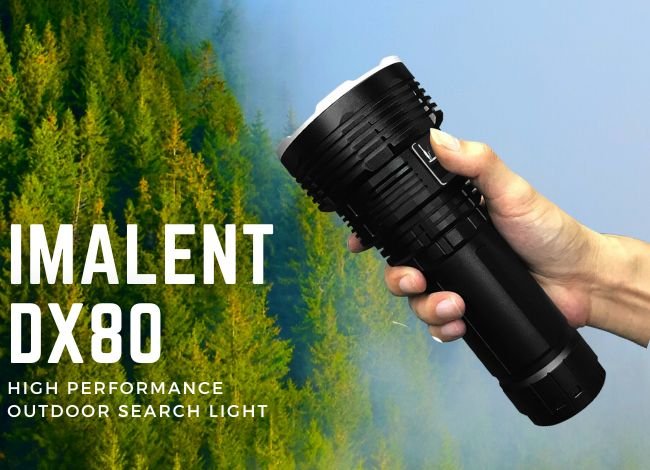
Imalent SR16 alternative. The SR16 is a separate Imalent searchlight rated for 55,000 peak lumens and a maximum beam distance of 1,715 m. Check Price
Imalent DX80 Review: Design, Build Quality & Key Features
Aerospace-Grade Durability
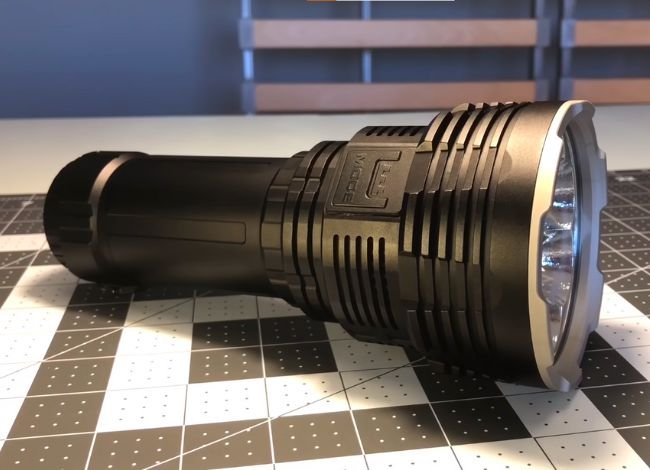
The DX80 has an aluminum alloy body with a Type III hard-anodized finish. The wide head has cooling fins and a toughened lens with an anti-reflective coating. There is room on the body for a full grip, though the large head and battery tube make this a substantial light to carry on a belt all day.
Advanced LED Technology
Eight Cree XHP70.2 LEDs sit in a textured aluminum reflector. The DX80 puts out a wide beam with enough intensity to reach well beyond the near foreground. Imalent rates it at 162,600 candela and 806 m of beam distance. That distance describes the reach of the beam under the rating standard. Seeing enough detail to identify a person or read a sign depends on the target, glare, haze and what else is illuminated between you and it.
The smaller Nitecore P12GT is a useful contrast. It uses a more concentrated beam in a pocket-size body, which makes sense for checking a particular object along a trail. If you need to see an entire clearing, the DX80’s extra spill helps. Our guide to flashlight flood and throw explains why peak lumens and beam distance tell you different things.
OLED Display and Thermal Management
The OLED can show the selected output, pack voltage, charge status and overheating warning. The lumen number on the display identifies the setting. The light can already be getting dimmer as the battery discharges or the head warms up.
Imalent’s DX80 manual describes a heat warning at about 50°C inside the light and a reduction to roughly 7,000 lumens in the high-output modes. Airflow, ambient temperature and battery charge affect how long the brighter stage lasts. If you need more light after a step-down, let the head cool first and return to a lower steady setting for continuous work.
IPX-8 Waterproof Rating and Impact Resistance
Imalent rates the DX80 for submersion to 2 m under its IPX8 test conditions and for a 1.5 m drop. Seat the charging-port cover fully before using it around water. Inspect the cover and O-rings if the light has taken a hard knock. The flat tail lets the light stand upright on a level surface. For indoor area lighting, a lower mode bounced off the ceiling is easier on the eyes and runs longer.
Built-in Safety Protections
The DX80 gives a low-voltage warning and has an electronic lockout for carrying it in the holster or a bag. Engage the lockout and confirm the switch is locked before packing it. A short burst at high output can heat the head quickly, so keep the lens clear of fabric and avoid pointing the beam at people or traffic.

Performance, Modes & Runtime
Versatile Light Modes
There are five regular brightness settings, a shortcut to Turbo and a separate strobe. The table uses Imalent’s ratings. Where two output levels are listed, the time at the starting output is followed by the time at the reduced output.
| Mode | Rated output and runtime |
|---|---|
| Low | 120 lm · 168 h |
| Mid-Low | 500 lm · 40 h 46 min |
| Mid | 1,500 lm · 5 h 40 min |
| Mid-High | 5,000 lm · 2 h 25 min |
| High | 13,000 lm for 8 min, then 7,000 lm for 122 min |
| Turbo | 32,000 lm for 3 min, then 7,000 lm for 100 min |
| Strobe | Double-press from Turbo to activate |

Outstanding Runtime
Imalent rates Turbo for about three minutes before the drop from 32,000 to 7,000 lumens. High starts at 13,000 lumens and is rated for about eight minutes before stepping down to the same level. For an extended search, start with 5,000 lumens when you need to cover a large area and save Turbo for short checks. On reflective surfaces or around a group, 500 or 1,500 lumens can be more comfortable.
The 168-hour rating belongs to the 120-lumen Low mode. That’s the setting I’d start with for lighting a campsite after dark or stretching a charge during a power outage. Low is still fairly bright for a tent or close-up reading. A smaller light with a dimmer setting can be more useful at arm’s length.
Easy One-Handed Operation
Tap the side switch to turn the light on or cycle through the five regular levels. Briefly hold it to switch off. Double-press for Turbo, then double-press again from Turbo for strobe. A single press exits strobe. The DX80 remembers the last regular setting and gives you a triple-press shortcut to the OLED information.
With the light off, hold the switch for about a second to lock it. Hold it again to unlock it. Try this at home before taking the light out, especially if you’ll be operating the switch with gloves.
Battery Pack and Charging
The DX80 runs on one factory pack built from eight 3,000 mAh 18650 lithium-ion cells. The cells are part of the pack assembly. If the pack fails, check with Imalent for the matching assembly instead of trying to fit loose 18650s. Our 18650 flashlight guide explains why cells with the same size designation can have different terminals and protection circuits.
Charge the pack in the flashlight through the covered barrel jack using the supplied 19 V, 2 A wall adapter. The DX80 manual estimates about 3 hours and 10 minutes for a full charge. The OLED shows charging progress and a full battery symbol at the end. Use the adapter approved for the DX80, get the plug version for your region, and close the cover after charging. A phone USB cable won’t plug into this charging port.
If a newly unpacked DX80 stays dark, check for a shipping insulator at the battery contact and make sure the head is fully threaded onto the pack. If the OLED still shows a low-battery warning after charging, check the adapter and seating before assuming the cells need replacing.
Real-Life Applications & Comparison
Ideal Use Cases
- Search and rescue. Use the wide beam to scan a clearing and reserve Turbo for a quick look across a field or down an embankment.
- Fishing and boating. A lower mode helps with knots and equipment without glare off the deck or water. Check the port seal before bringing the light aboard.
- Security and patrol. The DX80 works well for checking the far end of a yard from a fixed position. For regular belt carry, a slimmer Fenix TK20R flashlight is easier to handle and has a tail switch.
- Construction and repairs. Tail-stand the light for bounced illumination or keep it low around polished or light-colored surfaces. A headlamp is easier when both hands are occupied.
- Camping and vehicle kits. The DX80 can light a wide pitch or help check a roadside problem. Its weight and dedicated wall adapter are worth factoring in if you will be hiking far from the car.
For a smaller light that lives on a belt or in a pocket, our best tactical flashlights guide covers models in several sizes.

Flashlight Comparison: Imalent DX80 vs. Acebeam X80GT
This comparison uses the original X80GT with 18 Cree XHP50.2 LEDs. The X80GT 2 has different LEDs and separate ratings of 34,000 lumens and 498 m. If you’re reading a box or a manual, look for the generation name before using the numbers below.
| Feature | Imalent DX80 | Original Acebeam X80GT |
|---|---|---|
| Maximum output | 32,000 lm | 32,500 lm |
| Emitters | 8 × Cree XHP70.2 | 18 × Cree XHP50.2 |
| Rated beam distance | 806 m | 369 m |
| Peak beam intensity | 162,600 cd | 34,000 cd |
| Turbo step-down | To 7,000 lm after about 3 min | To 4,000 lm after about 1 min on Turbo Max |
| Body material | Hard-anodized aluminum | Hard-anodized aluminum |
| Battery | Factory pack with eight 3,000 mAh 18650 cells | Four removable high-drain 3,100 mAh 18650 cells |
| Charging | Wall adapter plugs into the DX80 | Remove the cells and charge them externally |
| Length | 213 mm | 117.7 mm |
| Weight | 1,204 g including pack | 330 g excluding cells |
| Water resistance | IPX8 to 2 m | Rated for accidental immersion to 30 m |
| Impact rating | 1.5 m | 1.2 m |
On paper, the DX80 gives you a longer first burst and a higher step-down level. The Acebeam is easier to carry when space is tight. Its 330 g rating excludes the batteries, while the DX80’s 1,204 g rating includes the pack. The depth ratings apply to water resistance. Acebeam describes the 30 m rating as protection against accidental immersion and advises against operating the X80GT underwater.
| Mode | Rated output and runtime |
|---|---|
| Low | 200 lm · 34 h |
| Med 1 | 1,000 lm · 7 h |
| Med 2 | 2,000 lm · 3.5 h |
| Med 3 | 4,000 lm · 1.7 h |
| High | 8,000 lm for 4 min, then 4,000 lm for 1.5 h |
| Turbo | 15,000 lm for 2 min, then 4,000 lm for 1.6 h |
| Turbo Max | 32,500 lm for 1 min, then 4,000 lm for 1.7 h |
| Strobe | 4,000 lm · 3.4 h |
The X80GT’s 32,500-lumen figure applies to Turbo Max. It starts to make more sense as a compact floodlight when you look at the 4,000-lumen Med 3 mode and the ability to recharge the four cells in a separate charger. Use a matching set of the recommended high-drain cells and follow the carrier’s polarity markings.
Original Acebeam X80GT Check Price
Imalent SR16 is the separate model to compare if you want more rated beam distance than the DX80. Check Price
Pros and Cons of the Imalent DX80
Pros of Imalent DX80
- Wide beam with a short 32,000-lumen Turbo and 806 m of rated reach.
- Useful middle settings and up to 168 hours at 120 lumens.
- Hard-anodized aluminum construction, IPX8 rating and a 1.5 m impact rating.
- Included eight-cell pack charges through a port on the light.
- OLED voltage and mode display, electronic lockout and a flat tail.
Cons of Imalent DX80
- High and Turbo step down, and the head warms up quickly at full power.
- At 1,204 g with the pack, this is too bulky for most everyday carry.
- Charging takes roughly three hours with the dedicated wall adapter.
- Battery service requires the matching pack assembly.
Final Verdict
I’d choose the DX80 for lighting up an open area from a fixed spot or for a vehicle kit with access to its wall charger. The 5,000-lumen setting is the figure I’d weigh for a longer search. The 32,000-lumen burst is useful when you need to see across a wide space for a few moments.
The original Acebeam X80GT makes more sense if you want broad light in a shorter body and prefer to charge the cells separately. For routine hiking or close work, a smaller light with a lower minimum setting is easier to carry and use.
Frequently Asked Questions (FAQ)
What accessories come with the Imalent DX80 flashlight? Imalent lists the rechargeable pack, wall charger, holster, lanyard, spare O-rings and user manual. The plug on the wall adapter depends on the region.
Is the flashlight zoomable? The DX80 has a fixed reflector. The switch changes brightness, while the shape of the beam stays broadly the same.
How does the warranty work? Imalent’s current store policy lists two years for the head and one year for the battery. The original printed DX80 manual described a five-year repair term. If you’re making a claim, keep your receipt and confirm the terms that apply to your purchase with the seller or Imalent.
How does it compare to other Imalent models like the DT70 or DN35? The DT70 is rated for 16,000 peak lumens and runs on four 18650 cells. It makes sense if you want a smaller high-output light. The DN35 is a palm-size model with one 26650 cell, a 2,200-lumen peak and a rated beam distance of 596 m. It is easier to carry if you mainly need to see one part of a trail or yard.
Is it good for tactical use? The one-handed controls and wide beam can help on a perimeter check or when looking over an open area. For routine patrol, consider how often you’ll need to draw the light from a belt or work one-handed for long periods.
How heavy is it with the battery? Imalent lists 1,204 g with the pack fitted, or about 2.65 lb. Allow extra space for the 92 mm head when you pack it.
Imalent has stopped working assuming its the battery ive had this light for just under two years. Am i able to get it tested?