Last Updated on October 15, 2026
In this detailed Fenix LD15R review, we’ll examine its specifications, real-world performance, battery life, durability, common problems, and whether it’s still a good choice in 2026.
One important detail is that Fenix has officially discontinued the LD15R. Although the flashlight remains practical, buyers should consider its limited availability and the condition of any remaining stock.
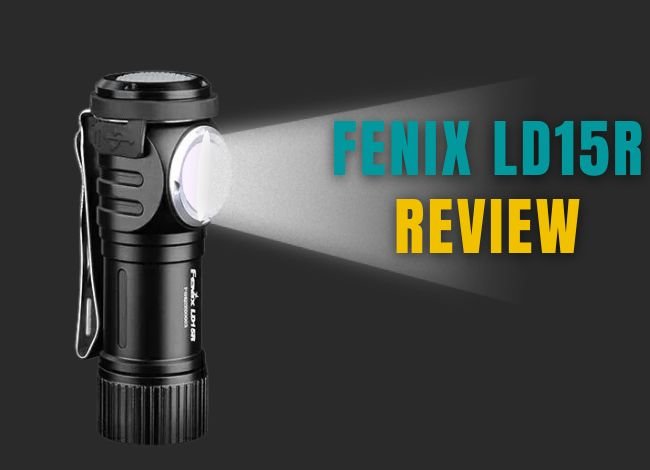
The Fenix LD15R comes with several features that make everyday tasks easier:
- Battery Level Indicator: Shows the approximate remaining battery charge.
- Red Light Mode: Provides low-intensity lighting that can help preserve dark adaptation.
- Magnetic Tail Cap: Allows the flashlight to attach to suitable ferromagnetic metal surfaces.
- Micro-USB Charging: Recharges the compatible 16340 battery without removing it.
- Four White Brightness Levels: Offers different outputs for close-up work and general illumination.
- Two-Way Body Clip: Makes it easier to attach the light to clothing, pockets, or suitable gear.
- IP68 Protection: Provides dust and water resistance within the manufacturer’s rated conditions.
With its compact size, durable construction, and practical lighting options, the LD15R remains an interesting choice for people who prefer a small everyday carry flashlight that can also be used hands-free.
Fenix LD15R Review: Quick Specifications
Before exploring the individual features, let’s look at the flashlight’s official specifications.
| Specification | Fenix LD15R |
|---|---|
| Maximum Brightness | 500 lumens |
| Maximum Beam Distance | 85 meters / 279 feet |
| Maximum Runtime | 110 hours |
| White Light Modes | Turbo, High, Medium, Low |
| Additional Modes | Red, Red Signal, Red SOS |
| Total Lighting Modes | 7 |
| White LED | CREE XP-G3 |
| Red LED | EVERLIGHT |
| Battery | 1 × 16340 rechargeable Li-ion or 1 × CR123A lithium |
| Original Included Battery | Fenix ARB-L16-700, 700mAh |
| Charging | 5V/1A Micro-USB |
| Approximate Charging Time | 1.5 hours |
| Battery Indicator | Yes, with compatible rechargeable battery |
| Switch | Single head-mounted electronic switch |
| Length | 70 mm / 2.76 inches |
| Body Diameter | 19 mm / 0.75 inches |
| Weight | 40 grams / 1.41 ounces without battery |
| Water Resistance | IP68, rated for 2-meter immersion |
| Impact Resistance | 1 meter |
| Body Material | High-strength aluminum alloy |
| Carrying Features | Two-way clip and magnetic tail cap |
| Product Status | Discontinued |
Fenix LD15R Review: Rechargeable Mini EDC Flashlight Features
If you’re looking for a compact yet powerful right-angle flashlight, the LD15R has several advantages worth considering.
Despite measuring only 2.76 inches long, it produces up to 500 lumens of white light. It also provides separate red-light modes, a magnetic base, and a practical two-way clip.
These features make it useful for jobs where holding a flashlight with one hand would be inconvenient.
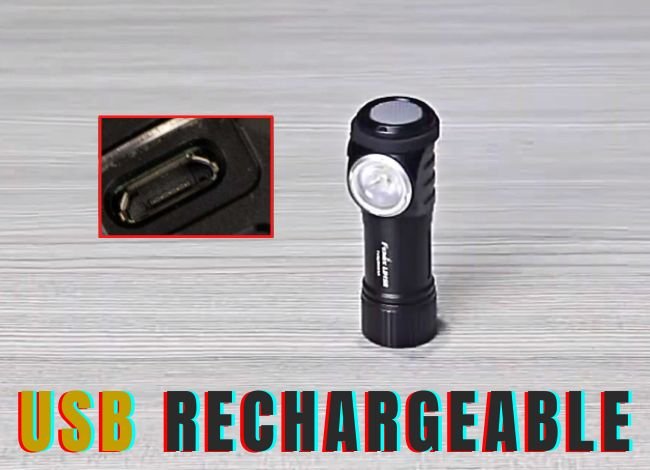
Right-Angle Design for Hands-Free Lighting
Most conventional flashlights shine straight ahead from the end of the body. The LD15R uses a different design, placing the light source at a right angle.
This makes it easier to position the beam where you need it while keeping your hands free.
For example, you can clip the flashlight onto a shirt pocket or suitable strap while working on equipment. The light faces forward instead of pointing toward the ground.
It’s also useful for looking inside cabinets, inspecting machinery, or working around a vehicle.
Because the flashlight is small, it doesn’t add much weight to your clothing or gear. However, the clip must be attached securely, and its angle may not suit every task.

Two-Way Body Clip and Magnetic Tail Cap
One of the strongest selling points of the Fenix LD15R is its flexible carrying design.
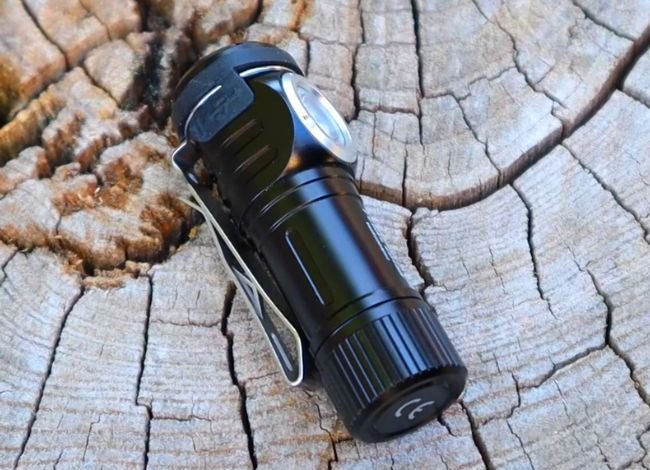
The two-way body clip lets you attach the flashlight in different orientations. This is particularly helpful when wearing it on a pocket or suitable piece of equipment.
The magnetic tail cap adds another practical option. You can attach the light to a stable steel surface and direct the beam toward your work area.
For example, when checking something under a vehicle hood, a magnetic flashlight can be much more convenient than holding a regular torch.
Keep in mind that the magnet won’t attach securely to aluminum, plastic, or nonmagnetic stainless steel. The surface should also be clean and strong enough to hold the flashlight’s weight.
For tasks involving moving machinery or electrical equipment, make sure the light is positioned safely before starting work.
Simple Single-Button Operation
The Fenix LD15R uses a single electronic switch located near the top of the flashlight.
This control handles power, brightness adjustment, and switching between white and red lighting modes.
According to Fenix’s operating instructions:
- Turn on: Press and hold the switch for approximately 0.5 seconds.
- Turn off: Press and hold the switch for approximately 0.5 seconds while the light is on.
- Change white brightness: Single-click to cycle through Low, Medium, High, and Turbo.
- Switch between white and red modes: Press and hold for approximately 1.2 seconds while the flashlight is on.
- Change red modes: Single-click to cycle through Red, Signal Light, and SOS.
The flashlight also remembers the last-used regular lighting output, making repeated use more convenient.
Although the controls are straightforward, it’s worth practicing the timing required for changing between white and red light.
Rechargeable Battery Options
The LD15R is powered by one rechargeable 16340 lithium-ion battery. The original retail package includes a Fenix ARB-L16-700 battery with a rated capacity of 700mAh.
It also supports a single CR123A primary lithium battery, which can be useful as emergency backup power.
Only one battery is used at a time. Do not install two CR123A batteries in this flashlight.
There is also an important difference between these battery types.
The 16340 lithium-ion battery is rechargeable, while a standard CR123A primary battery is not. Never try to recharge a non-rechargeable CR123A cell inside the flashlight.
The LD15R has a built-in Micro-USB port that can recharge its compatible 16340 battery. Fenix specifies approximately 1.5 hours to recharge the original battery under normal conditions.
When using the flashlight during charging, only the Low output is available, and charging may take longer.
The rechargeable setup is especially convenient if you use the flashlight frequently. Instead of replacing disposable batteries, you can charge it using a suitable USB power source.
Battery Level Indicator
Another useful feature is the built-in battery indicator. It lets you check the approximate remaining charge before starting a task.
With the flashlight switched off, single-click the top button. The indicator displays the battery status for approximately three seconds.
| Indicator | Battery Level |
|---|---|
| Solid Green | 85%–100% |
| Flashing Green | 50%–85% |
| Solid Red | 25%–50% |
| Flashing Red | 1%–25% |
This feature is designed for use with the compatible rechargeable lithium-ion battery. Fenix notes that battery level indication is unavailable when using a CR123A primary battery.
If the indicator flashes red, it’s a good idea to recharge or replace the battery before relying on the flashlight for an extended task.
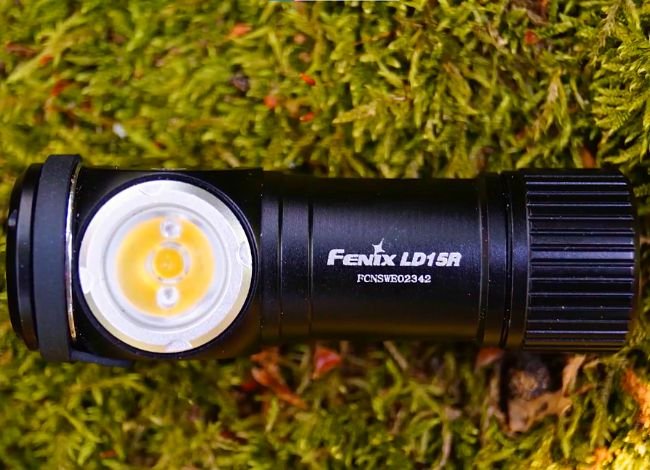
Red Light for Nighttime Tasks and Emergency Signaling
Unlike many basic EDC flashlights, the Fenix LD15R includes a separate red LED.
Red light is useful when you need low-intensity illumination without using a bright white beam. At a suitable brightness, it can help preserve dark adaptation during nighttime activities.
For example, you may prefer red light when reading a map, checking gear inside a tent, or moving around a campsite after dark.
The flashlight also includes red signal and SOS modes that can help attract attention in an emergency.
However, red light doesn’t guarantee that insects will stay away, and it shouldn’t be treated as a reliable insect-repellent method. It is primarily a lighting and signaling feature.
The LD15R does not include a conventional high-output white strobe mode, which may be a limitation for users who specifically want that feature.
Compact and Durable Construction
The LD15R measures only 70 mm long and weighs approximately 40 grams without the battery. This makes it easy to carry in a pocket, backpack, or small equipment pouch.
Its high-strength aluminum housing has a premium hard-anodized finish that helps resist scratches and everyday wear.
The flashlight also carries an IP68 rating, with manufacturer-specified water resistance at a depth of up to 2 meters.
That makes it useful in rainy or dusty environments, provided the tail cap and charging-port cover are properly secured and the seals remain in good condition.
It also has a 1-meter impact-resistance rating, offering some protection against accidental drops.
Fenix LD15R Flashlight Performance and Runtime
The Fenix LD15R produces a maximum of 500 lumens with a rated beam distance of 85 meters.
For a flashlight this small, that is a useful amount of light. It can illuminate nearby work areas, paths, camping equipment, and objects at moderate distances.
Its beam is more appropriate for general utility work than for extended long-range searching.
Keep in mind that the maximum beam-distance rating is determined under standardized test conditions. The distance at which you can clearly identify an object will generally be shorter.

White Light Brightness Levels
| Mode | Brightness | Rated Runtime |
|---|---|---|
| Turbo | 500 lumens | 1 hour 20 minutes |
| High | 150 lumens | 2 hours 50 minutes |
| Medium | 30 lumens | 13 hours 20 minutes |
| Low | 3 lumens | 110 hours |
These figures are manufacturer-rated results using a specified rechargeable battery and laboratory test conditions. Actual runtime can vary with battery health, temperature, and use.
Does the LD15R Maintain 500 Lumens Continuously?
No. The flashlight automatically reduces brightness after approximately five minutes of Turbo operation.
Fenix specifies that the LD15R steps down to approximately 200 lumens to limit excessive heat buildup.
This behavior is normal and helps protect the flashlight during prolonged operation.
For routine tasks, the 150-lumen High mode often offers a useful balance between brightness and battery life.
The 3-lumen Low mode is particularly helpful when you need a little light for a long period, such as during a power outage or inside a tent.
Where Is the Fenix LD15R Most Useful?
Vehicle Maintenance and Inspection
The magnetic base and right-angle head make the LD15R particularly useful for inspections and light mechanical work.
You can attach it to a suitable steel surface, point the beam toward the area you’re inspecting, and keep both hands available for the task.
The flashlight is small enough to fit into many confined spaces where a larger work light would be inconvenient.
Camping and Hiking
For outdoor activities, the two-way clip and red-light modes are helpful additions.
The white light can illuminate a trail or campsite, while the red output is useful when you want less disruptive nighttime lighting.
However, the LD15R doesn’t come with a dedicated headband in its standard package. If you regularly need a forehead-mounted light, a purpose-built headlamp may be more comfortable.
Emergency Preparedness
The LD15R is also practical for emergency kits because it supports two battery types and offers a long-running Low mode.
Its magnetic tail allows flexible positioning, and the red signaling functions provide another way to attract attention.
For extended storage, remove the battery or follow the manufacturer’s storage guidance. Recharge stored compatible batteries periodically.
Fenix LD15R Troubleshooting Guide
Even a reliable flashlight can develop problems after repeated use. Battery condition, dirty contacts, loose components, and charging-port issues are among the first things to check.
| Problem | Possible Cause | Recommended Solution |
|---|---|---|
| Flashlight doesn’t turn on | Battery insulation disc, depleted battery, incorrect installation, or dirty contacts | Remove any shipping insulation disc, verify polarity, charge or replace the compatible battery, and inspect contacts. |
| Works only while plugged in | Depleted or defective rechargeable battery | Test with a known-good compatible battery. Seek service if the problem remains. |
| Unexpected shutdown | Low battery voltage, battery protection activation, or connection problem | Recharge or replace the compatible battery and check accessible contacts. |
| Flickering or intermittent output | Dirty contacts, loose tail cap, or worn electrical connection | Clean accessible contacts safely and secure the tail cap. Seek service if flickering continues. |
| Charging indicator turns green but flashlight won’t operate | Battery condition or internal power issue | Test with a compatible battery before assuming the charging indicator proves the battery is healthy. |
| Brightness suddenly decreases | Normal Turbo step-down or low battery | Check operating duration and battery status. A reduction after five minutes on Turbo is expected. |
| Charging doesn’t work | Damaged cable, unsuitable power source, dirty port, or battery problem | Try a suitable Micro-USB cable and 5V power source. Inspect the port without inserting metal objects. |
Safe Maintenance Tips
If the flashlight isn’t working properly, remove the battery before inspecting or cleaning accessible contacts.
Fenix recommends cleaning dirty contacts with a cotton swab lightly moistened with rubbing alcohol. Make sure everything is completely dry before reinstalling the battery.
Never attempt to dismantle the sealed flashlight head or force the electronic switch. These parts are not intended for routine user servicing.
Also inspect the O-rings and replace worn seals using suitable replacement parts to maintain water resistance.
Fenix LD15R Pros and Cons
Advantages
- Very compact and lightweight.
- 500-lumen maximum output.
- Practical right-angle design.
- Magnetic tail for hands-free use.
- Two-way body clip.
- Micro-USB rechargeable.
- Supports a compatible CR123A backup battery.
- Separate red-light and signaling modes.
- Battery level indication.
- 110-hour maximum rated runtime.
- IP68 dust and water resistance.
Disadvantages
- Officially discontinued.
- No high-output white strobe.
- No dedicated tactical tail switch.
- Uses older Micro-USB charging.
- Turbo automatically steps down after five minutes.
- Small battery limits high-output runtime.
- No dedicated headband in the standard package.
- Replacement accessories may be harder to find.
Fenix LD15R vs HM50R: Which Flashlight Is Better?
The Fenix LD15R and original Fenix HM50R share several features, including compact construction, 16340 battery compatibility, and a maximum white-light output of 500 lumens.
However, they serve different purposes.
The LD15R focuses on everyday carry and handheld or magnetic hands-free use, while the HM50R is designed primarily as a rechargeable headlamp.
This comparison uses the original HM50R, not the newer HM50R V2.0.
| Features | Fenix LD15R | Original Fenix HM50R |
|---|---|---|
| Maximum Brightness | 500 lumens | 500 lumens |
| Beam Distance | 85 meters | 80 meters |
| Battery | 1 × 16340 or CR123A | 1 × 16340 or CR123A |
| Charging | Micro-USB | Micro-USB |
| White Brightness Levels | 4 | 4 |
| Red Light | Yes | No |
| Red Signal and SOS | Yes | No |
| Dedicated Headlamp Setup | No | Yes |
| Magnetic Tail | Yes | No built-in magnetic tail |
| Pocket Clip | Yes | No |
| Water Resistance | IP68 | IP68 |
| Impact Resistance | 1 meter | 1 meter |
| Weight | 40g without battery | 63g including holder and headband, without battery |
| Best For | EDC, repair work, inspection | Camping, hiking, headlamp use |
Choose the LD15R for Everyday Carry and Work
The LD15R is the better option when you want a small flashlight that can be clipped to clothing or attached to metal surfaces.
Its magnetic base, red-light function, and pocket-friendly design are particularly useful for repairs, inspections, and general EDC.
Choose the HM50R for Headlamp Use
The original HM50R is more suitable if you want to wear a light on your head for hiking, camping, or working in places where you need continuous hands-free illumination.
Its included headband and holder make it easier to direct light by moving your head.
Both models are older designs. Before purchasing either one in 2026, check the exact version, condition, and availability of suitable replacement batteries.
Is the Fenix LD15R Still Worth Buying in 2026?
The LD15R remains a useful flashlight, especially for people who value compact size and hands-free versatility.
Its right-angle design, magnetic tail, red-light modes, and 500-lumen maximum output make it practical for everyday tasks. The ability to use either a compatible 16340 rechargeable battery or a single CR123A primary battery also adds flexibility.
However, its discontinued status changes the buying decision.
Newer compact flashlights may provide USB-C charging, updated battery systems, stronger output, or more convenient controls. That doesn’t make the LD15R obsolete, but it does mean you should compare alternatives before paying a premium for remaining inventory.
Before buying, check the following:
- Whether the unit is new old stock, refurbished, or used.
- Whether the original rechargeable battery is included.
- Whether the battery still holds a reliable charge.
- Whether the Micro-USB charging port works correctly.
- Whether all white and red lighting modes operate.
- Whether the magnetic tail and pocket clip are secure.
- Whether the seller offers a reasonable return policy.
If you already own the LD15R and it works properly, it can still be an excellent everyday utility flashlight.
Final Thoughts on the Fenix LD15R Flashlight
The Fenix LD15R combines several useful features in a remarkably small body. Its 500-lumen maximum output, right-angle design, magnetic base, and two-way clip make it suitable for close-up inspections, outdoor activities, and general household tasks.
The red-light modes and rechargeable battery system add convenience, while the durable aluminum construction and IP68 rating provide useful protection for demanding environments.
Of course, it isn’t perfect. The flashlight lacks a conventional tactical tail switch, uses an older Micro-USB charging port, and automatically reduces Turbo brightness after five minutes.
Its discontinued status is another important consideration for new buyers.
To conclude this Fenix LD15R review, it’s still a practical compact flashlight for people who value portability and flexible hands-free lighting. If you find a genuine unit in good condition at a reasonable price, it can be worth considering. Otherwise, comparing newer rechargeable models is a sensible choice.
Frequently Asked Questions About the Fenix LD15R
1. How bright is the Fenix LD15R flashlight?
The LD15R produces a maximum of 500 lumens using a CREE XP-G3 white LED. It also offers 150-lumen, 30-lumen, and 3-lumen brightness settings for different tasks.
2. What type of battery does the Fenix LD15R use?
It uses one compatible 16340 rechargeable lithium-ion battery or one CR123A primary lithium battery. The original package includes a Fenix ARB-L16-700 rechargeable battery.
3. Can I recharge the Fenix LD15R directly?
Yes. The flashlight has a built-in Micro-USB charging port. Fenix specifies approximately 1.5 hours to recharge the included 700mAh battery under normal conditions. Never attempt to charge a non-rechargeable CR123A battery.
4. How far can the Fenix LD15R beam reach?
The maximum manufacturer-rated beam distance is 85 meters, or approximately 279 feet. Actual useful visibility depends on the environment and target.
5. Is the Fenix LD15R waterproof?
Yes. It has an IP68 rating, with Fenix specifying water resistance for immersion up to 2 meters under its rated conditions. The flashlight’s seals and charging-port cover must remain in good condition.
6. What is the battery runtime of the Fenix LD15R?
The manufacturer rates Turbo for 1 hour 20 minutes, High for 2 hours 50 minutes, Medium for 13 hours 20 minutes, and Low for up to 110 hours. Turbo automatically reduces output after approximately five minutes.
7. Does the Fenix LD15R have a magnetic base?
Yes. Its magnetic tail cap lets you attach the flashlight to suitable ferromagnetic metal surfaces for hands-free lighting.