Last Updated on November 10, 2026
The Fenix PD25 may be small in size, but it packs a serious punch. Designed for those who prefer a bright, compact, and ultra-durable everyday carry (EDC) flashlight, the Fenix PD25 stands out as an exceptional choice. With a maximum output of 550 lumens, this high-performance LED flashlight offers impressive brightness in a portable and lightweight design.
Featuring an intuitive user interface, the Fenix PD25 ensures effortless operation, making it ideal for outdoor enthusiasts, law enforcement, and everyday users. It comes with a holster, belt clip, and lanyard, allowing for secure and convenient carry wherever you go. Whether you’re looking for a compact tactical flashlight, a reliable backup light, or a powerful EDC companion, the Fenix PD25 delivers outstanding performance.
Read this in-depth Fenix PD25 review to explore its features, durability, and why it’s considered one of the best compact LED flashlights on the market today!
This Fenix PD25 review covers the original 550-lumen PD25. The newer PD25R is a separate model with different output and charging hardware.
Technical Features of the Fenix PD25 Flashlight:
| Fenix PD25 feature | Original PD25 specifications |
|---|---|
| Maximum Brightness: | 550 lumens with 16340 Li-ion; 400 lumens with CR123A |
| Minimum Brightness: | 5 lumens with either battery |
| Maximum Run-time: | 53 hours with 16340; 100 hours with CR123A, both on Low |
| Minimum Run-time: | Turbo: 35 minutes with 16340; 1 hour 10 minutes with CR123A, including reduced output |
| Beam Distance: | Up to 130 meters; peak beam intensity 4,225 candela |
| Modes: | Four brightness levels plus Strobe |
| Low-voltage warning | Output reduction and flashing warning with 16340 Li-ion |
| Reverse polarity protection | Yes |
| Battery includes: | Battery supplied depends on the package; accepts one suitable protected 16340 Li-ion or one 3V CR123A |
| LED: | Cree XP-L V5 |
| Body: | Aircraft-grade aluminum with Type III hard-anodized finish |
| Waterproof standard: | IPX8, submersible to 2 meters |
| Length: | 93 mm; body diameter 21.5 mm |
| Weight: | 47 grams excluding battery |
| Impact resistance | 1 meter |
| Price: |  Check Price |
Fenix PD25 review: brightness and battery runtime
| Mode | 16340 Li-ion: output / runtime | CR123A: output / runtime |
|---|---|---|
| Turbo | 550 lumens / 35 minutes | 400 lumens / 1 hour 10 minutes |
| High | 150 lumens / 2 hours 25 minutes | 150 lumens / 3 hours 15 minutes |
| Medium | 50 lumens / 7 hours 10 minutes | 50 lumens / 9 hours 5 minutes |
| Low | 5 lumens / 53 hours | 5 lumens / 100 hours |
| Strobe | 550 lumens / no rated runtime | 400 lumens / no rated runtime |
The original PD25 drops from Turbo to High after about five minutes. Its Turbo runtime includes that lower-output period, so 35 minutes does not mean 35 minutes at 550 lumens. Battery condition and temperature also affect runtime.
My Review: Important points to note before buying
The Fenix PD25 can light a pavement, help you find something in the car, or provide light while changing a tire at night. Four brightness levels and Strobe give it useful flexibility. Its main appeal is simple: a small light with a tail switch, rather than a bulky torch you leave at home.
A good everyday flashlight should fit your pocket, be easy to switch on, and offer a comfortable setting for close work. The PD25 covers those basics, although longer outdoor jobs may call for a larger battery. Get the best tactical flashlight list here: https://tacticalflashlightguide.com/
Fenix PD25 Flashlight Product specifications
- Aircraft-grade aluminum body with an anti-roll, slip-resistant shape
- Type III hard-anodized finish and toughened glass lens with anti-reflective coating
- Four steady brightness levels plus Strobe
- Momentary-on tail switch and separate side mode button
- Last-used brightness memory, excluding Strobe
- Reverse polarity protection, timed Turbo step-down, and low-voltage warning with a 16340 battery
Pros:
- Small 93 mm body and 47 g weight before adding a battery
- Tail switch gives quick momentary or constant light
- Choice of rechargeable 16340 or disposable CR123A power
- IPX8 waterproof rating and 1-meter impact resistance
- Low output is useful for close tasks without using Turbo
Cons:
- No built-in USB charging port or electronic switch lockout
- Turbo reduces to High after about five minutes
- No SOS mode or magnetic base
- A small battery limits extended use at higher output
Fenix PD25 Review: Compact Power in Your Pocket
If you’re in search of a small yet powerful everyday carry flashlight, this Fenix PD25 review will walk you through its strengths and limits. The Fenix PD25 is a pocket-sized light designed for users who value portability, brightness, and durability.
Despite its tiny size, the PD25 reaches 550 lumens and a rated beam distance of up to 130 meters with a suitable rechargeable 16340. Its Cree XP-L LED also works with a CR123A, which limits maximum output to 400 lumens. The aluminum body and tactical tail switch suit everyday carry and backup use.
Dual switch
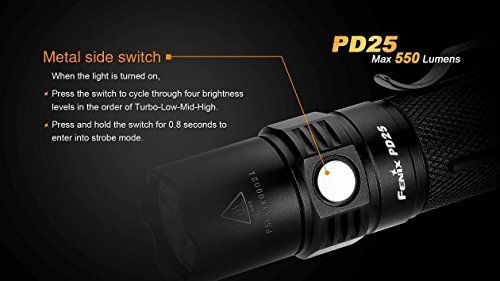
Lightly press the tail switch for momentary light, or fully click it for constant illumination. With the light on, click the side button to change brightness. Hold that button for about 0.8 seconds to access Strobe; click it again to return to steady light. The PD25 remembers your last steady brightness level.
 Check Price
Durable aircraft-grade aluminum construction
The aluminum body, hard-anodized finish, and textured grip make this a practical light for regular carry. The anti-roll shape helps it stay put on a flat surface. Check the O-ring occasionally and replace it when worn so the seal remains effective.
Build for tactical use
The forward-click tail switch is useful when you only need a quick look. The original PD25 has an IPX8 rating for immersion to 2 meters and a 1-meter impact rating. Those ratings describe controlled tests; they do not make the light indestructible or suitable for diving.
It has four output modes + Strobe mode
Low works well for close tasks, while Medium and High offer a useful balance of brightness and battery life. Save Turbo for short checks farther ahead. Strobe is a flashing mode, rather than a guarantee of protection in a confrontation. Get the top Fenix flashlight list here: https://tacticalflashlightguide.com/fenix/
Powered by one 16340 rechargeable Li-ion or 3v CR123A battery
Choose a suitable protected 16340 for the highest output and reusable power, or a quality 3V CR123A for disposable battery convenience. Insert the positive end toward the head. The CR123A provides longer rated runtimes in the published test, while the 16340 gives brighter Turbo output. Our guide to flashlight battery types explains the differences between these cells.
The original PD25 has no charging socket. Remove a rechargeable battery and use a compatible charger, or charge it through the battery’s own port if it has one. Never recharge a disposable CR123A.
Low-voltage warning function
With a 16340 Li-ion battery, falling voltage makes the light step down. At Low, the main beam flashes periodically to prompt a battery change or recharge. The original PD25 does not use the PD25R’s colored battery-level indicator, and its low-voltage warning does not work with a CR123A.
Reverse polarity protection
Reverse polarity protection helps protect the light if a battery is inserted backward. It does not make every battery chemistry or size compatible. Use the correct cell and orientation.
Powerful flashlight
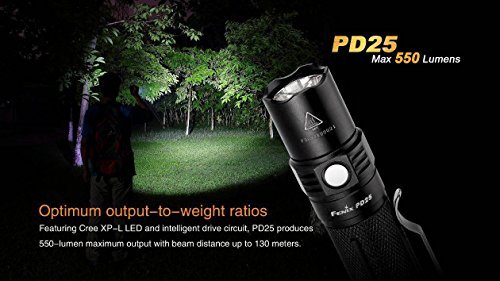
This Fenix PD25 review favors the light for short everyday jobs and backup carry. Its 130-meter rating is a standardized beam-distance figure; useful detail is easier to see at shorter distances. For longer tasks, battery capacity matters as much as the headline lumen number.
 Check Price
If you need a larger flashlight, Fenix pd35 tac could be your choice. The PD35 family has several versions, so compare their battery and charging arrangements before choosing.
Uses CREE XP-L LED
The Cree XP-L V5 LED has a stated design life of 50,000 hours. That is an LED lifespan rating, rather than a guarantee that the complete flashlight will last that long. A clear glass lens and reflector shape the beam for a combination of a central spot and surrounding spill.
Troubleshooting guide to address common problems:
1. Flashlight Not Turning On
Try a known-good compatible battery, confirm positive-end-first installation, and tighten the head and tailcap. Remove the battery before cleaning dirty contact surfaces with an alcohol-dampened cotton swab, then let them dry. Do not dismantle the sealed head.
2. Inconsistent Light Output or Flickering
A depleted battery, dirty contacts, or a loose connection can cause flickering. Clean the accessible contacts and check that the threaded sections are secure. Persistent faults or loose internal parts are a reason to seek repair, rather than force a retaining ring with pliers.
3. Turbo Mode Step-Down
A reduction after roughly five minutes is expected on this model. Charge or replace the battery if the light steps down unusually quickly. Keep the recommended protected cell; removing battery protection is not a fix for reduced brightness.
4. Difficulty Operating Side Switch
Locate the side button before heading into darkness and rotate the body in your grip if needed. Keep dirt away from the switch. Avoid adding anything that could hold it down or interfere with its movement.
General Maintenance Tips:
Keep threads and seals clean, replace a damaged O-ring, and remove the battery for long storage. For transport, loosen the tailcap about half a turn or remove the cell to prevent accidental activation. Keep loose batteries in a protective case.
Fenix PD25 vs. Olight S1 vs. Streamlight vs. Fenix LD12
For compact pocket carry, the original PD25 and Olight Baton 3 are the closest pair here. The Baton 3 is a different model from the original S1. The larger Streamlight and AA-powered LD12 are covered separately below.
| Fenix PD25 comparison | Fenix PD25 | Olight Baton 3 |
|---|---|---|
| Maximum Brightness: | 550 lumens with 16340; 400 with CR123A | 1,200 lumens initially |
| Minimum Brightness: | 5 lumens | 0.5 lumen |
| Maximum Run-time: | 53 hours with 16340; 100 with CR123A | 20 days on Moonlight |
| Highest-output runtime: | 35 minutes including step-down, with 16340 | 1.5 minutes, then 300 lumens for 75 minutes |
| Beam Distance: | 130 meters maximum | 166 meters maximum |
| Modes: | Four brightness levels plus Strobe | Five brightness levels plus Strobe |
| Battery: | One suitable protected 16340 or 3V CR123A | Customized 550 mAh 3.7V IMR16340 |
| Length: | 93 mm | 63 mm |
| Weight: | 47 g excluding battery | 53 g including battery |
| Charging: | Battery removed for charging | Magnetic charging; Premium Edition adds a charging case |
| Price: | Check Price | Check Price |
Fenix PD25: simple tail-switch carry
Choose the PD25 if a momentary tail switch and CR123A option matter most. It is easy to carry, but this Fenix PD25 review would not choose it for continuous maximum brightness.
Olight Baton 3: shorter body and magnetic charging
The Baton 3 suits close work and very compact carry. Its Moonlight mode is dimmer than the PD25’s Low setting, and the magnetic base can support hands-free use. Its 1,200-lumen output is brief, and the customized battery is not interchangeable with an ordinary PD25 cell.
Streamlight ProTac HPL USB: longer-distance use
The ProTac HPL USB is a larger light for reaching farther across open ground. Its long head and heavier body make it less convenient in a trouser pocket than the two compact models above.
| Streamlight ProTac HPL USB feature | Specification |
|---|---|
| Maximum / minimum brightness | 1,000 / 65 lumens |
| High / Low runtime | 1.5 / 24 hours |
| Beam distance | 374 meters on High |
| Modes | Three brightness levels plus Strobe; TEN-TAP programmable |
| Battery | Rechargeable lithium-ion pack, SL-B26 pack, or two CR123A cells |
| Length / weight | 180 mm / 262 g with battery |
| Charging / weather resistance | In-light USB charging with compatible rechargeable pack; IPX4 |
| Price | Check Price |
Fenix LD12: AA-powered alternative
The LD12 family suits people who prefer AA power. On the 2017 version, a supported 14500 raises output to 320 lumens; AA operation peaks at 150 lumens. Earlier LD12 generations have different output and battery limits, so use the instructions for your exact version.
| Fenix LD12 2017 feature | Specification |
|---|---|
| Maximum Brightness: | 320 lumens with supported 14500; 150 lumens with AA |
| Minimum Brightness: | 5 lumens |
| Maximum Run-time: | Low: 50 hours with 14500; 60 hours with tested Ni-MH AA; 40 hours with alkaline AA |
| Highest-output runtime: | 1 hour with 14500; 1 hour 45 minutes with tested Ni-MH AA; 50 minutes with alkaline AA |
| Beam Distance: | 135 meters with 14500; 94 meters with AA |
| Modes: | Four brightness levels plus Strobe |
| Battery: | One supported 14500, Ni-MH AA, or alkaline AA |
| Length: | 102.5 mm |
| Weight: | 56 grams excluding battery |
Explore the LD12 family: Check Price
Final Thoughts
The original PD25 remains a useful compact light for owners who value simple controls and flexible batteries. This Fenix PD25 review comes down to those strengths, with a clear limit: Turbo is a short boost. If built-in charging and more reach matter, the separate PD25R offers USB-C charging, 800 lumens, and a 250-meter rated beam.
Frequently Asked Questions (FAQs)
How bright is the Fenix PD25 flashlight?
Up to 550 lumens with a suitable 16340 rechargeable Li-ion battery, or 400 lumens with a 3V CR123A.
What type of battery does the Fenix PD25 use?
One suitable protected 16340 Li-ion or one disposable 3V CR123A. AA and 14500 batteries are not PD25 substitutes.
How far can the Fenix PD25 beam reach?
Its maximum rated beam distance is 130 meters. That does not mean detailed visibility at that entire distance.
Does the Fenix PD25 have multiple brightness modes?
Yes: Low, Medium, High, and Turbo, plus Strobe. It has no SOS mode.
How long does the battery last on different modes?
With the tested 16340: 35 minutes on Turbo including step-down, 2 hours 25 minutes on High, 7 hours 10 minutes on Medium, and 53 hours on Low.
Does the flashlight have a memory function?
Yes. It recalls the last steady brightness level, excluding Strobe.
Is the Fenix PD25 suitable for everyday carry (EDC)?
Yes, if you want a small tail-switch light. Its removable clip, compact body, and choice of batteries make it practical for daily backup use.