Last Updated on November 12, 2026
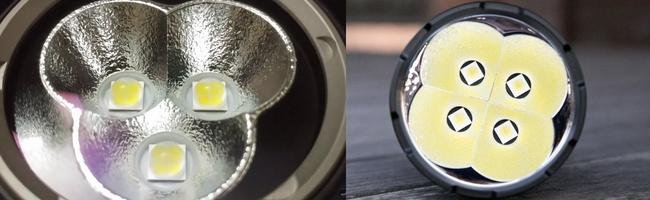
I switched from a smaller AA flashlight when I wanted to see more of the ground in front of me at once. The Imalent DT70 makes a big difference on a dark campsite or when checking the far side of a yard. Its four LEDs give it a wide beam, and the dedicated Turbo button lets me brighten that beam without stepping through every setting.
In this Imalent DT70 review, I’ll cover how the two buttons work, what the OLED tells you and what to expect from the four-cell battery setup. Imalent rates Turbo at 16,000 lumens, but for a longer walk I pay more attention to the 1,000-lumen Mid setting and how much heat builds up in the head.
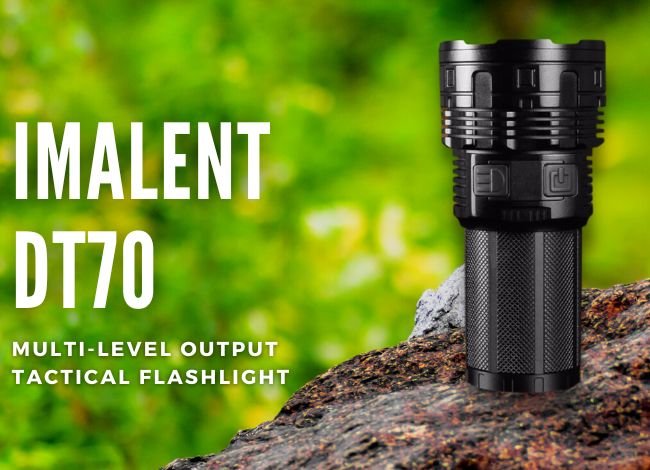
Technical Features of the Imalent DT70 XHP70 Flashlight
| Feature | Imalent DT70 |
|---|---|
| Peak output | 16,000 lumens on Turbo |
| Beam rating | 700 m and 123,000 cd peak intensity |
| Emitters | Four Cree XHP70 LEDs. Imalent lists a 50,000-hour LED service life. |
| Optics | Textured aluminum reflector and anti-reflective mineral glass |
| Body | Type III hard-anodized aluminum alloy |
| Controls | Two side buttons and an OLED display |
| Modes | Four brightness levels plus Strobe, SOS and Beacon |
| Battery | Four removable high-drain protected button-top 18650 Li-ion cells, supplied with the original kit |
| Charging | Micro-USB, 5 V / 2 A recommended. About 8 hours with a 2 A adapter. |
| Size | 146 mm long, 70 mm head, 50 mm body |
| Net weight | 427 g, as listed by Imalent |
| Water and impact | IPX8 to 2 m and 1.5 m drop rating |

Imalent lists the DT70 at 146 mm long. The 70 mm head and four cells make it feel closer to a small searchlight than a pocket light. That’s a useful trade when you want to illuminate an open area and have room for the holster in your kit.
Tactical Flashlight Imalent DT70 Review
Robust Build and Design
The aluminum body has a hard-anodized finish and a textured grip. Imalent rates the light for a 1.5 m drop. The tube is broad enough to get a steady grip, but the two buttons sit close to the display, so it’s worth learning which one is which before you need to use them in the dark. For regular belt carry I’d look at the slimmer Fenix TK20R, which uses a tail switch.

Brightness and Light Modes
The DT70 has four brightness settings. Strobe, SOS and Beacon are separate modes. The right button turns the light on with a click, cycles through Low, Mid and High, and switches the light off with a brief hold. Hold the left button for about two seconds to enter Turbo and tap the right button to leave it. With the light on, double-tap the left button for Strobe. Further double-taps cycle through SOS and Beacon.
| Mode | Rated output and total runtime |
|---|---|
| Low | 80 lm · 40 h |
| Mid | 1,000 lm · 5 h 30 min |
| High | 8,000 lm initially · 2 h total, including lower output |
| Turbo | 16,000 lm initially · 1 h 30 min total, including lower output |
The manual’s runtimes are totals for each mode. High and Turbo both step down as the light heats up. Imalent says Turbo generally lasts less than two minutes at peak, with conditions affecting the timing. The jump from Mid to High is substantial. For a campsite or workshop, I’d start on Mid and save High or Turbo for a brief look across a larger space.
The rated 700 m comes from a beam-distance test. If you want to see detail at distance, consider how much of the output goes into the center of the beam. The DT70 lights up plenty of ground around that center, which is useful on uneven trails and in open yards. Try the light on the ground in front of you first so you can judge how much of the surrounding trail you can see.
OLED Display Benefits
The display is one feature I didn’t realize I needed until I had it. It shows the selected output, cell voltage, charging progress and an overheating warning. The lumen number identifies the setting. If output has stepped down with heat, the figure on the screen is less useful than the warning and what you can see in the beam.
The Imalent DX80 also uses an OLED. It’s the larger 32,000-lumen model with a factory battery pack and dedicated wall adapter. I’d favor the DT70 if being able to remove individual cells and recharge through a standard 5 V supply matters more than peak output.
Waterproof and Versatile Use
Imalent rates the DT70 IPX8 for submersion to 2 m under its test conditions. Keep the rubber charging-port cover fully seated when you go out in rain or work near water. If you’ve opened the body to change cells, check that the seal is clean and the two halves are threaded together firmly. The flat tail lets you stand the light on a level surface and bounce the beam off a ceiling on a lower setting.
Rechargeable Convenience
The rubber cover on the head hides a Micro-USB charging port. The manual lists a 5 V supply rated for 1–2 A and recommends 5 V / 2 A. With that adapter, it estimates about eight hours for four cells. I’d charge it ahead of an overnight outing. Use the supplied cable or a compatible Micro-USB cable, watch the OLED for charging progress and close the cover when you’re done.
If the battery symbol blinks and charging fails to start, Imalent’s first check is the connection between the head and the battery tube. Unplug the cable, reseat the tube firmly, then reconnect. On a light that has just been unpacked, check for insulating discs at the battery contacts. A USB-C cable is useful for newer lights, so it’s easy to bring the wrong lead if you pack both types.

Long Runtime and Battery Protection
The DT70 uses a matching set of four high-drain, protected button-top 18650 lithium-ion cells. The original kit included four cells. Fit them with the positive ends facing the head and keep them together as a set. Imalent’s manual warns against mixing cell types or charge levels and specifies protected button tops. If you need a replacement set, check that every cell meets the manual’s terminal and protection requirements before fitting it.
Low has the longest published runtime, up to 40 hours at 80 lumens. That’s enough light for sorting gear or walking around camp. The low-voltage warning gives you a chance to switch to a backup or recharge before the light cuts out. The anti-reverse circuit is a backup for a mistake during installation. Check polarity each time you fit the cells.
Temperature Regulation
The printed manual describes an OLED warning at around 50°C and a drop to roughly 1,800 lumens in the high-output modes. Ambient temperature and airflow affect the timing. The head can still get hot enough to make handling uncomfortable. I’d save Turbo for short checks and switch down as soon as I’ve seen what I need to see.
Summary: Why You Should Buy the Imalent DT70
The DT70 suits people who need a broad, bright beam for checking a yard, work site or open campsite. I like having a dedicated Turbo button and a visible battery warning. I’d also factor in the long charging time and bring a smaller backup light when walking far from the car.
- Wide beam from four Cree XHP70 emitters, with a short 16,000-lumen Turbo burst.
- Separate brightness and Turbo buttons, an OLED display and removable cells.
- Hard-anodized body, IPX8 water resistance and a flat tail for area lighting.
Cons
- The large head and four-cell setup take more space than a slim duty light.
- The two side buttons can be hard to tell apart by touch.
- There’s a big gap between the 1,000-lumen Mid and 8,000-lumen High.
- Turbo steps down quickly, and in-light charging is an overnight job for an empty set.
A Smaller Imalent Alternative
The Imalent MS03 is a separate, shorter light for someone who wants a high-output model that takes less space. It’s rated for up to 13,000 lumens and uses one 21700 cell with a USB-C charging port on the battery. The DT70 has the longer rated beam and the larger head.
FAQs
What is the role of the OLED display? It shows the selected output, voltage, low-power and heat warnings, and the charging indicator. Check the warning if the beam dims soon after switching to Turbo.
Is the Imalent DT70 waterproof? Imalent rates it IPX8 to 2 m under its test conditions. Keep the charging cover shut and check the seal after changing the batteries or dropping the light.
What type of batteries does it use? Use four matching protected, high-drain button-top 18650 lithium-ion cells. The original kit came with four. Keep the spare set together at a similar charge level.
Is it better than a keychain flashlight? The DT70 is better suited to lighting up a wide area, while keychain flashlights are easier to carry and make more sense for finding a lock or looking inside a bag.
Can I use the flashlight while it’s charging? Switch the DT70 off for charging and give the four cells time to finish. If you need light while it’s plugged in, keep a backup within reach.
What environments is the DT70 suited for? Its broad beam works well at a camp, on open ground or when checking a work site. The lower settings are easier on the eyes in enclosed spaces and around shiny surfaces.
How does it compare to the Acebeam X70? The original Acebeam X70 is a larger 60,000-lumen searchlight with its own rechargeable pack and active cooling. The DT70 is easier to pack and its four removable cells are simpler to replace as a matched set.
What warranty applies? The original printed manual described a five-year repair term. Imalent’s current store policy lists two years for the head and one year for the battery. Keep your receipt and check which terms apply to your purchase if you need a repair.
If you’re using a DT70 and have a question about the buttons, the display or charging, leave it in the comments.