Last Updated on November 21, 2026
The Maglite XL series has built a solid reputation for offering high-performance, reliable flashlights that meet the demands of both everyday users and tactical professionals. Among its most talked-about models are the Maglite XL50 and Maglite XL200, each praised for its durable build and practical features. If you’re deciding between these two, this Maglite XL50 VS XL200 comparison is exactly what you need.
The Maglite XL50 LED flashlight is the simpler choice and has the longer rated High runtime. The Maglite XL200 offers more functions, higher total lumen output in its current specification, and the longer runtime at low output. In this detailed review, we’ll break down their specs, performance, pros and cons, and help you decide which one suits your needs best.
Before diving in, if you’re still new to the world of tactical flashlights, check out our flashlight buying advice for beginners to understand which features to prioritize.
Key Feature Comparison — Maglite XL50 VS XL200
Let’s start with a head-to-head breakdown of core specifications. This table compares the 200-lumen white LED XL50 with Maglite’s 264-lumen XL200 specification. Earlier XL200 packages have different output and runtime ratings, so use the figures on the package of the edition you are buying.
Maglite XL50 vs XL200 Specifications
| Features | XL50 | XL200 |
|---|---|---|
| Maximum Brightness: | 200 lumens | 264 lumens |
| Luminous Intensity: | 12,533 cd | 7,712 cd |
| Beam Distance: | 224 Meters | 176 meters |
| Low runtime: | 25 hours | 182 hours |
| High runtime: | 6 hours 45 minutes | 3 hours 30 minutes |
| Light source type: | LED | LED |
| Switch: | QuickClik tail switch | QuickClik tail switch plus motion adjustment |
| Modes: | 3 | 5 primary functions |
| Battery Include: | Yes (3 AAA batteries) | Yes, 3x AAA alkaline batteries |
| Water Resistance: | IPX4 | IPX4 |
| Body Material: | Anodized Aluminum | Anodized Aluminum |
| Length: | 4.8 inches | 4.8 in. |
| Weight with batteries: | 3.68 ounces (104 g) | 3.68 ounces (104 g) |
| Price: | 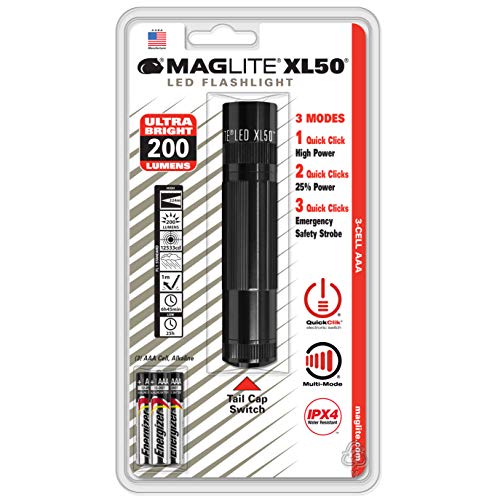 Check Price |
 Check Price |
For a closer look at operation, read our Maglite XL50 review and XL200 controls and performance review.
Maglite also lists a 230-lumen XL200 edition with 163-meter reach, 1 hour 45 minutes on High, and up to 156 hours on Low. Older 172-lumen editions carry other ratings. These are separate specifications, not interchangeable figures for the same test configuration.
Both flashlights are extremely well-built and reliable, but as this table shows, they differ in runtime, output, beam concentration, and controls. Their listed dimensions and battery-installed weights are the same. Let’s take a closer look at each of them.
Maglite XL50 – Compact Power in Your Palm
The Maglite XL50 is a favorite among users who need a compact, lightweight flashlight that doesn’t compromise on brightness. Crafted with anodized machined aluminum, the XL50 provides solid durability and impact resistance. Its 200 lumens output and tail cap push-button switch make it incredibly user-friendly, especially for quick on/off access.
Build and Design
- Length: 4.8 inches
- Weight: 3.68 ounces with batteries
- Material: Anodized aluminum, inside and out
- Water Resistance: IPX4 – handles splashes, rain, and minor exposure
This model is great for general use, emergency kits, or even everyday carry flashlights. Its short body fits a tool pouch or jacket pocket, although a slim penlight may be more comfortable in a trouser pocket.
Light Performance
The XL50’s 3 lighting modes allow users to toggle between:
- High power
- 25% power
- Emergency strobe
Its 224-meter rated beam distance reflects a more concentrated hotspot than the XL200. The standardized beam-distance figure is a low-light threshold, so it does not promise clear identification of objects at that full distance.
Battery & Runtime
It runs on three AAA batteries and provides:
- 25 hours on low
- 6 hours 45 minutes on high mode
Pros of Maglite XL50
- Lightweight and highly portable
- Simple push-button interface
- Powerful 200 lumens beam
- Anodized for internal and external corrosion resistance
- Manufacturer warranty subject to the applicable regional terms
Cons of Maglite XL50
- No continuously adjustable brightness or automatic SOS function
- Earlier XL50 editions have different output and runtime ratings; check the package
- Limited to just three lighting modes
Start with the flashlight off: one quick click selects High, two quick clicks select Low, and three select Strobe. Another click turns it off. Practice the click timing before relying on it during an outage.
Maglite XL200 – Advanced Features and Extended Runtime
While the Maglite XL50 prioritizes simplicity and a concentrated spot beam, the Maglite XL200 takes a different approach. It offers advanced features and a more customizable experience for users who want more control over their flashlight settings. Its 264-lumen specification provides more total light than the 200-lumen XL50, while its wider beam has a shorter rated reach. Its adjustable output and signaling functions make it the more flexible option in this Maglite XL50 VS XL200 comparison.
Build and Ergonomics
- Material: Machined anodized aluminum
- Length: 4.8 inches
- Weight: 3.68 ounces with batteries
- Grip: Textured for better handling
- Water Resistance: IPX4 (splash-resistant, suitable for outdoor use)
The XL200 shares the XL50’s 4.8-inch length, 1-inch body diameter, and listed 3.68-ounce weight with batteries. It does not gain a durability advantage from extra weight. Both are IPX4 splash-resistant and rated for a 1-meter drop; neither is intended for underwater use.
Innovative Interface
The XL200’s QuickClik interface sets it apart. Starting with the light off, one through five quick clicks select Full Power, Strobe, Nite Lite, Signal, or SOS respectively. The motion-based controls adjust brightness or strobe speed within the appropriate function; rotation does not replace the click sequence used to select a function.
This motion-based brightness adjustment is what makes the XL200 stand out in this comparison. It’s ideal for users who want:
- Precise brightness control
- Quick access to specific lighting functions
5 Light Modes Breakdown
The XL200 features five distinct lighting modes:
- High Power
- Strobe – adjustable-rate attention signal
- Nite-Lite – gradually dims while stationary and responds to movement
- Signal – manual Morse signaling mode
- SOS – emergency beacon mode
This level of versatility is unmatched by the XL50 and gives the XL200 a clear edge for advanced or tactical users.
Runtime & Battery Performance
Just like the XL50, the XL200 uses three AAA batteries, but it outperforms in terms of longevity on low power:
If you prefer a slimmer penlight powered by only two cells, our best 2 aaa flashlight guide includes two-AAA options to compare with these three-cell Maglites.
- High mode: ~3.5 hours
- Low mode: Up to 182 hours
That longest runtime is measured at low output. It does not mean 182 hours at 264 lumens, and it cannot establish better efficiency without comparing the same output levels.
Pros of Maglite XL200
- Customizable brightness and unique control interface
- More functions for signaling, low-level lighting, and emergencies
- Excellent runtime on low power – up to 182 hours
- Durable, compact body with the same listed dimensions as the XL50
- Brightness and strobe-rate settings can be adjusted and memorized
Cons of Maglite XL200
- Extra controls take more practice than the XL50’s three-function interface
- No built-in charging; requires three AAA alkaline cells
- Alkaline leakage can damage either model; remove batteries for long-term storage
- Requires adjustment period to get used to the motion-based controls
- Warranty coverage and service costs depend on regional terms and the cause of damage
If long runtime is a priority for your camping or hiking adventures, you might also want to consider the Fenix UC35 V2.0 flashlight if you prefer a larger rechargeable model with a built-in charging port. Its battery system and output levels differ, so compare useful working brightness as well as maximum runtime.
Maglite XL50 VS XL200 — Key Differences Explained
While both models belong to the Maglite XL series, there are noticeable distinctions in how they perform in real-world conditions. Below, we explore the most significant differences between the Maglite XL50 and Maglite XL200, focusing on what matters most: brightness, modes, runtime, size, and usability.
1. Light Modes & Versatility
Perhaps the biggest functional difference is the number of lighting modes and how they’re accessed:
- Maglite XL50: 3 Modes
- High Power
- 25% Power
- Emergency Safety Strobe
- Maglite XL200: 5 Modes
- High Power
- Strobe
- Nite-Lite (dimming feature)
- Signal (Morse code)
- SOS (automatic distress pattern)
Verdict: If you’re a camper, hiker, or someone who values tactical versatility, the XL200 clearly wins. The XL50 is better suited for users who prefer a simpler flashlight without added complexity.
2. Brightness & Beam Distance
Brightness is a vital factor in any flashlight buying decision.
- XL50: 200 Lumens, 224-meter beam distance
- XL200: 264 Lumens, 176-meter beam distance
The XL200 produces more lumens overall, but the XL50 concentrates its light into a stronger hotspot: 12,533 candela versus 7,712 candela in these specifications. That explains why the XL50 has the longer beam-distance rating despite its lower lumen output.
Verdict: Pick the XL50 for a concentrated spot and greater rated reach. Pick the XL200 for more total light and adjustable brightness. Lumens and beam distance describe different qualities.
3. Runtime
Battery efficiency can make or break your experience with a flashlight—especially when you’re in a survival or travel situation.
- XL50:
- Max: 25 hours (low mode)
- High Mode: ~6 hours 45 minutes
- XL200:
- Max: 182 hours (low mode)
- High Mode: ~3 hours 30 minutes
The XL200 has the longer low-output runtime, while the XL50 has the longer rated High runtime. Low settings on different models are not necessarily equally bright, and neither High runtime means the initial output stays constant throughout the test.
Verdict: Choose the XL200 for extended low-level light, or the XL50 for its longer High-runtime rating. Carry spare cells when light is essential; battery age, temperature, and selected output affect actual endurance.
If charging access matters more than replaceable AAA cells, compare battery systems in our guide to the best rechargeable flashlights.
4. User Interface & Controls
- XL50: One, two, or three quick clicks from off select High, Low, or Strobe.
- XL200: QuickClik motion-based interface. Rotate the flashlight to adjust brightness.
The XL200 gives you more control and customization, but beginners might find it less intuitive.
Verdict: XL50 is easier to use, while XL200 is more flexible once you get used to it.
5. Size, Weight & Portability
- XL50: 3.68 ounces with batteries; 4.8 inches long
- XL200: 3.68 ounces with batteries; 4.8 inches long
Both have a 1-inch barrel and the same listed weight with batteries. Do not compare the XL50’s empty-body weight with the XL200’s battery-installed weight; that creates a misleading portability difference.
Verdict: Size and weight do not decide this comparison. Choose the interface you prefer, and consider a slimmer light if pocket comfort is your priority.
Related: Explore our best EDC flashlight guide for more portable flashlight options.
Summary: Which One Should You Choose?
- Choose Maglite XL50 if you want:
- Simplicity and ease of use
- More concentrated beam and longer rated throw
- Lightweight EDC light for general use
- Longer rated runtime on High
- Choose Maglite XL200 if you need:
- More light modes and control features
- Extended runtime for camping or emergencies
- Motion-sensitive brightness control
- Tactical versatility
Final Verdict and FAQs — Maglite XL50 VS XL200
After reviewing the core features, performance differences, and real-world usability of both flashlights, it’s clear that the Maglite XL50 and XL200 serve slightly different purposes. Whether you’re an everyday user looking for simplicity or an outdoor enthusiast who wants full control and longer runtime, there’s a solid option for you in the XL lineup.
Final Verdict: Which Should You Buy?
Go with the Maglite XL50 if you need:
- A more concentrated spot beam for distance
- Lightweight and ultra-compact design for EDC
- Simple operation with just 3 modes
- Longer rated High runtime with replaceable batteries
Go with the Maglite XL200 if you need:
- Extended runtime for longer trips or emergencies
- More advanced light modes including SOS and Morse signal
- A flashlight with adjustable brightness control
- Versatile functionality for camping, survival, or search and rescue
Both models come with Maglite’s legendary anodized aluminum durability and IPX4 water resistance, making them great choices for demanding conditions.
Still undecided? Visit our roundup of the best tactical flashlights available today to explore more alternatives across top brands like Fenix, SureFire, and Olight.
Frequently Asked Questions — Maglite XL50 VS XL200
1. Which flashlight is better for outdoor adventures?
The Maglite XL200 suits low-level camp lighting and signaling, while the XL50 offers a simpler interface and longer rated High runtime. Both are splash-resistant rather than submersible. Take a backup light and spare batteries for trips where dependable lighting matters.
2. Is the Maglite XL50 brighter than the XL200?
The 264-lumen XL200 produces more total light than the 200-lumen XL50. However, the XL50 has the more concentrated hotspot and longer rated reach: 224 meters versus 176 meters. Earlier XL200 versions have different ratings.
3. What type of batteries do they use?
Both flashlights run on three AAA alkaline batteries. Maglite specifies alkaline cells for these ratings, and neither flashlight has built-in charging. Follow the battery guidance for your exact edition instead of assuming any AAA-shaped rechargeable cell is suitable.
4. Is the XL200 more difficult to use?
The XL200 features a motion-sensitive brightness control interface, which has a slight learning curve. However, once you’re familiar with it, it provides more flexibility compared to the XL50’s basic push-button system.
5. Can I use these flashlights for self-defense?
Both have a flashing function for signaling or attracting attention. Strobe is not a dependable way to stop an attacker. For a comparison with a purpose-designed tactical interface, explore our Fenix TK16 tactical flashlight review.
6. Are Maglite flashlights still a good investment in 2026?
They can make sense if you prefer an aluminum body and readily replaceable AAA batteries. Check the exact edition, controls, and current asking price against your needs. A rechargeable light may suit frequent use better, while a straightforward replaceable-cell light can be convenient when charging is unavailable.
Final Thoughts
In this detailed Maglite XL50 VS XL200 review, we’ve compared all aspects from brightness and runtime to control systems and practical usability. Your final choice should be based on your primary use case:
- Need a concentrated beam, longer High runtime, and simpler controls? Go for the Maglite XL50.
- Need longer low-output runtime and more control? The Maglite XL200 is your pick.
Whichever model you choose, you’re getting a dependable flashlight built for performance and longevity.
Still have questions? Drop a comment below or explore more flashlight reviews on our home page.