Last Updated on November 11, 2026
Lots of people like AA flashlights for a simple reason. When the light goes out, a spare cell from the kitchen drawer can get it working again. If you are looking for the best AA flashlight for your money, start with the batteries you plan to use and the kind of light you need. Checking a fuse box calls for a different beam than walking the dog down an unlit road.
A single AA usually has more capacity than an AAA of the same chemistry. What you get out of it also depends on the LED, the electronics and the brightness setting. If you need a small everyday carry flashlight for a keyring or shirt pocket, an AAA flashlight will suit you better. For a jacket pocket, a tool bag or a backup in the house, a one-cell AA light offers a useful balance of size and runtime.

Best AA Flashlight Comparison Table
These three options take AA batteries, although only the Streamlight needs a single AA. The other two take a pair of AAs or their specified rechargeable pack. Each number in the table belongs to the listed power source. If you plan to use disposable cells most of the time, compare the AA column first.
| Image | AA Flashlights | Output & Modes | Key Features |
|---|---|---|---|
2026 Editor’s Choice Check Price |
Streamlight 88061 ProTac 1L-1AA Dual-Fuel Flashlight Read Review |
With AA: Up to 150 lumens With CR123A: Up to 350 lumens Modes: High, Low, Strobe |
Battery: One AA alkaline/lithium or one CR123A Weight: 2.8 oz with alkaline AA Charging: No built-in charging Protection: IPX7 |
Rechargeable Choice Check Price |
Nitecore MT2A Pro Rechargeable AA-Compatible Flashlight Nitecore MT2A Pro review |
With 2 AA: Up to 500 lumens With NL1416R: Up to 1,000 lumens Modes: 3 with NL1416R; 2 with AA |
Battery: Two AA or included NL1416R rechargeable battery Weight: 1.41 oz without battery Charging: USB-C port on NL1416R battery Protection: IP68 |
Versatile Choice Check Price |
ThruNite Archer 2A C Dual-Switch Flashlight ThruNite Archer 2A C detailsArcher-series photo. Product link goes to the Archer 2A C. |
With 2 AA: Up to 500 lumens With included battery: Up to 1,018 lumens peak Modes: 4 brightness levels + Strobe |
Battery: Two AA or included 1600mAh rechargeable battery Length: Approximately 6.1 inches Charging: USB-C port on the rechargeable battery Protection: IPX8 |
The best AA flashlight for a spare-cell kit may be the shortest one you can switch on in the dark. A longer two-cell light makes more sense if you want a stronger beam and a grip you can hold with gloves. Check the cell count along with the length. Carrying two spare AAs is easy if your other gear already uses them, and takes more pocket space if the flashlight is your only AA device.
Our Review: Top 10 Best AA Flashlights for 2026
The ProTac leads the comparison. Below it are two dual-power alternatives, then the remaining AA reviews, including simple pocket lights, adjustable beams and a classic incandescent Maglite.
Streamlight 88061 ProTac 1L-1AA (Our Top Pick)
The Streamlight 88061 is our best AA flashlight pick if you want a sturdy light that takes a common cell and can switch to a CR123A for more output. You install one cell at a time. On either AA alkaline or AA primary lithium, the High mode is rated at 150 lumens. The 350-lumen rating belongs to a CR123A. If you buy it for an AA-only kit, its 105-meter rated beam on High is the figure to use.
Technical Specifications of the Streamlight 88061
| Features | Streamlight 88061 ProTac 1L-1AA |
|---|---|
| Peak output | 350 lm on CR123A. 150 lm on AA alkaline or AA primary lithium. |
| High rated runtime | CR123A 1 h 30 min; AA alkaline 1 h 20 min; AA primary lithium 4 h 15 min. |
| Low rated runtime at 40 lm | CR123A or AA primary lithium 14 h; AA alkaline 7 h 30 min. |
| Maximum beam distance | 160 m on CR123A; 105 m on AA. |
| Switch and modes | Tail switch. High and Low, plus Strobe in the default program. TEN-TAP also offers High only and Low/High. |
| Body and protection | Anodized aluminum and glass lens; IPX7; 2 m impact-resistance rating. |
| Length | 4.25 in (10.8 cm). |
| Weight with cell | 2.5 oz with CR123A; 2.8 oz with alkaline AA; 2.4 oz with lithium AA. |
| Power | One CR123A, one AA alkaline or one AA primary lithium. Separate battery types are alternatives. |
| Charging | No charging port. |
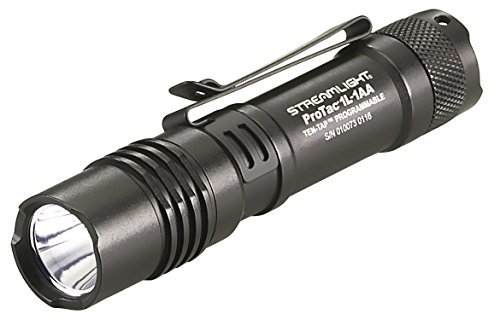 Check Price
The AA options share the same rated high and low output, but the runtime changes. Streamlight rates High at 1 hour 20 minutes with alkaline and 4 hours 15 minutes with primary lithium. For a short trip, either can be useful. For a light that stays on for repeated checks, the AA lithium runtime and the price of your spares matter more than the shared 150-lumen number. Low is 40 lumens with all three cell options. That is useful around the house or for close checks, although someone who reads maps in a dark tent may want a much dimmer mode.
The tail switch gives you quick one-handed access. The default sequence gives you High, Strobe and Low. TEN-TAP programming also lets you choose High only or Low/High. Low/High is the one I would set for routine work at arm’s length. It avoids stepping through Strobe to find Low and leaves High one step away. Decide how you want it to start before it goes into an emergency kit, then try it with the batteries you will actually keep beside it.
The metal body is easy to grip and the reversible clip gives you more than one carry position. The light has an IPX7 rating and a 2-meter impact-resistance rating. Its modest length helps if you carry it every day, although it is thicker than a basic single-AA keychain light. There is no charging port, so a spare approved cell is more useful here than a USB cable. The manufacturer lists the supported primary cells. Check the manual for your unit before using any other battery type.
- Pros: Simple tail switch, three selectable programs, replaceable clip and two useful power options in one compact body.
- Cons: Forty lumens is the lowest setting, and the higher 350-lumen rating requires a separate CR123A.
Nitecore MT2A Pro: A Rechargeable Option with AA Backup
The MT2A Pro makes a good case for a two-cell body. It gives you a slim light with a rear switch and a more concentrated beam, and it still runs when all you have is a pair of compatible AA batteries. It is a different model from the original 345-lumen MT2A reviewed below. The Pro reaches 1,000 lumens with the Nitecore NL1416R rechargeable cell and up to 500 lumens with two AAs. A pair of ordinary 3.7-volt 14500s is incompatible.
The supplied NL1416R has the USB-C charging port on the cell. To charge it, switch off the light, take the cell out and connect the cable to the battery. This is handy if you already keep a USB-C cable at your desk. You will need to open the flashlight for charging, so a second set of approved cells is useful if the flashlight has to be ready during that time.
There are three levels with the rechargeable cell and two with the AA pair. The 1,000-lumen figure is the top output, and you should expect lower output during part of the rated runtime. If you need a lamp for walking or doing a repair, look for a usable lower mode and a beam that lights enough of the area around the target. A brighter central spot can help across a yard, while a softer spread is often more comfortable next to a wall. That distinction matters when two lights have similar peak numbers.
ThruNite Archer 2A C: AA Backup and a Separate Mode Switch
The linked Archer 2A C is the two-cell model with a USB-C rechargeable pack. Its published peak is 1,018 lumens and 167 meters with the included pack. With two compatible AA batteries, ThruNite lists 500 lumens and 93 meters. The photo above shows the similar Archer body style. Look for 2A C on the packaging if the removable rechargeable pack is a feature you want.
The power switch is on the tail and the brightness switch is on the side. I like that arrangement for tasks where I want to switch the light on without using the mode button, then adjust brightness once I can see what I am doing. Firefly gives you enough light for a bag or bedside table without lighting up the whole room. Low or Medium is a better starting point for repeated jobs, while High comes in handy to see across a larger space. Hold the side switch for Strobe when you deliberately want that mode.
Keep the pack and its charging cable with the light if you expect to use the rechargeable option. The AAs are a useful fallback, and two fresh matching cells make a sensible spare set. For regular use, choose this model over the shorter Archer below if you prefer more room for your hand and want the stronger rated output from the included pack. For one-cell convenience, I would carry the shorter light.
ThruNite Archer 1A V3 AA Flashlight
The Archer 1A V3 is a shorter light in the same family, with a tail switch for power and a side button for modes. It is a good fit if you like the separate controls on the Archer 2A C but want a flashlight you can use with one AA. The reviewed XP-L V6 generation was rated around 200 lumens on AA at its top setting. Its lower settings make more sense for reading, work at arm’s length and a light you may leave on for longer.
 Check Price on Amazon
Firefly, Low, Medium and High are the regular brightness levels, with Strobe available separately. An older runtime chart lists about 17 days in Firefly under its test conditions. That is a tiny amount of light, useful for finding something in a tent or room where your eyes are already used to the dark. On a dark trail, use a brighter mode and expect a much shorter run. The textured reflector helps spread light around the bright spot so you can see a little outside the center of the beam.
Check the model name on the body and its instructions before using a rechargeable lithium-ion cell. The Archer family contains one-AA and two-AA models, and published ratings from the Archer 2A V3 and Archer 2A C belong to those separate lights. If you want another single-AA light from the brand, the ThruNite T10 review covers a different switch layout and compares two T10 versions.
- Pros: One AA, separate brightness button, a very dim setting and a compact body.
- Cons: The side button takes some practice to find in gloves, and the shorter light has less room for a firm grip.
Fenix E12 AA LED Flashlight
The Fenix E12 LED flashlight is one of the simplest lights here to carry and operate. It runs on one AA and has a mechanical tail switch. The older E12 in this review was rated at 130 lumens on High, 50 on Medium and 8 on Low. Those figures belong to the original generation. The E12 V2.0 is a 160-lumen model, while the E12 V3.0 reaches 200 lumens and adds a magnetic tail and a two-way clip.
 Check Price
The original switch and its slightly recessed position suit a flashlight that rides in a coat pocket or alongside other tools. Start at a lower setting when you are reading an instrument panel or checking beneath a sink. It is much easier on your eyes when the beam reflects off a pale wall. High is there for the walk back to the house. A small light you can stand on its tail can also bounce light off a ceiling during an outage. Check your version’s tail design if that is how you plan to use it.
The later V3.0 can also hold onto a suitable steel surface, so its magnet is useful for a garage shelf or an appliance cabinet. Treat the one-AA E12 as an AA light and follow the cell list in its instructions. The later magnetic model still uses a replaceable AA. A photo, a clip style and the output on the package can all help you distinguish versions with the same E12 name.
- Pros: Short body, straightforward one-handed switch and a useful low setting.
- Cons: The original lacks the later clip and magnet. A small one-cell light is easier to use for nearby jobs than for extended high-output work.
Nitecore MT2A 345 Lumens Flashlight
The original MT2A has a narrow two-AA body with a tail power switch and a head that selects between Turbo and the user-defined mode. Nitecore’s data for the 345-lumen version lists a maximum beam distance of 152 meters. The regular levels are 345, 138, 55 and 17 lumens. Its rating of up to 50 hours is for the 17-lumen setting. At 345 lumens the rated runtime is much shorter and the light can step down in use.
 Check Price
Key Features of Nitecore MT2A
With the head fully tightened, the light goes into Turbo. Loosen the head slightly to access the user-defined group, then use the tail switch to select brightness or a signaling mode. If you are used to a side mode button, try the head-and-tail sequence at home. It is easy to set up a preferred lower level once you know the sequence, and the tightened head gives you a quick way to return to Turbo when you need more reach.
The original is a contender for the best AA flashlight if you want a longer beam and already carry AA spares in pairs. The light takes two matched AAs. Keep spare cells as pairs, and replace both at the same time. The knurled body, included carry accessories and separate mode groups are useful on an outdoor light. There is no USB charging port or long rechargeable pack in this version. Buy the MT2A Pro if you specifically want that separate power option. The original MT2A makes sense when a two-AA supply is already part of your kit.
- Pros: Slim two-cell body, useful lower modes, good reach for the size and direct access to Turbo.
- Cons: Learning the head-and-tail controls takes longer than learning a simple three-mode switch.
Gerber Infinity Ultra LED Task Light
The Gerber Infinity Ultra is a small single-AA light with a twist control and a pocket clip. It is best suited to looking under a desk, finding a keyhole or reading a label. A restrained beam can be more convenient at close range than a light whose default setting fills the room. It also gives you a simple backup for jobs where you need one steady level and can spare very little room in a bag.
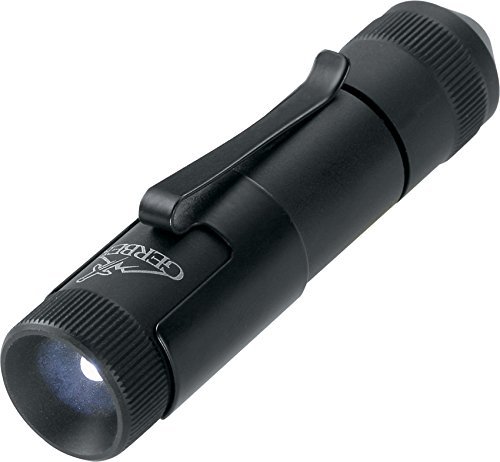 Check Price
Make sure the twist control is fully off when you put it away. Try the switch with your usual work gloves if you plan to use it outdoors. A twist head is uncomplicated with bare hands, while a large tail button tends to be easier with thick gloves. Check your specific model’s instructions for water exposure and battery types. I would choose one of the adjustable lights higher up the page for regularly lighting a driveway or an outdoor path.
- Pros: Compact body, low-effort controls and a replaceable AA.
- Cons: One useful close-work level gives you little choice when you need a longer beam.
Coast HP1 190 Lumens EDC Flashlight
If you want the best AA flashlight with an adjustable beam, look at the shape of the spot and flood. The compact HP1 lets you move between them with one hand. Slide the head to widen the light around a work area or concentrate it on something farther away. It is the difference between flood and throw you notice first when moving from one setting to the other. You can keep the light wide for a walk or narrow it to inspect a gate latch from a few steps back.
 Check Price
Coast HP1 versions have been sold with different output and power descriptions. The 190-lumen rating is associated with the higher-output compatible rechargeable configuration. Use the rating for your exact battery and package if you plan to run it on an ordinary AA. Look at the manual or battery compartment label before trying a 14500 or a replacement rechargeable cell. On a compact light like this, a small cell is convenient, while runtime at a useful brightness still depends on the battery and beam setting.
The HP1 is short enough to keep in a glove compartment or apron pocket. If you need hands-free close work, a fixed inspection beam or a headlamp might suit the task better than refocusing a handheld light. The Coast flashlight reviews cover other fixed and focusing beams if you like the brand but want a larger light or a different switch.
- Pros: Sliding focus, compact shape and easy access to the tail switch.
- Cons: Check the exact cell before comparing brightness and runtime with another HP1 package.
Maglite Mini Incandescent: Classic AA Flashlight for Everyday Carry
This is the two-AA Mini Maglite with a replaceable incandescent lamp. Maglite lists 14 lumens, a 96-meter beam distance and 5 hours 15 minutes of rated runtime for the Classic AA version. Its twist head adjusts the beam from a broad patch to a tighter spot. The tight spot and relatively low total output explain why a narrow beam can reach a useful distance with fewer lumens than a wide LED beam.
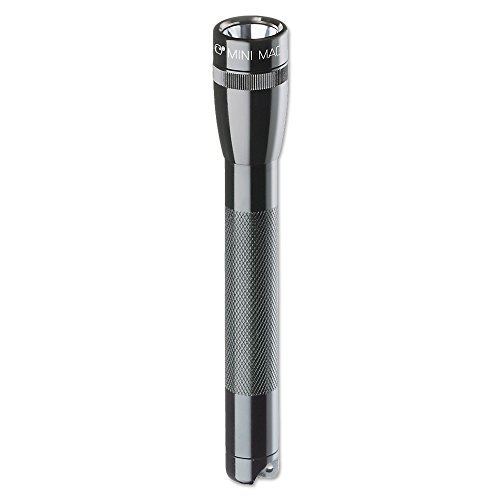 Check Price
There is one output level. The light’s head can support the body for candle mode, and the spare lamp is stored inside the tail cap. Try the candle setup on a stable surface before relying on it in an outage. For a flashlight that spends months in a drawer, check the batteries periodically and remove them for long-term storage. If yours already has a stuck Mini Maglite battery cap, check the cause before applying extra force to the threads.
The classic body and simple twist mechanism are the reasons to choose it. It may be the best AA flashlight for someone who specifically wants a replaceable lamp and a warm, adjustable beam. If you want a brighter LED spot from the brand, the Maglite XL50 LED flashlight uses three AAA cells and has a different control scheme. Compare the Mini’s low output and warm beam with those practical differences before choosing between them.
- Pros: Adjustable focus, candle mode, readily replaceable cells and a spare lamp in the light.
- Cons: The incandescent beam is dimmer than the LEDs in many similarly sized lights. The basic body has limited pocket-clip options.
UltraFire 7W LED Lighting Tool: Compact Zoom Flashlight
This compact UltraFire-style flashlight has a sliding focus head, a textured grip and a rear switch. The wide setting can help when you want to see across the floor in front of you. Slide the head forward for a narrower spot. On zoom lights of this design, the narrow setting may project an outline of the LED when you point it at a nearby wall. Test both beam patterns at the distance you expect to use the light.
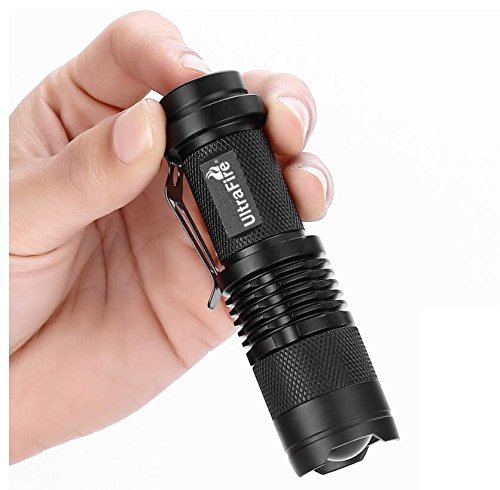 Check Price on Amazon
Packages can differ in the LEDs, modes and cells they specify. I would buy a light like this for inexpensive close-range jobs and use the battery marked for the exact unit. A 14500 can physically resemble an AA, while its higher voltage can damage a light that only accepts ordinary AA cells. The J5 V1 Pro comparison describes a similar adjustable-beam layout if you prefer to compare the controls and grip before choosing.
- Pros: Easy spot-to-flood adjustment, useful pocket clip and a compact shape.
- Cons: Check the included instructions for exact battery support and mode order. Beam quality can change as you move the head.
Hausbell 7W LED Tactical Device Review
The Hausbell is another small adjustable-beam light for short checks around the house, vehicle or campsite. The grip is textured and the head moves between a wide circle and a narrower spot. The version shown has a small pocket clip. Some packages of this design also have a glow ring at the front. It can help you locate the light after it has been exposed to light and put down nearby.
 Check Price
A small focusing light is convenient if you want to keep one by the door and carry another in your toolkit. Look for a mode order you can use without hesitation. If a model cycles through bright, dim and strobe, you may prefer a simpler one-mode light for a drawer that everyone in the house uses. Follow the cell type specified for your exact Hausbell light, and compare runtime with the same battery you expect to carry. I would use the wide beam for changing a tire or checking a drawer and save the tight spot for a quick look across the garage.
- Pros: Fits in a small pocket, adjustable beam and straightforward rear switch.
- Cons: Output and mode order can vary by kit. A narrow spot covers less of the ground during a walk.
ThorFire TG06S Mini Flashlight Review
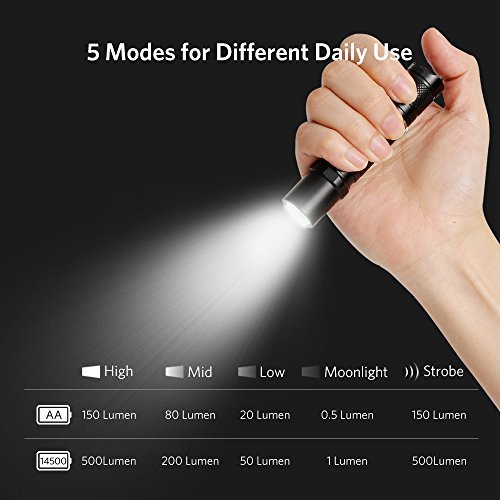
If you want the best AA flashlight for close work, look for a low setting you can reach easily. The TG06S is a clip-on pocket light with a tail switch and a dim Moonlight mode. This model was sold as compatible with one AA or a supported 14500 lithium-ion cell. Its advertised 500-lumen peak belongs to the 14500 configuration. If you plan to use an AA for convenience, expect lower output and choose it for the smaller tasks that suit a one-cell light.
 Check Today’s Price
Moonlight is useful when you want to look into a bag beside someone who is sleeping. A middle level is more comfortable for tasks like walking a dark hallway or checking the ground for a dropped screw. Higher settings are better for brief checks outside. The switch gives access to several steady modes and a hidden Strobe. Get familiar with the mode order before carrying the light somewhere you have to use it by feel.
The light body has no charging port. A rechargeable cell needs an appropriate charger unless the specific approved cell has a charging port of its own. If you are comparing this with the Olight S1A Baton review, pay attention to the shape and length of supported batteries as well as the rated output. A protected 14500 can be longer than a standard AA even if it uses a similar diameter. Check both voltage and fit rather than relying on the name of the battery size alone.
- Pros: Small body, clip and a useful spread of brightness levels for everyday use.
- Cons: The strongest output requires a compatible rechargeable cell and a separate charging arrangement.
How to Choose the Best AA Flashlight for Your Batteries
Start by looking at what you already keep in the house or carry in your bag. If a spare alkaline AA is the only one you can count on, the best AA flashlight is the one that gives you a useful beam on that battery. If you use the light every week and already have a suitable charger, check whether the flashlight lists rechargeable NiMH. For a light that takes a dedicated rechargeable pack, include the pack and charging lead in your plan. Our guide to flashlight battery types explains which names describe a size and which ones describe a battery chemistry.
- AA alkaline: This is the familiar 1.5-volt AA. For a light that gets occasional use, it is straightforward to keep a few sealed spares near the flashlight. If a two-cell flashlight gets dim, replace the pair with fresh cells of the same type. Store the spares in their packaging or a case so the terminals stay protected.
- AA NiMH: A 1.2-volt rechargeable AA is useful for lights you turn on often when the instructions approve it. Use an appropriate external charger. Compare high and low runtime with NiMH data where it is published, since a number tested with a different battery can give you the wrong expectation.
- AA primary lithium: A disposable 1.5-volt lithium AA can be useful where the light’s manual lists support. In the ProTac, it gives the same rated initial 150-lumen High as alkaline with a longer rated runtime. It still needs to be replaced when spent. Check the package before buying a set of spares because rechargeable lithium-ion cells can carry similar wording.
- 14500 lithium-ion: The usual nominal voltage is about 3.6–3.7 volts. Put one in only when the exact flashlight’s instructions list a suitable 14500. The longer rechargeable packs used by the MT2A Pro and Archer 2A C are different options. Two short 14500s are incompatible with either pack.
There is also a difference between runtime and how long the peak brightness lasts. A light rated for hours on High may spend part of that time at a lower level. Peak brightness matters if you need to spot something briefly. For a walk or a job that keeps you in the dark, look at the published step-down or runtime graph and compare the brightness you can use for most of the task. A light with a comfortable Medium can do more for you than a brighter light that becomes hard to handle or drops below what you need.
Think about the switch as part of the battery choice. The best AA flashlight for a household drawer may have a single useful setting, so someone can turn it on without learning a sequence. For a work bag, try the switch and clip in the same position you will carry them. If you prefer a side button, check whether it can start on your last used level. If you wear gloves, see whether the button is easy to find by feel. Two lights with the same peak output can feel very different in use.
The beam gives you another way to compare. A wide beam lights your hands and the area around them. A narrower spot is useful if you are looking down a long hallway or across a yard. Higher candela generally means the light concentrates more intensity into the brightest part of the beam. That is why a moderate-output light with a tight spot can reach farther than a brighter floodlight. Decide how far away your usual target is before paying for a larger or heavier model.
Final Thoughts
If you want a small light that runs on AA and has the option of more output from a CR123A, I would pick the ProTac 1L-1AA. A Fenix E12 is easier to slip into a tight pocket when you want one AA and simple controls. For a more focused beam and a rechargeable cell with AA backup, look at the MT2A Pro. Choose the Archer 2A C if you prefer a separate brightness button and want the option of using its rechargeable pack or a pair of AAs.
For a larger light that you charge regularly, our bigger rechargeable flashlight guide gives you more charging and battery options. The best AA flashlight here is the one that fits your pocket or kit, works with the cells you keep on hand, and gives you a low setting you will actually use. Check the label and instructions for the exact model when you compare two similar names. That takes a minute and can save you from buying the wrong batteries later.
FAQs of the Best AA Flashlight
Is it okay if the flashlight becomes hot after using it for some time?
Warmth around the head is common at higher output. How quickly it heats up depends on the flashlight and the conditions. If it gets uncomfortable to hold, select a lower level and allow the light to cool. A light that becomes unusually hot on Low, changes behavior abruptly, or has a damaged battery needs to be taken out of use and checked against the manufacturer’s instructions. A very bright turbo mode is usually most useful for a brief look at something in the distance.
How long should my flashlight stay underwater?
Check the specific flashlight’s rating and instructions before it goes near water. IPX7 and IPX8 describe tested immersion conditions, and the maker specifies the conditions for its IPX8 rating. A splash-resistant light can be useful in rain but has a different level of protection. Keep a USB cover properly closed where one is fitted. Before opening a wet light to change the batteries, wipe it dry and check for water near the cap or port.
What are the advantages of AA batteries?
AA cells are common in household devices, and lights that use them are easy to share with the rest of your gear. Some take one cell, so you can fit a useful light and a spare in a small pouch. The best AA flashlight for backup use can be simple and easy to keep ready. The exact cell type still matters. If you keep lithium AAs or NiMH rechargeables in your kit, choose a model that lists those cells in its instructions.
Should I buy a single-AA or two-AA flashlight?
The best AA flashlight for a shirt pocket is usually a single-cell light. A single-AA light is easier to clip to a pocket and carry regularly. A two-AA body gives you a longer grip and often more energy for higher settings, depending on the light. For a backup in your pocket, try the single-cell design first. For a walk or a light that lives in a vehicle kit, the longer body may be easier to hold with gloves. Compare the ratings with the battery you will actually use.
Great article! I completely agree that the Nitecore MT2A has durability issues. Mine did not last very long.